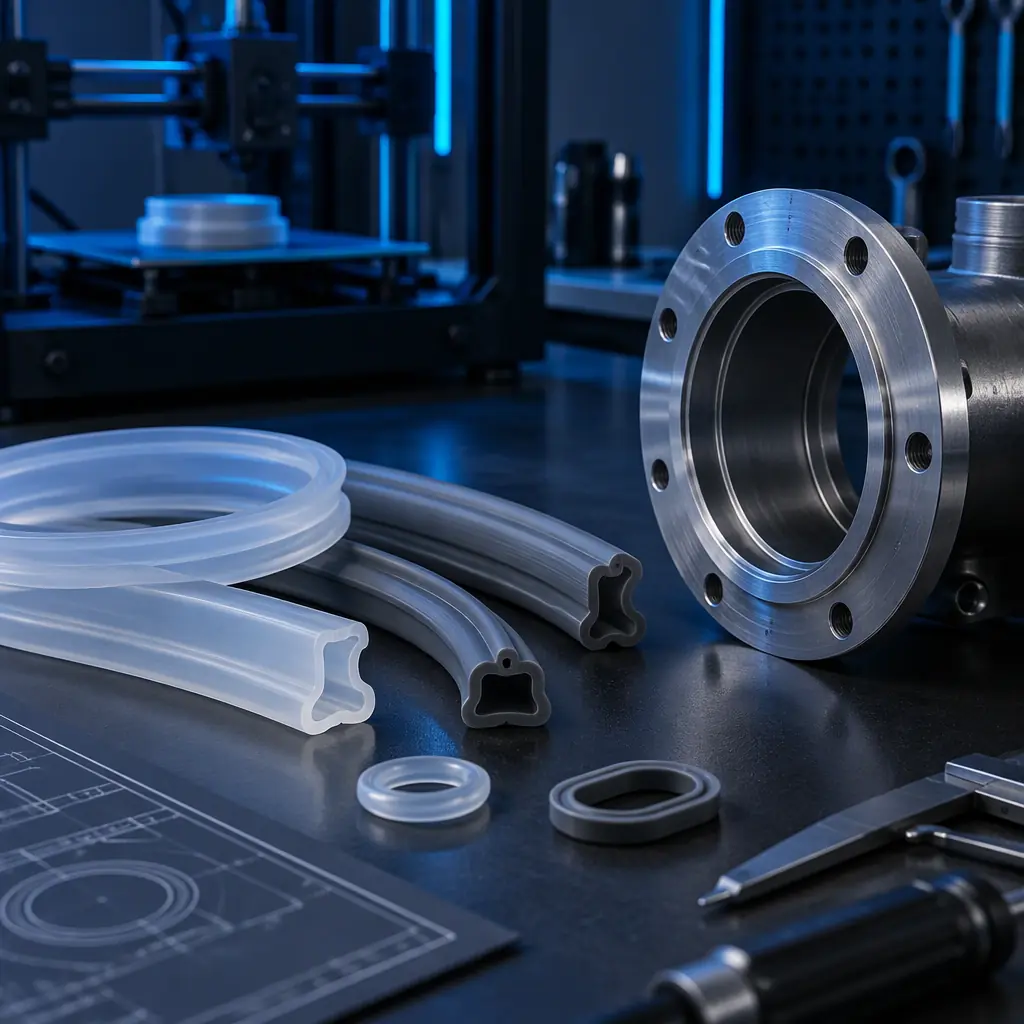
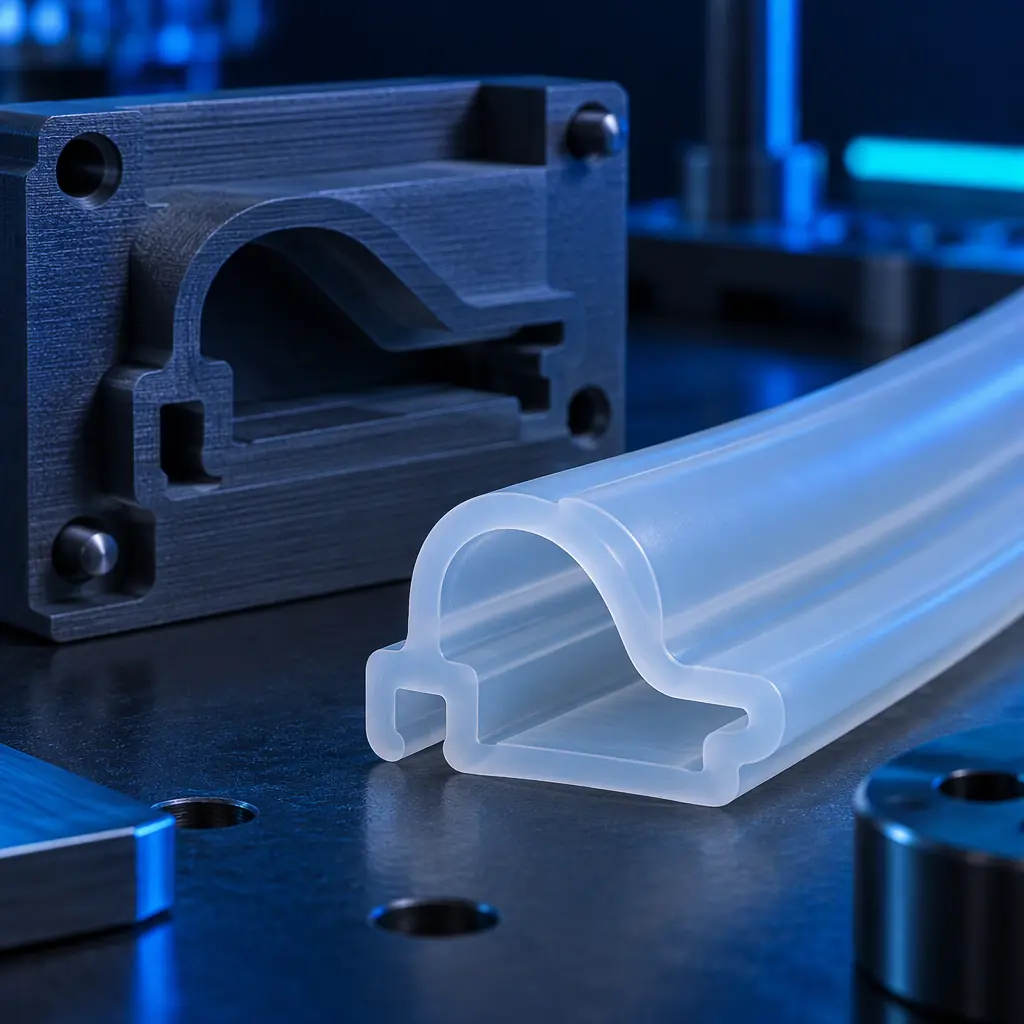
Silicone is the default sealing material for a reason: it stays flexible from about -50 to 200 °C, it does not take a permanent set easily, it is chemically inert, and it is available at hardnesses low enough to seal at very light compression. Every one of those properties is a problem for additive manufacturing. Low hardness means the part cannot support itself during printing; high elasticity means any support structure leaves a mark the material cannot recover from; and the thermoset cure chemistry does not melt-and-resolidify the way a filament does.
The result is that there is no single additive answer to silicone sealing. There are three routes, and they suit different combinations of volume, geometry and environment. This guide sets out all three with the data needed to choose.
Why Silicone Resists Printing
The core difficulty is that silicone is a thermoset cured by a Platinum-catalysed addition reaction, not a thermoplastic that can be melted and reflowed. A filament-based approach requires a thermoplastic, so standard silicone cannot be extruded as a rigid filament and re-melted at the nozzle. The low hardness compounds that seal best are also the softest, and a soft material has to be printed with support that it cannot tolerate.
The three properties that matter for any sealing application are hardness, compression set and temperature range. They are worth stating in numbers before comparing routes, because they are what actually decides whether a printed seal will hold.
Read together, those figures immediately rule TPU out for high-temperature sealing and for the softest low-pressure seals, and equally show where it is perfectly adequate: a machine-guard gasket, a dust seal, a low-temperature trim piece. The rest of this guide is about picking the right route rather than defending one.
Route 1: Printing Liquid Silicone Rubber
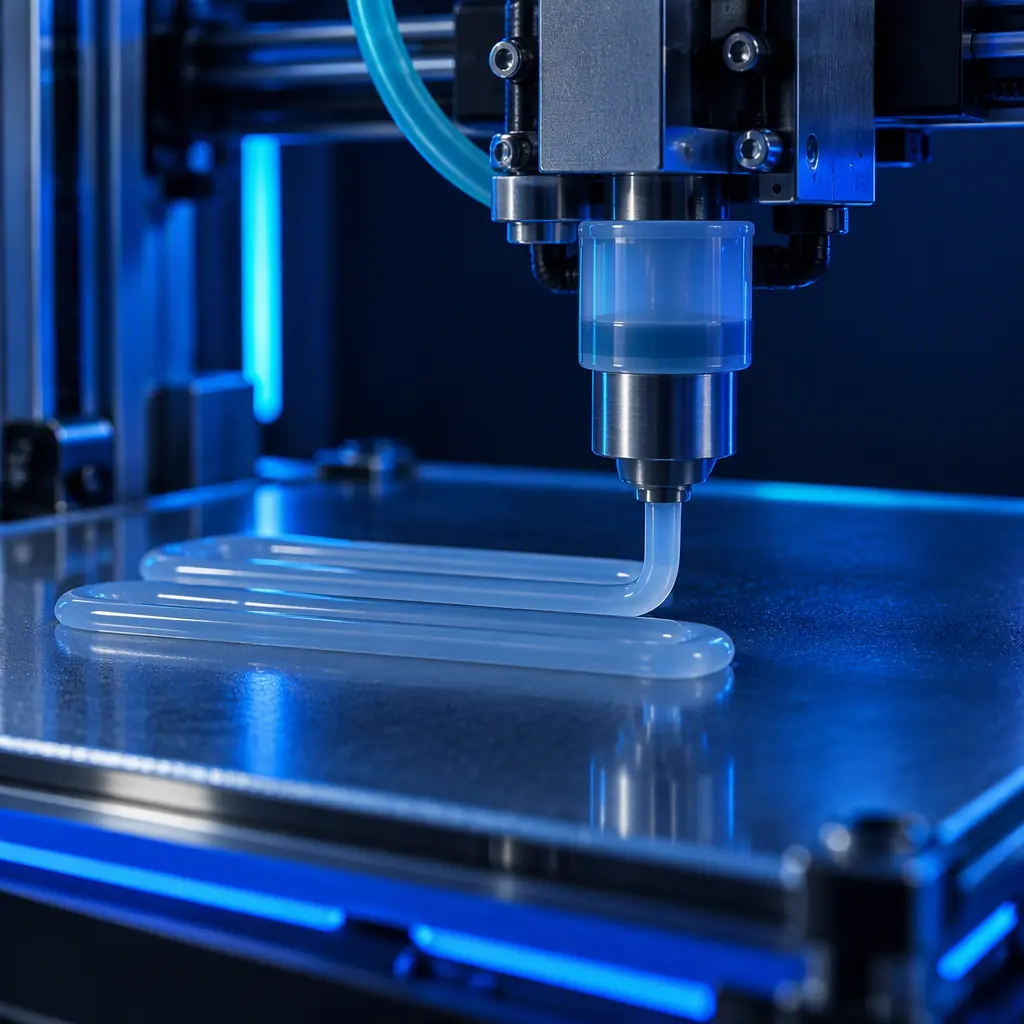
Liquid silicone rubber printing uses a two-part LSR pumped through a static mixer into a nozzle and deposited onto a heated build platform, where it cures as it is deposited. The process is genuinely additive and produces a cured silicone part with material properties close to moulded silicone.
The reason it is not the default answer is machine cost and geometry limits. An LSR printer is a specialist machine, not a converted filament printer, and it occupies a cost bracket well above a consumer or prosumer resin printer. Geometry is limited because the deposited bead must be supported by what is already beneath it: unsupported overhangs are impossible, the material cannot bridge, and any feature that would require support cannot be printed. Parts are generally designed as solid pads, simple profile gaskets and planar shapes rather than complex three-dimensional forms.
- Best for: production quantities of profile gaskets and pads where genuine silicone properties are required.
- Geometry limits: no unsupported overhangs, no bridges, limited vertical repetition of soft features.
- Material result: hardness 20-60 Shore A, compression set comparable to moulded silicone.
- Economics: high machine cost, offset at volume; per-part material cost is modest.
For a distributor, LSR printing is a specialist recommendation and rarely the entry point to a customer conversation. It becomes relevant when a customer has a genuine silicone requirement plus enough volume that a printed mould route would be a bottleneck.
Route 2: TPU as a Silicone Substitute
Thermoplastic polyurethane is printable on an ordinary filament printer, comes in hardnesses down to about 75 Shore A, and in most applications where the sealing environment is benign it does the job. The trade-off is explicit: TPU is harder, has worse compression set, and has a much narrower temperature window.
Printing TPU well requires recognisable changes to the machine setup. Direct-drive extrusion is effectively mandatory, because a Bowden tube adds friction that a flexible filament follows rather than pushes against. Print speed needs to drop to roughly 15-25 mm/s. Retraction should be minimised or disabled, since retraction on a flexible filament is a common cause of jamming and grinding. Layer height should be set relatively coarse rather than fine, because a tall stack of thin soft layers is more prone to wobble than a shorter stack of thicker ones.
The sealing geometry rule for TPU is different from silicone because the material is harder. Where a silicone O-profile gasket seals at 15-25 percent compression, a TPU gasket of the same profile needs more compression to reach the same sealing pressure, which raises the bolt load the housing must carry. The practical adjustment for a TPU seal is a taller bead with a narrower contact face, so that the available compression produces adequate sealing pressure without over-loading the joint.
What TPU cannot do is worth stating plainly, because it is where a specification goes wrong. It cannot hold a seal across a 150 °C process temperature; it takes a higher permanent set, so a joint that is opened and re-closed repeatedly will leak sooner than the same joint with silicone; and at the softest end it cannot be printed reliably at all, since the printable floor is about 75 Shore A against silicone's 10-30 Shore A for soft seals. The material comparison data sits alongside the flexible filaments TPU/TPE/TPC guide.
Route 3: Print the Mould, Cast the Silicone
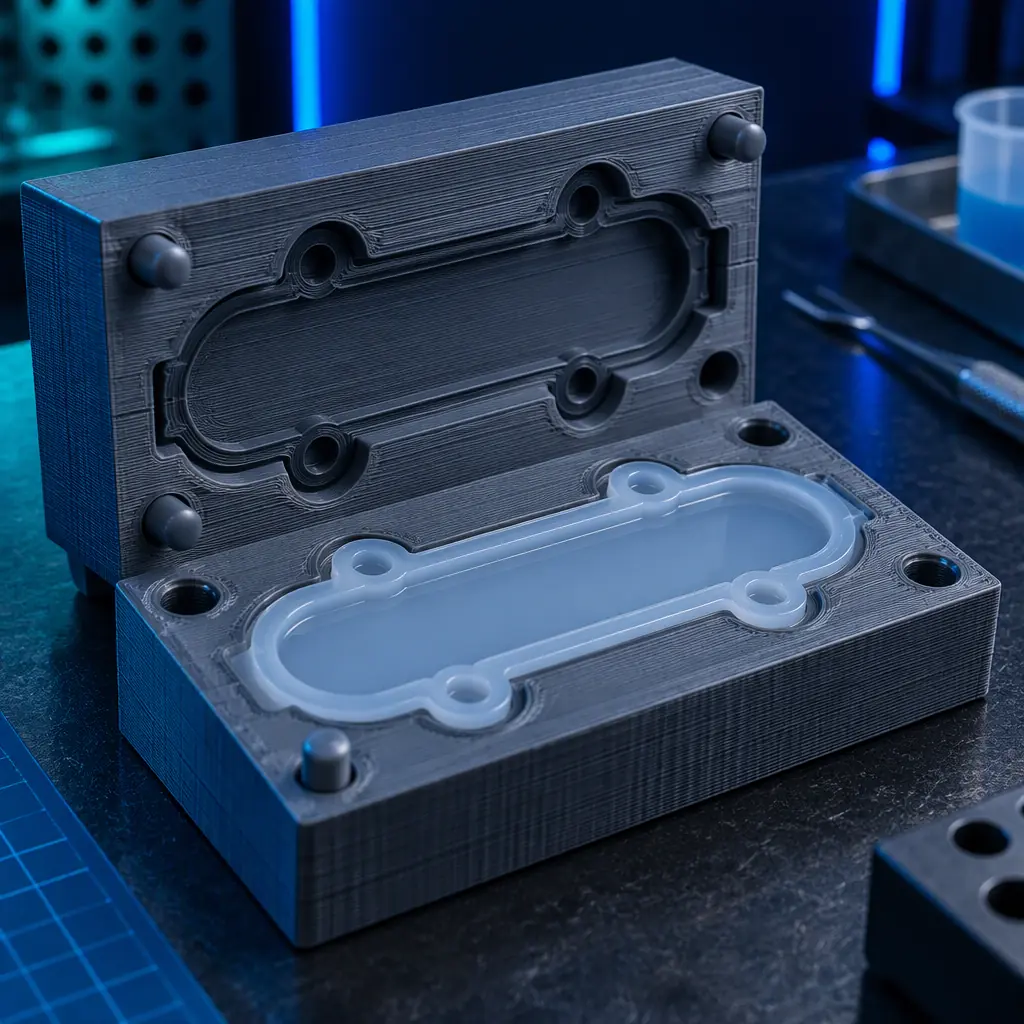
The route that most labs and small manufacturers actually adopt is to print the mould and cast silicone into it. This uses ordinary printable material for the tool and reaches silicone's real properties for the part, which is usually a better trade than compromising the seal by printing it directly.
The distinction that matters for the mould is whether it is a master or a production tool. A printed mould for a short run — tens to a few hundred parts — works well because the print cost is amortised over the run and the casting step is fast. Beyond that range the printed mould's surface degrades with repeated demoulding and heat cycles, and the mould should be printed as a master from which a durable tool is cast rather than used for the production run itself.
Two design points decide whether a printed casting mould works. First, the mould must be printed with the cavity surface as smooth as the printer allows, and post-processed if necessary, because the cavity surface is transferred directly to the seal and any layer line becomes a leak path along the sealing face. Second, the print orientation must put the cavity surface facing up wherever possible, so that no support marks land on the sealing surface; support on a sealing face is a mould that has to be reworked.
What you're looking for: A leak along the whole face is a material or compression problem and points back to the seal specification. A leak at corners and edges is a moulding or geometry problem — a mould that did not fill a corner, or a bead profile too uniform for a re-entrant corner to seal. The remedies are on opposite sides of the workflow.
Choosing the Route
The decision normally resolves on three questions in order: what temperature does the seal see, what hardness does the seal need, and how many parts are required.
The commercial structure here is unusually favourable for a distributor, because all three routes lead back to the same supplier conversation. The TPU route sells material and a printer. The cast route sells the printing material for the mould, the silicone for the part, and often a service relationship around the mould design. The LSR route sells a specialist machine. A distributor who can present all three, and who can honestly say which one is right for a given temperature and volume, is offering engineering rather than a catalogue. The wider tooling context is in the manufacturing tooling guide and the casting-material detail in the urethane casting and silicone moulding masters guide. Mould surface quality is a subset of the wider finishing problem covered in the printed part surface decoration guide, and the process-validation paperwork a sealing part usually needs is set out in the PPAP production part approval guide.
Bottom Line
Silicone resists printing because it is a low-hardness thermoset that needs support it cannot tolerate, so there is no single additive answer. LSR printing gives genuine silicone properties and works for profile gaskets, but is a specialist machine with no unsupported-overhang capability. TPU prints on an ordinary direct-drive printer and is adequate below about 90 °C, provided the seal geometry is adjusted for its higher hardness and worse compression set. Printing the mould and casting silicone reaches real silicone properties at low to medium volume and is the route most labs should start with, with the cavity surface printed smooth and free of support marks. Choose on temperature, hardness and volume, in that order.
Reviewed by the Precise3D engineering & OEM team. Material data and test documentation that accompanies the catalog is auditable at the certification register.
Start Your Partnership
Supply seals and soft parts to your market
Request the OEM & white-label program sheet, flexible-material portfolio data and volume pricing for your territory.