Distribution is a margin business, and margin is exactly what uninsured risk attacks. A distributor operating on 25% gross margin with $500,000 in annual revenue earns roughly $125,000 in gross profit. One container of 60 printers valued at $48,000 that arrives with water damage — a loss absorbed entirely if the freight term puts risk on the buyer and no cargo policy exists — is 38% of that gross profit gone in a single shipment. The insurance conversation is not an administrative chore; it is a pricing input. Distributors who structure risk properly fold it into cost of goods and sleep through events that bankrupt underinsured competitors. For the full picture of what a healthy distributor P&L looks like, see our financial KPI benchmarking guide.
The Four Risk Buckets Every Distributor Carries
Every risk a 3D printer distributor faces falls into one of four categories, and each one is covered by a different instrument:
- Product liability — bodily injury or property damage caused by a printer you sold. Covered by a product liability policy; the exposure grows with every unit in the field.
- Cargo and property — damage to goods in transit, in the warehouse, or on display. Covered by marine cargo insurance (per-shipment or open policy) and warehouse contents coverage.
- Warranty and returns — the cost of repairing or replacing defective units. Not insurable at sensible rates; funded by a warranty reserve built from revenue.
- Cyber and errors — a breach of your customer database or a mistake in a quote that causes a customer loss. Covered by cyber liability and errors & omissions policies.
The common failure mode is treating these as one problem. A general liability policy with a product liability endorsement covers bucket one and stops. The cargo policy is often skipped entirely because the supplier's freight terms look like they transfer risk — until a claim shows up that nobody owns. Warranty costs are usually paid out of operating cash as they arrive, which turns a predictable 2–4% of revenue into a lumpy surprise. Structuring all four deliberately is the difference between a risk program and a hope.
Product Liability: What a 3D Printer Can Actually Do
A 3D printer is a machine with a 200–300°C hotend, a heated bed, mains-voltage electronics, and a fan-cooled enclosure — and it is sold to operate unattended for hours at a time. The realistic liability scenarios are thermal events (a failed heater control or a knockoff power supply that fails short), mechanical injury (a moving gantry or a filament cutter), and fire spread from an unattended print. Certification is your first line of defense: a printer with CE marking and a certified power supply is dramatically harder to paint as defective in a claim. Our certification and compliance guide covers which marks matter and how to verify them at the factory.
The coverage math: a small distributor moving 500–2,000 units per year should carry product liability limits of $1–2 million per occurrence. Typical annual premiums for that limit, on a policy combined with general liability, run $1,500–4,000 for a distributor with a clean history — roughly 0.3–0.8% of product revenue. The premium rises with unit volume, with the inclusion of "consumer use" as an exposure (printers sold to end consumers carry higher risk than those sold to businesses), and with the presence of aftermarket accessories in your catalog that you did not manufacture. The single most effective premium reducer is documentation: inspection records, factory audit reports, and certification files. A distributor who can show an incoming QC process for every batch has a measurable risk story; one who cannot is priced as a wildcard. The factory audit and QC checklist is the starting point for building that file.
What you're looking for: The answer should be: the batch's incoming QC record, the CE declaration of conformity, the PSU certification, and the sales contract's warranty terms. If any of those four documents does not exist for a unit you shipped, that gap is your real liability — the policy covers the claim, but the documentation decides who is at fault. Close the gap with the incoming QC guide before the event, not after.
Cargo Risk: The Ocean, The Warehouse, The Last Mile
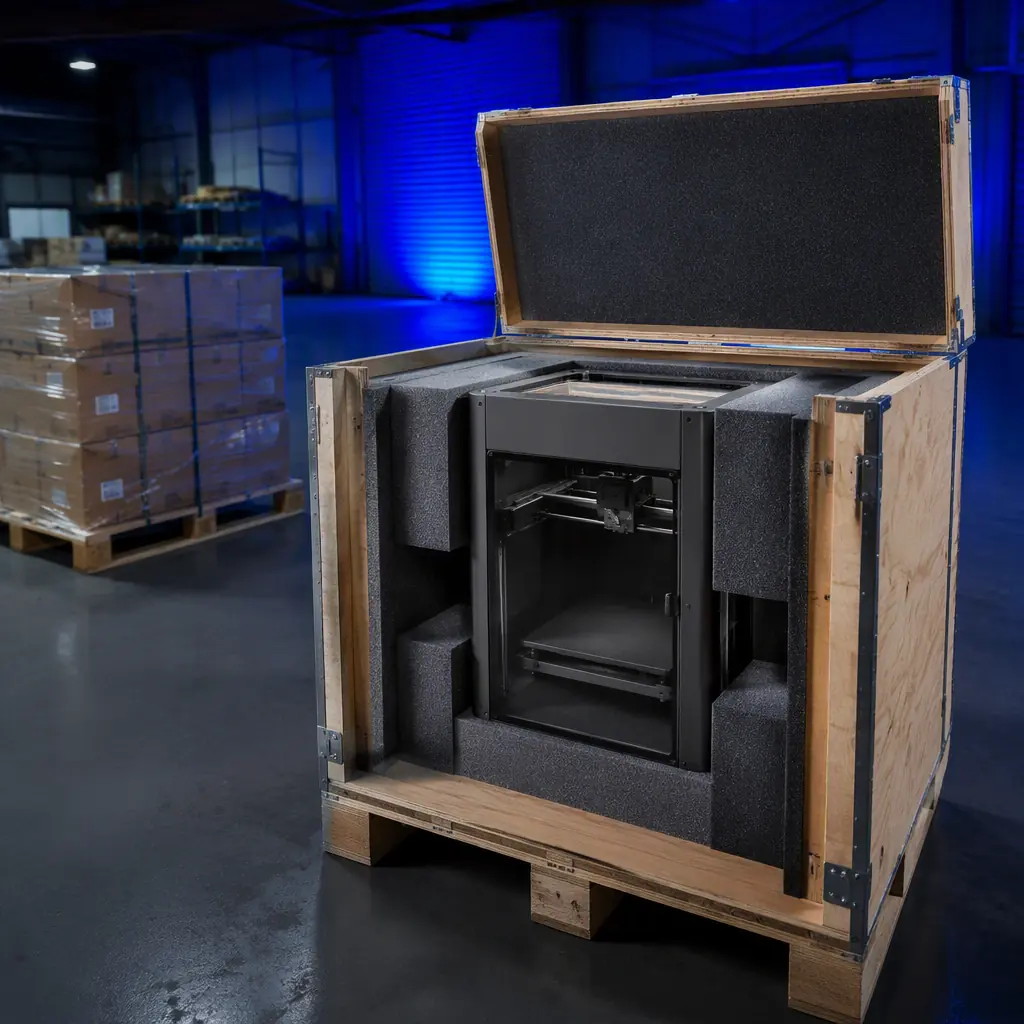
Goods are most vulnerable when they are moving. Marine cargo insurance on an open policy basis typically costs 0.3–0.5% of declared cargo value — on a $48,000 container, that is $144–240 per shipment, with a deductible of $500–1,000 per claim. The alternative, self-insuring transit, is a bet that most distributors lose eventually: freight damage rates on well-crated machinery run 1–2% of shipments, and a single crushed or water-damaged container wipes out years of premium savings. Crating quality is the controllable factor — proper foam suspension, moisture barrier, and corner protection reduce damage claims by an order of magnitude. Our crating and packaging guide details the standard that keeps claims rare.
Two terms decide who owns the risk while goods move: Incoterms and the insurance clause. Under EXW (Ex Works), risk transfers to your customer at the factory gate — but that means your customer's insurance covers the shipment, and if they are a small reseller with no cargo policy, a damaged container becomes a dispute, not a claim. Under CIF (Cost, Insurance, Freight), the seller carries insurance only to the destination port — the inland leg remains uncovered unless you extend it. The practical rule: for any shipment where you carry the risk, insure to the final delivery point, and confirm your customer's cargo coverage in writing for the legs you do not own. Import compliance interacts with cargo value declaration — see our HS codes and customs guide for how valuation affects both duty and insurance.
Warranty Reserves: Funding the Promise
Warranty is the risk bucket insurance cannot fix at sensible prices — insurers treat it as a business cost, not an insurable event. The fix is a funded reserve. Industry data on consumer electronics and desktop machinery puts return rates at 3–8% of units within the first year, with 3D printers at the higher end because they are sold to users who push them hard. A distributor selling 1,000 printers per year at an average $350 cost of goods, with a 5% return rate and an average $120 cost per return (freight both ways, repair labor, parts), spends $6,000 per year on returns — 1.7% of product revenue. That number is not optional; it is structural, and it must be reserved before it is spent.
The reserve mechanics: set aside 1.5–3% of printer revenue into a dedicated account monthly, sized to your actual return rate (track it quarterly — most distributors drift upward in year two as warranty claims from year-one sales mature). Draw from the reserve for return freight, repair parts, and replacement units, and reconcile the balance against the return rate every quarter. A distributor who funds the reserve at 2% and sees actual claims at 1.7% has a stable, boring line item; one who pays claims from operating cash experiences the same 1.7% as a quarterly crisis. The interaction with your return policy — restocking fees, return windows, and whether you prepay return freight — is covered in our warranty and returns guide, and the cash-flow mechanics of funding reserves are in the distributor cash flow guide.
The Policy Checklist: What to Ask Your Broker
Brokers quote what you ask for. The checklist below turns a generic "business insurance" conversation into a 3D-printer-specific risk program:
- Product liability with "consumer use" named — confirm the policy covers units sold to end consumers, not only B2B. The rate difference is material; the coverage gap if you skip it is worse.
- Worldwide territory — if you export, claims can be filed in the destination country. A domestic-only policy leaves your largest market uncovered.
- Vendor's legal liability — coverage for defects in goods you imported and resold under your brand, which is precisely the distributor position.
- Open cargo policy with inland extension — automatic coverage on all shipments, extended beyond the port.
- Aggregate limits that match your growth — a $1M aggregate that fits year-one volume is a false comfort at year three.
Bring your documentation to the broker conversation: certification files, QC records, return rate history, and your warranty terms. Every one of those documents lowers the quoted premium, because it lowers the underwriter's perceived risk. A distributor who treats the policy as a price to minimize — rather than a structure to design — ends up with the cheapest quote that covers the least.
How to Structure Risk Into Your Pricing
Risk should be priced, not discovered. The clean way to fold it into your numbers: add cargo insurance as a per-unit logistics cost (roughly $2–5 per printer on a $48,000 container of 60 units), add product liability as a percentage of revenue (0.3–0.8%), and add the warranty reserve at your tracked return cost (1.5–3%). Combined, that is 2–4% of product revenue that must sit above your break-even margin. Most distributors who fail at this price only the hardware and absorb risk as it arrives; the ones who survive price it like the cost it is. When you build that structure into your distributor pricing and margin plan, the margin conversation changes from hope to arithmetic — see our pricing and margin guide for the full framework.
The bottom line: insurance is not the boring part of distribution, it is the part that decides whether the interesting parts survive. A $2,000–6,000 annual risk program protects a business whose entire asset base — inventory in transit, inventory in the warehouse, and reputation in the market — is exposed to events that happen to other distributors every month. Structure the four buckets, fund the reserve, document the machines, and risk becomes a line item you can plan around instead of a phone call you dread.
Reviewed by the Precise3D engineering & OEM team. Compliance files that accompany the catalog are auditable at the certification register.
Start Your Partnership
Ready to Bring insurance liability to Your Market?
Our OEM program supports insurance liability programs end to end - the product line, firmware and compliance files that travel with each shipment.