
Why the Payment Layer Is the Attack Surface
In a domestic sale, you can reasonably ask a buyer a question over the phone. In an export deal, the buyer may be thousands of kilometres away, reachable only by email, and the entire transaction runs on trust plus paperwork. That makes the payment step the natural choke point for fraud, because it is the only step that moves value that is easy to convert and hard to recover.
The commercial side of choosing a payment instrument — wire, letter of credit, escrow — is covered in the B2B payment methods guide. This guide is about the fraud and compliance layer that sits on top of whichever instrument you choose.
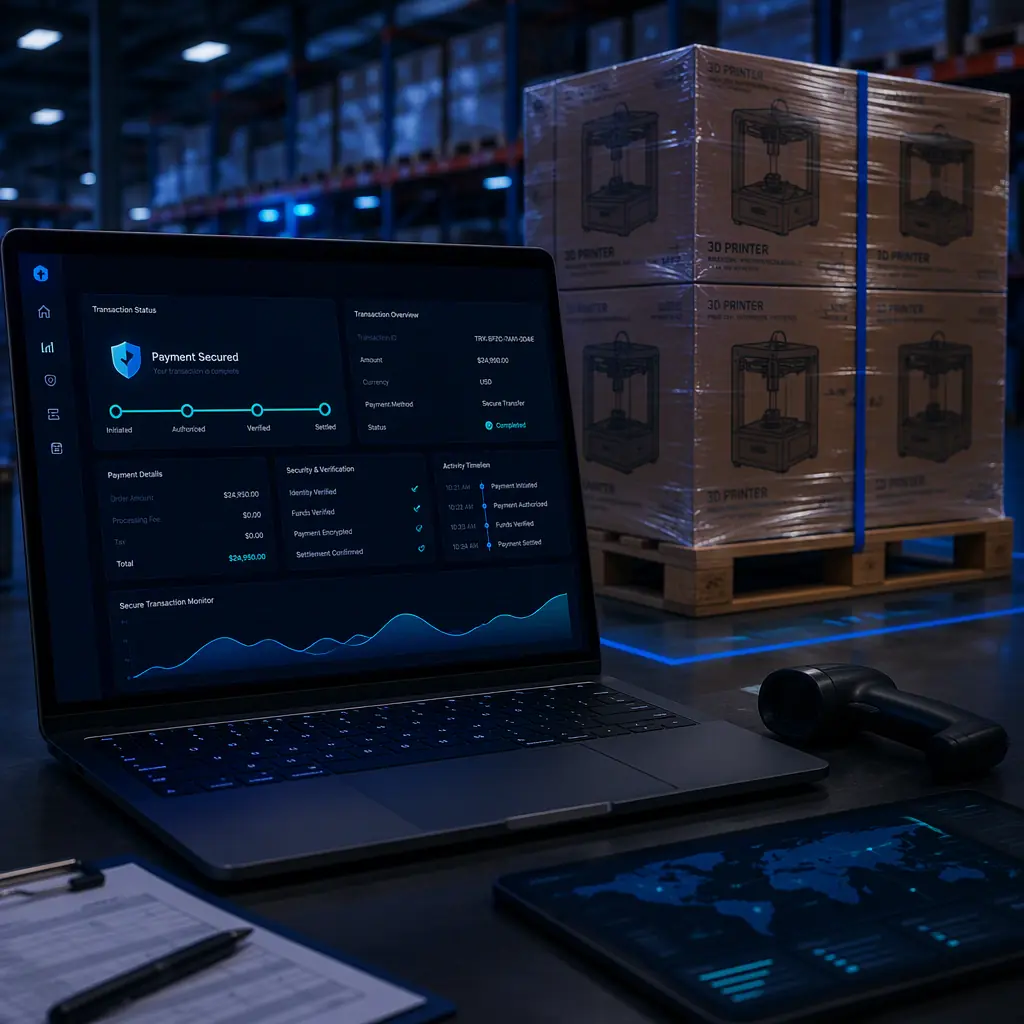
The Fraud Types That Actually Hit Exporters
These are not theoretical attacks. They are the patterns that show up in real export desks, and each one has a counter that is cheaper than the loss.
The redirection attack is the most common single cause of loss. A legitimate buyer is already corresponding with the seller, and a message arrives that looks exactly like the seller — same signature, same logo — saying "please send the wire to this updated account." The fix is a standing rule that no payment instruction is ever accepted by email change; the account is verified on a previously established channel.
A Proportionate KYC Baseline for an Export Desk
Know-your-customer is often framed as a bank obligation, but for any exporter it is simply discipline: confirm that the entity you will sell to is a real, traceable company, and that the person signing is authorised to bind it. The depth of the check should be proportionate — a first sample order of one-to-five units does not need the same vetting as a full 100-unit container program.
- Registered entity — a company registration that resolves to a real registry and a real address, not a mailbox.
- Beneficial owner — who actually controls the business, so you know who you are really dealing with.
- Sanctions and PEP screening — check the entity and its principals against applicable sanctions and politically-exposed-person lists.
- Business footprint — a website, an operating history, references, or a track record of the type of deal you are entering.
- Authorised signatory — confirm the person negotiating has the authority to commit the company.
Most of this is cheap to verify and expensive to skip. The supply-chain side of the same discipline — making sure you are dealing with the factory you think you are — is covered in the factory audit & QC checklist, which is how a buyer verifies the counterparty at the manufacturing end.
AML Controls and Transaction Monitoring
Anti-money-laundering controls are less about suspicion and more about documentation. For an exporter, the practical controls are: knowing who your customer is, understanding the origin of the funds well enough to satisfy a basic check, keeping records of the transaction, and being able to flag an unusual pattern — such as a sudden change in payment route, a third party paying for a buyer you have not vetted, or a rapid sequence of overpayments.
The rule of thumb is proportionality and consistency. A small exporter is not expected to run a full compliance program, but it is expected to do a reasonable check, keep the evidence, and be able to explain its own transaction. That is the same record-keeping mindset that underpins the export documentation guide and the Incoterms guide — the paperwork is the proof, so make it accurate.

Red Flags Worth Stopping For
A single red flag is often noise; two or more together is reason to pause. Run the list against every new buyer before a large batch ships.
- Rushed payment — pressure to pay immediately, or excuses about a wire "that will arrive shortly."
- Changed account — a last-minute change of bank details, especially by email.
- Overpayment — a transfer that exceeds the invoice, followed by a request to refund the difference.
- Unverifiable entity — a registry that does not resolve, a website that was registered last week, or no operating footprint.
- Third-party payer — money arriving from an unrelated company or individual for a buyer you have not vetted.
- Odd route — a buyer in one country asking to ship to another, or a request to split payment across multiple accounts.
Some of these overlap with the operational risk outlined in the return fraud prevention guide, which is the same pattern of an untrusted party abusing a process, just at the returns stage rather than the payment stage.

Building a Clean Payment Workflow
The strongest counter to payment fraud is process, not vigilance. A written workflow that every export invoice follows removes the judgement call that fraudsters exploit.
This is the same principle as the verified supply-chain discipline we detail in the supply chain resilience guide — a documented process closes the gap that individual attention leaves open.
What you're looking for: If the answer is "we would probably just send it," you do not have a payment control. Adopt a standing rule that no payment instruction is accepted by email change, vet the buyer entity on every new account, and document the transaction so you can explain it. The cost of the control is minutes; the cost of a single redirection is the whole batch.
How Precise3D Runs Its Export Payment Process
At Precise3D we operate through a controlled supply chain and quote wholesale pricing on a defined spec — the Pro X1 with a 500×500×500 mm build volume and 320°C hotend, the Creator C1 with 36-point auto-leveling, and the Start S1 as the entry model — with MOQ from 100 units per model and a one-to-five-unit sample order so a partner can validate before a full program. Payment methods and commercial terms follow the B2B payment methods guide, and every quote is accompanied by the certification file — CE LVD (EN 62368-1:2014+A11:2017) and RoHS (EU 2015/863) — so the paperwork a buyer needs to commit to is available before the money moves.
We build these controls in so a distributor does not have to reinvent them. The certification compliance guide and the OEM pricing negotiation guide explain how the terms and evidence we provide support a transaction that is both compliant and efficient.
Reviewed by the Precise3D OEM & distribution team. Payment fraud and KYC/AML requirements are jurisdiction- and instrument-specific; always confirm the applicable anti-fraud, anti-money-laundering and sanctions rules for your particular market, payment method and customer profile with a qualified compliance or legal resource before you transact.
Export With Confidence
Buy and Sell Through a Trusted Channel
Join our network of global distributors. A controlled supply chain, compliance on file, and an export process built so the payment step never becomes the risk step.