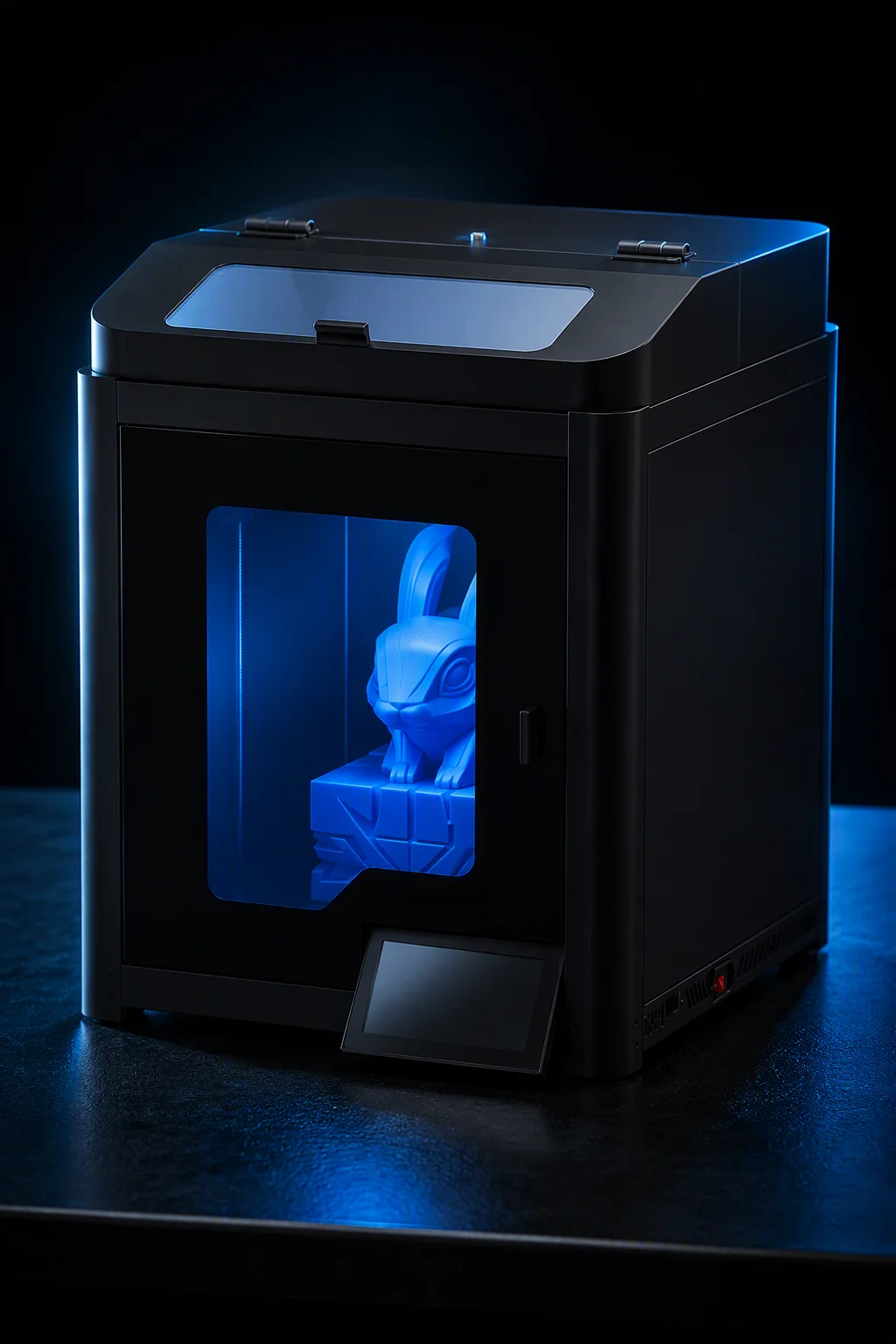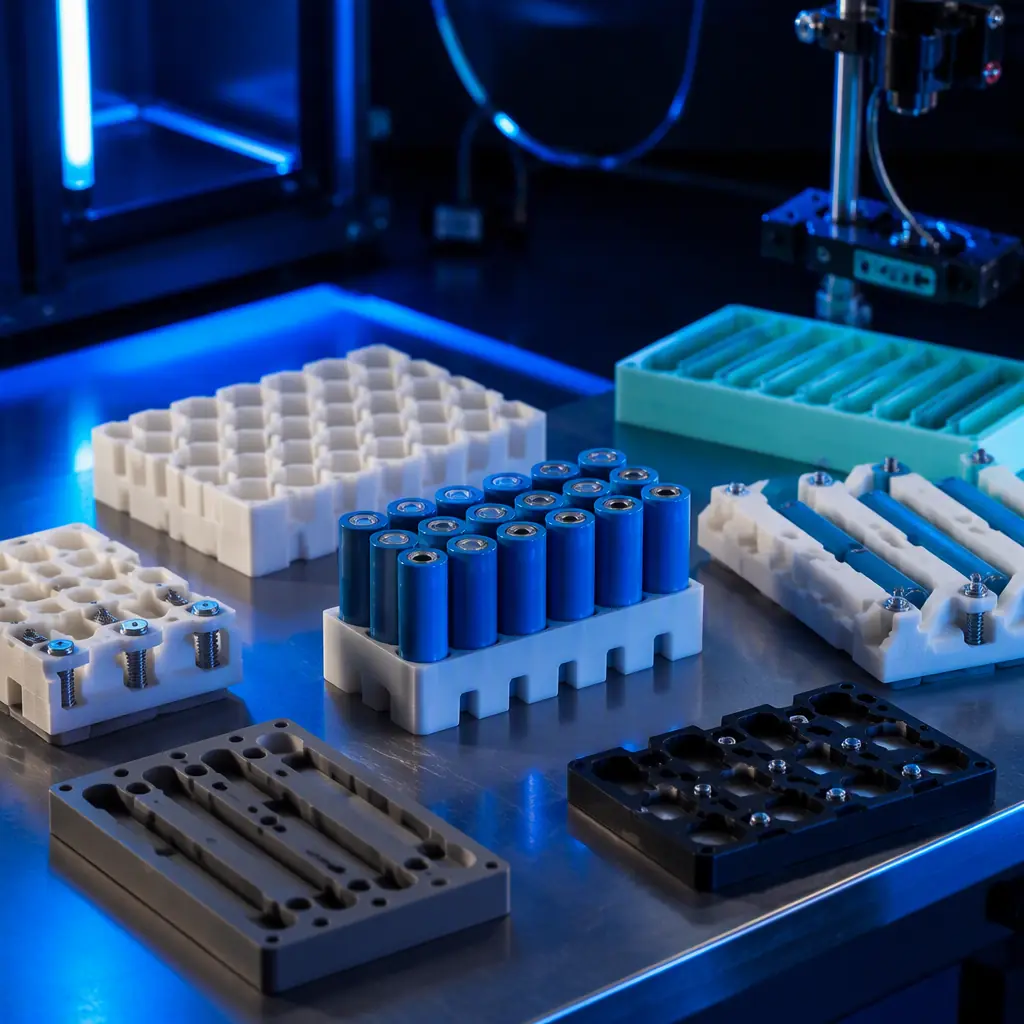
The battery industry's fixture problem is structural. A cell production line is built around one cell format — cylindrical (18650, 21700, 4680), prismatic, or pouch — and every format change, every electrode design revision, and every new module architecture requires new handling tooling: trays to carry cells through the line, jigs to hold electrode stacks during welding, fixtures to align modules during assembly, and test rigs to validate cells before they ship. These parts are low-volume, high-variation, and time-critical. A line changeover costs $5,000–20,000 per hour of downtime, so the difference between a fixture that arrives in 48 hours and one that arrives in 8 weeks is measured in hundreds of thousands of dollars of lost production. That arithmetic is why battery plants were early adopters of in-house FDM printing — and why they are the highest-value vertical customer for a 3D printer distributor. The broader story of why engineering teams print more than anyone else is in our R&D and rapid prototyping guide.
The Four Fixture Families Battery Plants Buy
Battery tooling demand clusters into four families, each with its own volume, material, and tolerance profile. A distributor who understands the four families can walk into any battery plant conversation with a catalog that maps to real needs.
- Cell holder trays — the highest-volume family. Trays carry cylindrical or prismatic cells through formation, aging, and testing. A mid-size plant runs hundreds of tray variants across cell formats, and trays are replaced on a wear and contamination schedule of 6–18 months. Printed trays with ±0.1–0.2 mm slot tolerance hold cells securely without binding.
- Electrode stacking and alignment tooling — jigs that hold electrode stacks in registration during stacking and tab welding. These demand the tightest tolerances (alignment pins at ±0.05–0.1 mm) and the most abrasion-resistant materials, because they touch the electrode surface thousands of times per shift.
- Module assembly fixtures — fixtures that locate prismatic or pouch cells in the module frame while busbars are welded and coolant plates are attached. These are the largest printed parts, often 300–600 mm across, and they carry compression loads during assembly.
- Test fixtures — probe holders, connector locators, and conditioning racks for cell testing. Every new cell type generates a new test fixture set, making this the fastest-reordering family and the natural entry point for a distributor.
The common thread: none of these parts makes sense as an injection-molded production part at the volumes battery plants need them. A plant might need 40 of a given tray variant, then a format change makes it obsolete. That is exactly the volume band where 3D printing wins on cost and lead time — and where a distributor with the right printer and material knowledge becomes a fixture supplier, not a one-off parts vendor.
Materials That Survive the Battery Floor
Battery plants are a hostile environment for plastics: elevated temperatures in aging rooms (45–60°C), electrolyte exposure during assembly, ESD-sensitive components, and flame-retardancy requirements driven by safety audits. The material selection determines whether a fixture lasts six weeks or eighteen months.
Flame retardancy is the compliance gate.
Most battery facilities require tooling in production areas to meet UL94 V-0 — the highest flammability rating for plastics, meaning the material self-extinguishes within 10 seconds of flame removal. Standard PLA and PETG fail this requirement outright. The workhorse answer is flame-retardant PA6 or PA12 filament, which carries V-0 ratings in common formulations and prints on standard FDM hardware. For the highest-temperature applications — near welding cells and busbar joining — PEEK and PEI (Ultem) grades hold structural integrity above 150°C continuous, at a material cost of $300–600 per kg versus $40–90 per kg for FR-PA. The full high-temperature material comparison is in our PEEK/PEI/PPSU materials guide.
ESD control is the second requirement.
Battery cells are ESD-sensitive during handling, and most plants require tooling that touches cells to be static-dissipative — surface resistivity in the 10⁶–10⁹ Ω/sq range. ESD-safe PA filaments achieve this with carbon loading, which also stiffens the part. The trade-off is a rougher surface finish and slightly lower impact strength than unfilled nylon, which is acceptable for trays and jigs. Where electrolyte contact is possible — filling and venting areas — the material must resist carbonate solvents; PPS and PVDF are the chemical-recovery grades, while PA12 with a sealed surface handles incidental splash with routine inspection. The nylon family behavior, including moisture absorption and annealing, is covered in our nylon filament guide.
Design Rules for Battery Tooling
Printed fixtures fail for predictable reasons, and the fixes are design rules, not heroics. First, compensate for layer anisotropy: FDM parts are 20–40% weaker across layer lines than along them, so load-bearing bosses and snap features must be oriented so the load runs parallel to the layers, not across them. Second, use heat-set inserts for anything threaded: a brass M4 insert pressed into PA6-CF resists pull-out at 30–80 kgf, versus 5–15 kgf for a printed thread — the difference between a fixture that survives a year of assembly and one that strips in a week. The full insert selection and installation data is in our heat-set inserts guide.
Third, design for the tolerance you can actually print: at 0.1 mm layer height, a well-tuned printer holds ±0.1–0.15 mm on slot widths and hole positions up to 200 mm, and ±0.2–0.3 mm beyond that. Designers who specify ±0.05 mm on a 300 mm tray are asking for machining, not printing — the conversation with the customer should set expectations at the design stage, not the inspection stage. Fourth, add wear and contamination control: ESD trays destined for clean areas should be printed with a sealed or vapor-smoothed surface so they do not shed particles, and high-wear contact points (cell seating lips, alignment pins) should be designed as replaceable inserts rather than monolithic features, so the plant replaces a 20-cent pin instead of a $150 tray. The dimensional behavior of printed parts across temperature and humidity — why a PA6 tray printed in a humid week can grow 0.3–0.5% — is detailed in our tolerances and dimensional accuracy guide.
What you're looking for: Aging rooms run at 45–60°C, which is above the glass transition of unfilled PLA (~60°C) and near the edge of standard PETG. The fix is a material change, not a design change: annealed PA12 or FR-PA6 holds dimensional stability at 60°C continuous, and PA6-CF adds stiffness. If the part also sees electrolyte splash, move up to PPS. This is the most common battery fixture failure we see, and it is always a material spec problem — which is exactly why the distributor who knows the material chart wins the account.
The Distributor Playbook for Battery Plants
Battery plants buy printers, materials, and fixtures in a predictable sequence. The entry point is almost always the test and validation team: they need new probe fixtures with every cell revision, they have budget, and their parts are small enough to print on a mid-range FDM machine. A distributor who wins the test team gets visibility into the plant's format roadmap — and format changes are what generate the tray and jig orders that follow. The plant then scales to dedicated machines running FR-PA and ESD materials, which means the manufacturing tooling playbook applies: printers sold to a tooling cell are consumable-driven accounts, with nylon and CF-nylon reorders landing every 4–8 weeks.
The printer requirements are specific: an enclosed chamber (nylon and FR-PA warp without one), a hardened steel nozzle (carbon-filled materials wear brass nozzles in 2–4 kg of material), and a heated bed to 100°C+ for PA adhesion. Distributors should also carry the consumable stack — FR-PA12, ESD-PA, PA6-CF, and a small PPS or PEI line — because the material is where the recurring revenue lives. The EV and e-mobility market context, including why battery labs are the fastest-growing buyer segment, is in our EV and e-mobility guide, and the carbon-fiber material economics are in the CF filament guide.
The bottom line: battery manufacturing is the ideal vertical for 3D printer distribution because its tooling demand is structurally incompatible with traditional manufacturing. High variety, low volume, short lead times, and constant revision are the exact conditions where printed tooling wins — and where a distributor with material knowledge becomes a supply-chain partner rather than a box shipper. The plant does not need to be convinced that 3D printing works; it needs a supplier who shows up with the right flame-retardant material, the right tolerance conversation, and the right fixture catalog on day one.
Reviewed by the Precise3D engineering & OEM team. Compliance files that accompany the catalog are auditable at the certification register.
Start Your Partnership
Ready to Bring battery manufacturing tooling to Your Market?
Start with the battery manufacturing tooling spec sheet, then validate every claim against the certification register.