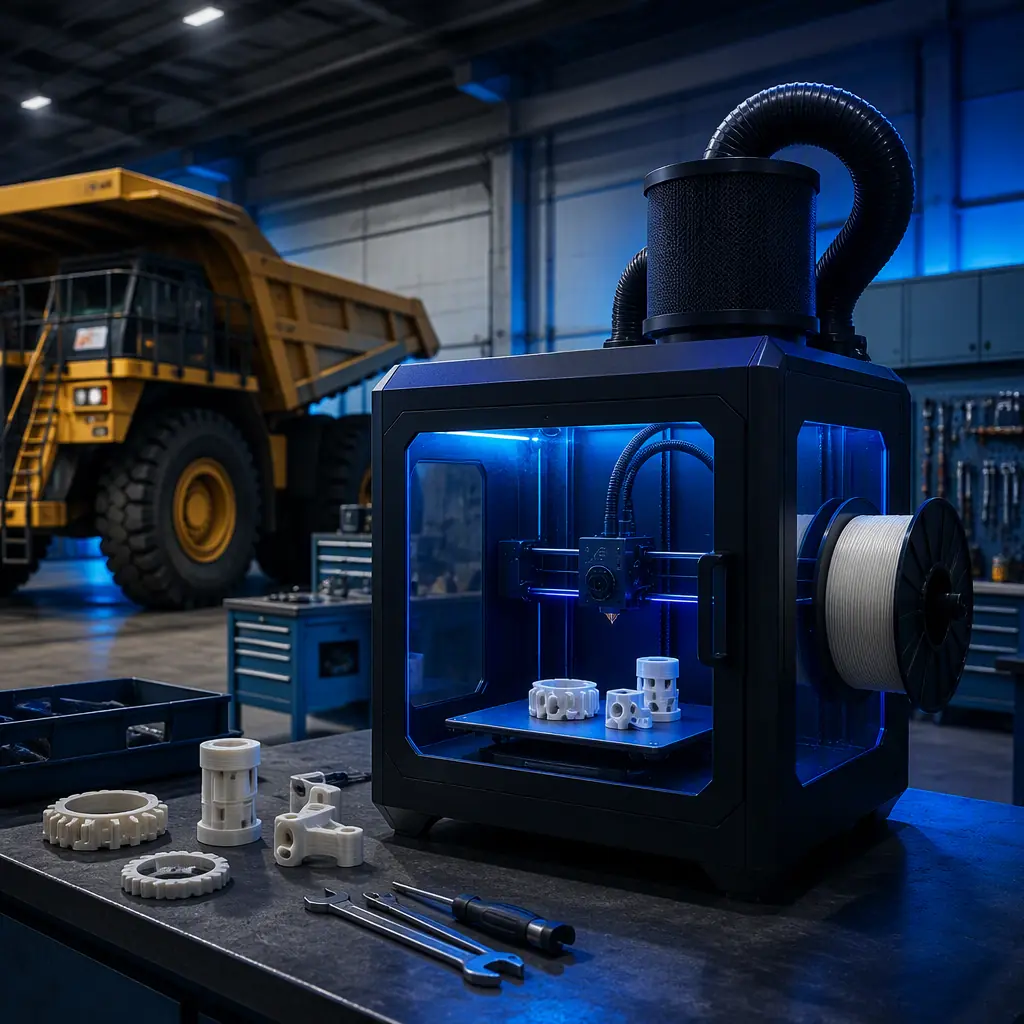
Mining is the vertical where the word "lead time" carries the highest price tag in manufacturing. Surface mines run 240-ton haul trucks that burn $150-400 of diesel per hour; underground operations run continuous miners and longwall systems where a mechanical failure stops a production face for the whole shift. The common denominator is that the parts which fail most often — cable guides, sensor mounts, dust seals, hose clamps, ventilation fittings, guard covers — are injection-molded plastics with long OEM lead times and minimum order quantities. A mine site with 3 printers and a materials shelf converts those failures into same-day parts at $2-20 each. For the framework on which verticals to prioritize in a distributor portfolio, see our portfolio strategy guide.
The Mining Customer Segments That Buy Printers
Mining splits into four segments with different entry points. Surface mines (open pit) buy for haul truck and shovel maintenance; underground operations buy for continuous miner and longwall support; mineral processing plants buy for slurry and conveyor systems; and exploration teams buy for remote field camps. Surface mines are the easiest entry because their workshops are large, dust-controlled, and already run maintenance programs with documented parts inventories. Processing plants are the highest consumable volume because slurry systems wear through parts on a schedule. Underground operations are the hardest sell on safety grounds but the most loyal once a program is approved. For the sales methodology that opens these accounts, see our B2B sales demo playbook.
Surface mines and processing plants are the highest-value entry segments: they have the workshops, the parts inventories, and the budget authority. A processing plant that wears through slurry pump spacers and conveyor scrapers on a schedule is a predictable monthly consumable account the moment its engineers trust the printed parts. For the consumables bundling model that maximizes per-account revenue, see our consumables bundling guide.
Materials That Survive Dust, Vibration, and Slurry
Mine-site parts fail from abrasion, impact, vibration, chemical exposure, and temperature — so the material conversation is the technical heart of the sale. Nylon PA12 is the workhorse: high impact strength, good abrasion resistance, and chemical tolerance, printing at 260-290°C. Carbon-fiber nylon (PA-CF) adds stiffness for brackets and guards that must hold geometry under load. Polypropylene handles slurry chemicals and low-friction surfaces where parts slide against each other. TPU makes dust seals, vibration isolators, and bumpers that absorb the shock that cracks rigid parts. For underground work, flame-retardant blends are the compliance answer where fire safety rules gate what can be installed. For the full industrial material lineup, see our PEEK/PEI/PPSU industrial materials guide and the nylon filament guide.
What you're listening for: The answer is the ROI script. If a mine idled a haul truck for a cable guide with a 6-week lead, that single event paid for three printers. The follow-up question is environmental: does the part see abrasion (nylon), chemicals (PP), or vibration (TPU)? Sites that track downtime by root cause are the fastest closers — they can already price the failure.
Printer Requirements for Mine-Site Workshops
A mine-site workshop is hot, dusty, and rough on equipment. The printers that survive there need an enclosed frame to keep dust out of the mechanics, an all-metal hotend capable of 290°C for nylon and PA-CF, a heated chamber or at least a heated bed with an enclosure for warpage control on large parts, and a robust Z-axis for the vibration that comes with workshop floors. Printers running unattended need the full reliability suite — thermal runaway protection, filament runout detection, and power-loss recovery — because a failed overnight print at a mine site wastes not just the part but the day. Filtration matters too: printing nylon and PC indoors requires a carbon filter or ventilation kit to keep workshop air clean. For the complete printer selection criteria, see our build volume guide, the safety features guide, and the large-format industrial guide.
Build volume in mining splits into two tiers. Most cable guides, sensor mounts, seals, and fittings fit a 256 mm cube. Conveyor scrapers, duct panels, and larger guards need 300×350 mm or bigger. The workshop sweet spot is a 300 mm-class printer that batches 10-20 small spare parts per overnight run — a night shift producing a week's worth of the most-failed parts. Jigs and fixtures for maintenance work print in PETG with no special requirements and are the perfect pilot application to get a printer approved before the production spare part program starts. For the operational scaling picture, see our print farm operations guide.
The Distributor Go-to-Market Playbook for Mining
Mining procurement is relationship-driven and safety-gated, which favors distributors who enter through the maintenance department rather than the purchasing office. The playbook: (1) start with jigs and fixtures for the maintenance shop — zero compliance review, immediate time savings, and a printer physically present on site; (2) build the parts library with the maintenance team by digitizing their most-failed small parts — every digitized part is a lock-in asset; (3) document everything: print parameters, material datasheets, and test results become the evidence that gets parts approved for machine-adjacent use; (4) sell the downtime math, not the printer: "this $30 cable guide idled a $300,000-per-day truck for six weeks; the file is now on your server and reprints for $4." The sales cycle is 6-12 months, but mining accounts are multi-year contracts with the highest retention of any vertical. For the recurring revenue models that lock in mining accounts, see our spare parts aftermarket guide and the maintenance plans guide.
Recurring Revenue: Mine Sites Consume on a Schedule
Mining consumable revenue is the most predictable in the distributor catalog because wear is scheduled. A processing plant replacing slurry wear parts monthly consumes 15-30 kg of nylon and PP per month; a surface mine printing cable guides, seals, and mounts runs 10-25 kg; add hardened steel nozzles (filled nylons wear brass within 4-6 kg), PEI build sheets, carbon filters, and maintenance kits, and a single mine site becomes a $2,000-6,000 monthly account at 40-55% gross margins. The switching cost is structural: once a site's maintenance team has a qualified parts library and documented print profiles, changing suppliers means re-qualifying every part. For the market sizing and trend context that supports the timing, see our 2026 market trends report.
Bottom Line
Mining is the vertical where the value of a printed part is measured in hours of production, not dollars of material. The parts that fail are small, plastic, non-structural, and expensive to source — precisely what a workshop printer with the right materials reproduces in hours. The entry path is deliberate: maintenance tooling first, spare parts second, compliance-gated underground programs third. The accounts are contract-based, the consumable demand is scheduled, and the competition is thin because most distributors never make the trip to a mine site. A distributor with 8 mining accounts averaging 3 printers each generates $60,000-100,000 in annual recurring consumable revenue at 40-55% margins — with a parts library and site relationships that compound year over year. The distributor who walks into the mine workshop with printed cable guides and a nylon spool in hand will own the spare part program before the OEM even quotes the lead time.
Reviewed by the Precise3D engineering & OEM team. Compliance files that accompany the catalog are auditable at the certification register.
Start Your Partnership
Ready to Bring mining heavy industry to Your Market?
Start with the mining heavy industry spec sheet, then validate every claim against the certification register.