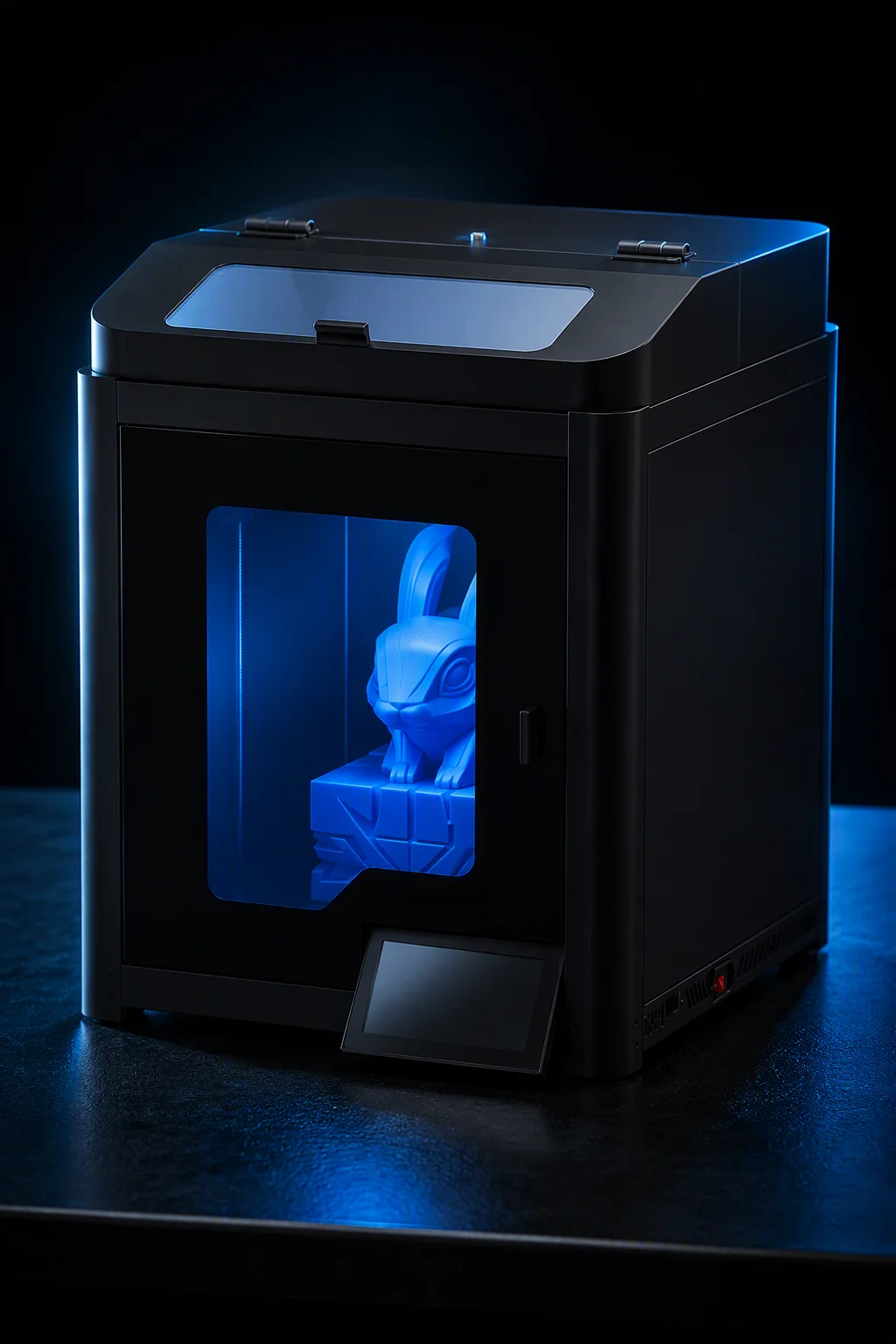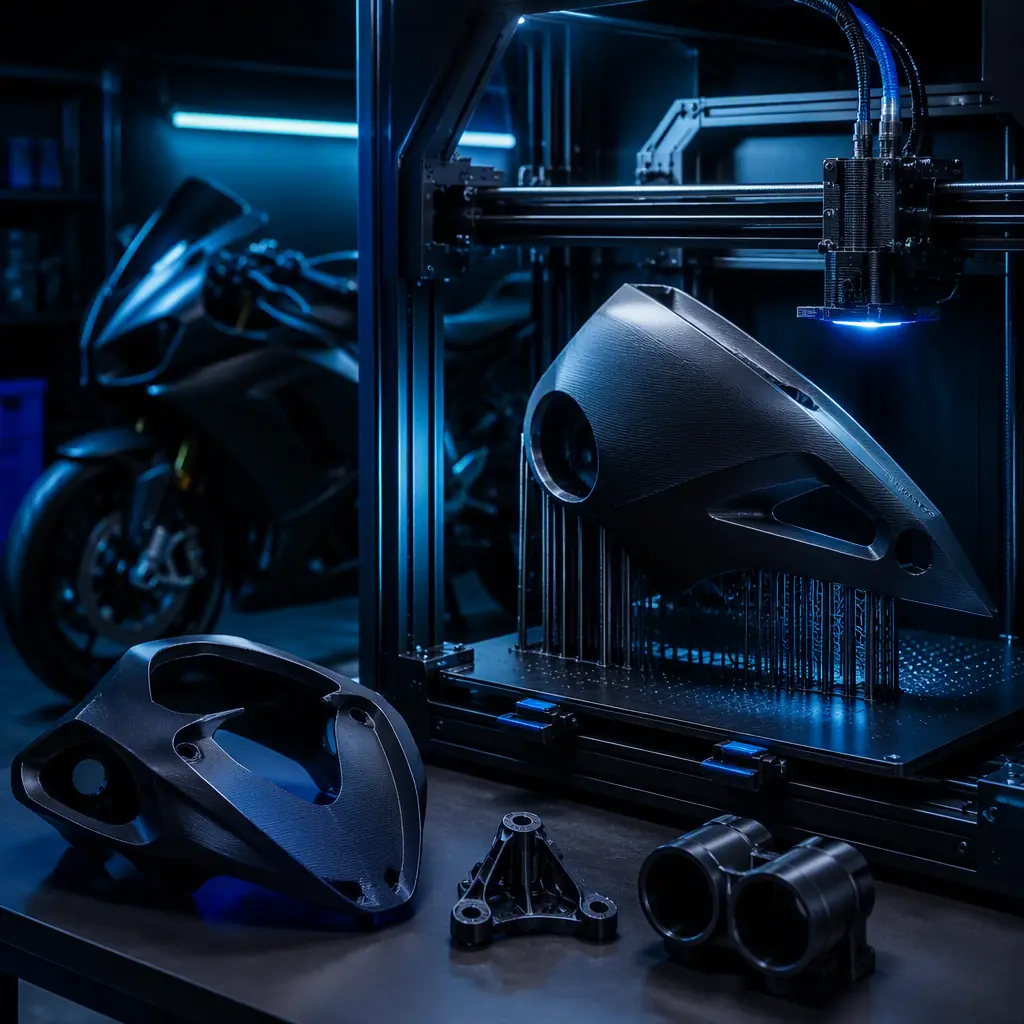
A powersports aftermarket distributor in Chongqing supplying fairing kits and spare parts to dealers across southwest China was losing 12-18% of its catalogue to obsolete stock: OEMs discontinued 30-50 SKUs per year, and minimum order quantities of 100-300 units per mold made low-volume replacement runs uneconomic. After adding a large-format FDM workflow, the distributor now prints discontinued brackets, cable guides, and gauge pods in 1-3 days for $5-40 in material, and a custom fairing prototype that previously cost $2,800 and six weeks with a fiberglass shop now ships in 5 days for $180. Motorcycle and powersports is a parts-supply market first and a manufacturing market second — which makes it one of the most natural fits for 3D printing in the entire vehicle aftermarket.
Why Motorcycle & Powersports Are Structural 3D Printing Buyers
Three structural facts make this vertical exceptional. First, parts proliferation with tiny volumes: a single model generation can carry 800-1,500 unique part numbers, and most sell in quantities of 1-50 units per year — far below any economic injection-molding threshold. Second, model-year discontinuity: motorcycles, ATVs, snowmobiles, and personal watercraft change styling every 1-3 years, orphaning parts that dealers must still supply for a decade or more. Third, customization culture: owners routinely replace fairings, seats, mirrors, and luggage mounts, and shops quote custom work in days — a tempo that favors printed parts over tooled ones. The discipline of producing end-use functional parts at these volumes is covered in our end-use functional parts guide.
The Applications That Actually Buy
Five clusters generate repeat orders. The buyers are OEM parts departments, aftermarket brands, dealerships, independent workshops, and race teams.
1. Legacy and discontinued replacement parts. The flagship application. Brackets, cable guides, clips, gauge pods, and trim pieces for models 5-25 years old. When a dealer needs a part the OEM no longer stocks, printed is often the only option short of a $5,000-15,000 mold. Reverse-engineered from the original or the customer's sample, printed parts restore serviceability at 5-15% of tooling cost. The dimensional discipline for these parts is covered in our tolerances & dimensional accuracy guide.
2. Custom fairings and body panels. Aftermarket fairing kits, radiator shrouds, fender eliminators, and one-off bodywork for custom builds. Printed prototypes let shops validate fitment before committing to fiberglass or vacuum-forming tooling, and short runs of 2-50 panels are increasingly printed directly in ASA or nylon. The material and durability questions are covered in our outdoor weather-resistant printing guide.
3. Small-batch production parts. Seat bases, tool trays, vent grilles, and accessory mounts produced in quantities of 20-500 per year. Printed production replaces low-utilization injection molds and warehousing, with per-part costs that beat tooled parts at these volumes. The economics of replacing traditional production are detailed in our manufacturing tooling guide.
4. Race-day and performance parts. Airbox adapters, chain guards, brake lever guards, windscreen brackets, and pit-lane fixtures. Race teams iterate weekly and need parts same-day or overnight — a tempo only additive manufacturing can meet. These are also the highest-margin parts in the vertical, often selling at 3-6x material cost.
5. Workshop tooling and service aids. Clutch-holding tools, seal drivers, caliper spreaders, oil-filter wrenches, and fixture blocks that workshops use internally. Low visibility, but they open the door to the parts conversation and build trust with the service department. The threaded-in-metal approach used in service tools is covered in our heat-set inserts guide.
Materials and Finish for Powersports Production
Powersports parts face vibration, UV, fuel vapor, and temperature swings from -20°C to 60°C. The map distributors should stock:
Two traps: (1) UV stability is non-negotiable for anything outside the fairing — ASA or UV-stabilized PC, never bare PLA, or panels will chalk and crack within a season; (2) heat and vibration matter in engine bays — a PA6-CF bracket near the exhaust must be validated at operating temperature, not just at room temperature. The full strength and stiffness landscape of these materials is covered in our carbon-fiber filament guide and nylon filament guide.
Economics: Molded/CNC vs Printed
The comparison that closes powersports accounts:
The distributor math is attractive because the purchase is systemic: once a dealer or workshop validates printed replacement parts, every discontinued part number flows through the same printer, filament, and finishing supply. A mid-size dealership can consume $6,000-18,000/year in filament, finishing consumables, and printed parts — before counting the printer itself. For building this ROI case, use our TCO/ROI calculator guide.
The Distributor Playbook: Entering Motorcycle & Powersports
The winning playbook has five moves:
1. Lead with the parts problem, not the printer. The pitch is "discontinued part in 2 days, no mold, no minimum order" — the printer is the tool behind the service. Start with a list of 20-30 common discontinued parts for popular models and print samples to show at dealerships.
2. Offer print-to-parts service. Most dealers do not want to run a printer in the back office. A distributor offering print-to-parts service (customer brings a sample or part number, distributor reverse-engineers, prints, and finishes in 3-5 days) turns a printer sale into a recurring service line. The service economics are developed in our after-sales support strategy.
3. Speak the parts-catalogue language. Dealers quote against part numbers, not geometry. Provide compatibility notes, fitment photos, and material data sheets for every printed replacement — the dealer's own catalogue workflow becomes your sales collateral. The certification landscape that applies across export markets is covered in our certification & compliance guide.
4. Stock the powersports material set. ASA, PA12, PA6-CF, PETG, TPU, and PC-ABS are the true margin engine, plus finishing consumables (primers, matte clear coats, and vapor-smoothing fluids for nylon). A workshop producing 30-80 printed parts per month consumes 8-20 kg of filament monthly; a filament-plus-finishing subscription locks the account.
5. Build the fitment flywheel. Every successfully fitted part becomes a reference: photograph it on the bike, log the model and year, and build a searchable library of print-tested replacements. One validated dealer recruits the next — powersports dealers talk constantly at EICMA, AIMExpo, and regional trade events.
Common Pitfalls in Powersports Accounts
Five mistakes account for most failed initiatives: (1) selling non-UV materials into exterior applications — bare PLA fenders and trim chalk and crack within one season; (2) ignoring heat and vibration — a nylon bracket that passes room-temperature testing can creep or fatigue near the engine, so validate at operating temperature; (3) underselling the fitment question — a replacement part that needs 0.3 mm accuracy must be printed with proper shrinkage compensation, not guessed; (4) underselling the consumable model — the printer is the foot in the door, but filament contracts and finishing-supply retainers are where margin compounds; and (5) neglecting the workshop channel — dealerships are not the whole market, so a distributor must also serve independent workshops and race teams with print-to-parts service, not just a printer. The discipline of documenting measurable outcomes mirrors what we teach for end-use parts in our end-use functional parts guide.
Getting Started: The First 90 Days
A 90-day entry plan: Month 1 — stock ASA, PA12, PA6-CF, PETG, TPU, and PC-ABS with full data sheets, plus primers and matte clear coats, and identify 10-15 target accounts (OEM parts departments, aftermarket brands, dealerships, independent workshops, race teams) within a 3-hour drive. Month 2 — reverse-engineer and print 20-30 common discontinued parts for popular models in your region; run two pilot fitment jobs at cost-plus-10% to build documentation evidence and a fitment-sample library. Month 3 — convert pilots to full accounts with filament-and-finishing subscriptions and print-to-parts retainers, publish your first co-branded case study with measured numbers ("discontinued mirror mount: $9,000 mold → $18 printed, 2-day turnaround, fitment verified on a 2019 model"), and exhibit at a regional powersports or motorcycle trade event. If you already serve automotive or bicycle accounts, our classic car restoration guide and bicycle & e-bike manufacturing guide show how the same parts-supply logic transfers directly to powersports.
Reviewed by the Precise3D engineering & OEM team. Compliance files that accompany the catalog are auditable at the certification register.
Enter the Powersports Market
Ready to Supply Motorcycle & Powersports Parts?
Get wholesale pricing on large-format FDM printers, ASA and nylon engineering filament lines, and the print-to-parts service playbook that wins dealer and workshop accounts.