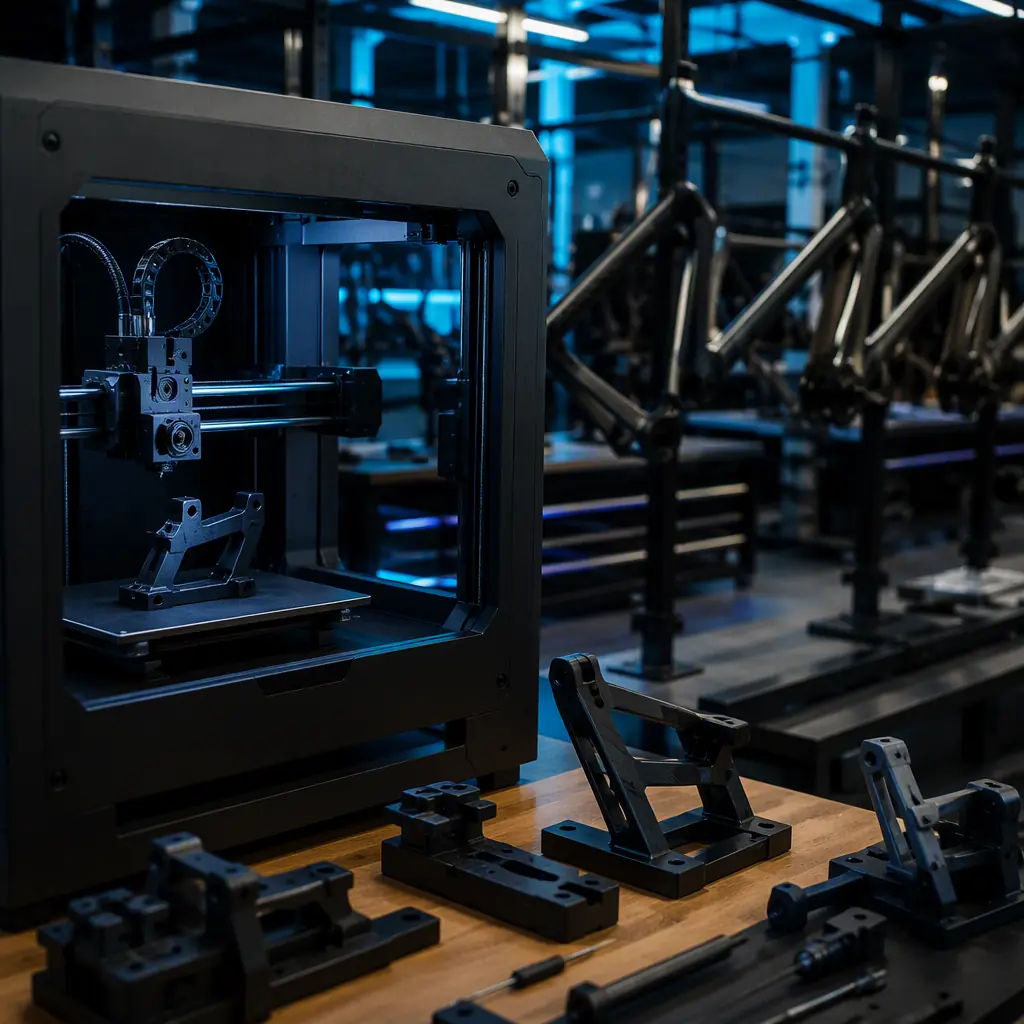
The bicycle industry's tooling problem has gotten worse exactly as its production has modernized. Traditional frame building relies on machined steel or aluminum jigs — alignment fixtures that hold the head tube, bottom bracket, and dropouts in precise relation while the frame is welded or bonded. These jigs are expensive, single-geometry, and slow to build, which was acceptable when a brand offered four frame sizes across two models. Today, a mid-size e-bike brand offers 10–20 models, each with multiple frame sizes and motor variants, and each geometry change means a new jig or a set of new fixture inserts. Add carbon frame production — where every layup needs its own molding mandrels and consolidation fixtures — and the tooling count per brand has tripled in five years. That is the demand curve 3D printing was built for, and it is the same pattern of low-volume, high-variety tooling we document in our manufacturing tooling playbook.
The Four Tooling Families Bike and E-Bike Plants Order
Bicycle tooling demand clusters into four families, each with its own volume, material, and tolerance profile. A distributor who can map the four families to specific production steps walks into any bike factory conversation with a catalog that matches real needs.
- Frame alignment jigs and fixture inserts — the core family. The head tube, bottom bracket shell, and dropouts must be held to ±0.2–0.5 mm during welding or bonding. Printed PA-CF fixture inserts replace machined aluminum inserts at 10–20% of the cost, and a printed jig body with replaceable inserts handles multiple frame sizes on one fixture.
- Carbon fiber molding and layup tooling — mandrels, consolidation fixtures, and bladder-end plugs for carbon frame and fork production. These see autoclave and oven temperatures (120–180°C), so the material bar is high: PEI or PEEK mandrels, or sacrificial printed mandrels for one-off layups. This family is where high-temperature material knowledge wins the account.
- Assembly fixtures and line tooling — motor-mount alignment fixtures, battery-box test stands, brake-bleed holders, and torque-check fixtures on the final assembly line. These are mid-tolerance (±0.3–0.5 mm) parts in PA12 or PETG, and they multiply with every e-bike model because the motor and battery integration points differ by platform.
- Custom and aftermarket parts — chain guides, mudguard brackets, battery enclosures, and prototype components for R&D teams. This family is the recurring-revenue driver: e-bike brands iterate enclosures and mounts constantly, and each revision is a new print order.
The common thread: every family is low-volume and high-variety, and none of it makes sense as machined or molded production tooling at the quantities bike brands need. The design-team adoption pattern behind this — why R&D engineers print before they machine — is covered in our R&D and rapid prototyping guide.
Materials That Survive the Bike Factory Floor
The material selection for bike tooling splits cleanly by temperature exposure. For assembly-floor fixtures — alignment jigs, motor-mount fixtures, test stands — the workhorse is PA-CF (carbon-filled nylon). It combines stiffness (modulus ~4–6 GPa, roughly 2–3× unfilled nylon), dimensional stability through the 30–45°C factory environment, and enough impact resistance for daily handling. A PA-CF dropout alignment insert holds ±0.2 mm through thousands of cycles and outlasts aluminum inserts in abrasive contact with steel dropouts. The nylon family behavior — moisture absorption, annealing, and CF reinforcement — is covered in depth in our nylon filament guide, and the carbon-fiber economics are in the CF filament guide.
For carbon molding tooling, the material bar is defined by the cure cycle. Standard carbon frames cure at 120–150°C in the oven or autoclave, which rules out PA12 (heat deflection ~100°C at load) and PETG. The candidates are PEI (Ultem) and PEEK, which hold structural integrity at 150–250°C continuous — and for sacrificial mandrels that are extracted or dissolved after layup, lower-cost printed mandrels in high-temp resin or PA-CF coated with release agent work when the geometry allows. The full high-temperature comparison, including the $300–600 per kg material cost and the printer requirements (enclosed chamber, 400°C+ hotend for PEEK), is in our PEEK/PEI/PPSU materials guide.
For custom parts and prototypes, PETG and PA12 cover most demand — PETG for enclosures and brackets where cost matters, PA12 for anything load-bearing. The engineering filament selection framework — when to spec each material by load, temperature, and chemical exposure — is laid out in our engineering filaments guide.
Design Rules for Bike Tooling
Printed bike tooling fails for predictable reasons, and the fixes are design rules. First, design for the tolerance you can actually hold: a well-tuned printer holds ±0.1–0.15 mm on features up to 200 mm, and ±0.2–0.3 mm beyond that. Frame alignment inserts should be designed so the critical datum — the dropout slot, the head-tube bore — is a replaceable insert printed separately from the jig body, so a worn or revised insert costs $20–50 instead of a whole new jig. The dimensional behavior of printed parts across temperature and humidity — why a PA-CF insert printed in a humid week can grow 0.3–0.5% — is detailed in our tolerances and dimensional accuracy guide.
Second, compensate for layer anisotropy: FDM parts are 20–40% weaker across layer lines than along them, so load-bearing features on assembly fixtures must be oriented with the load running parallel to the layers. Third, use heat-set inserts for anything threaded: a brass M4 insert pressed into PA-CF resists pull-out at 30–80 kgf versus 5–15 kgf for a printed thread — the difference between a fixture that survives a production year and one that strips in a week. The full insert selection and installation data is in our heat-set inserts guide. Fourth, for carbon molding tooling, verify the thermal cycle: a mandrel printed in the wrong material will soften, off-gas, or bond to the layup in the oven — the release-agent and material-selection conversation must happen before the first part, not after a ruined frame.
What you're looking for: Dropped-insert accuracy in a PA-CF fixture is almost always wear on the contact faces — steel dropouts sliding against printed nylon abrade the datum surface, and a worn datum shifts every frame after it. The fix is a design change, not a material change: make the contact faces replaceable wear inserts (printed in PA-CF with the grain oriented for abrasion, or fitted with machined steel pins), so the factory replaces a $20 insert instead of re-certifying a $500 jig. If the insert also warped, check the print orientation and annealing — PA-CF should be annealed at 80–100°C to stabilize dimensions. This is the most common failure we see in bike tooling accounts, and the replaceable-insert conversation is exactly what turns a parts sale into a long-term fixture partnership.
The Distributor Go-to-Market Playbook for Bike Factories
Bike and e-bike manufacturers buy in a predictable sequence. The entry point is the R&D team: they iterate frame prototypes, motor mounts, and enclosures constantly, they control prototyping budgets, and their parts are small enough to print on a mid-range FDM machine. A distributor who wins the R&D team gets visibility into the brand's model roadmap — and model launches are what generate the assembly-fixture and jig orders that follow. The factory then scales to dedicated machines running PA-CF and high-temp materials, which means the end-use functional parts guide applies: tooling sold to a bike factory is a consumable-driven account, with nylon and CF-nylon reorders landing every 4–8 weeks.
The printer requirements are specific: an enclosed chamber (nylon warps without one), a hardened steel nozzle (carbon-filled materials wear brass nozzles in 2–4 kg of material), and a heated bed to 100°C+ for PA adhesion. For carbon-molding accounts, add a high-temperature machine (400°C+ hotend) for PEI/PEEK. Distributors should also carry the consumable stack — PA-CF, PA12, PETG, and a small PEI line — because the material is where the recurring revenue lives. The e-mobility context, including why e-bike production is the fastest-growing segment of the light-vehicle industry, is in our EV and e-mobility guide, and the broader manufacturing-tooling demand pattern is in the manufacturing tooling playbook.
The bottom line: bicycle and e-bike manufacturing is one of the most tooling-dense verticals in consumer goods because its product cadence has outrun its traditional tooling supply chain. New geometries, new motor platforms, and new battery integrations generate fixture orders on a schedule that machined tooling cannot meet — and that printed tooling handles in 48 hours. A distributor with fixture-design skill, PA-CF material knowledge, and high-temperature capability becomes a production partner, not a box shipper. The factory does not need to be convinced that 3D printing works; it needs a supplier who shows up with the right insert design, the right material spec, and the right fixture catalog on day one.
Reviewed by the Precise3D engineering & OEM team. Compliance files that accompany the catalog are auditable at the certification register.
Start Your Partnership
Ready to Bring bicycle ebike manufacturing to Your Market?
Our OEM program supports bicycle ebike manufacturing programs end to end - the product line, firmware and compliance files that travel with each shipment.