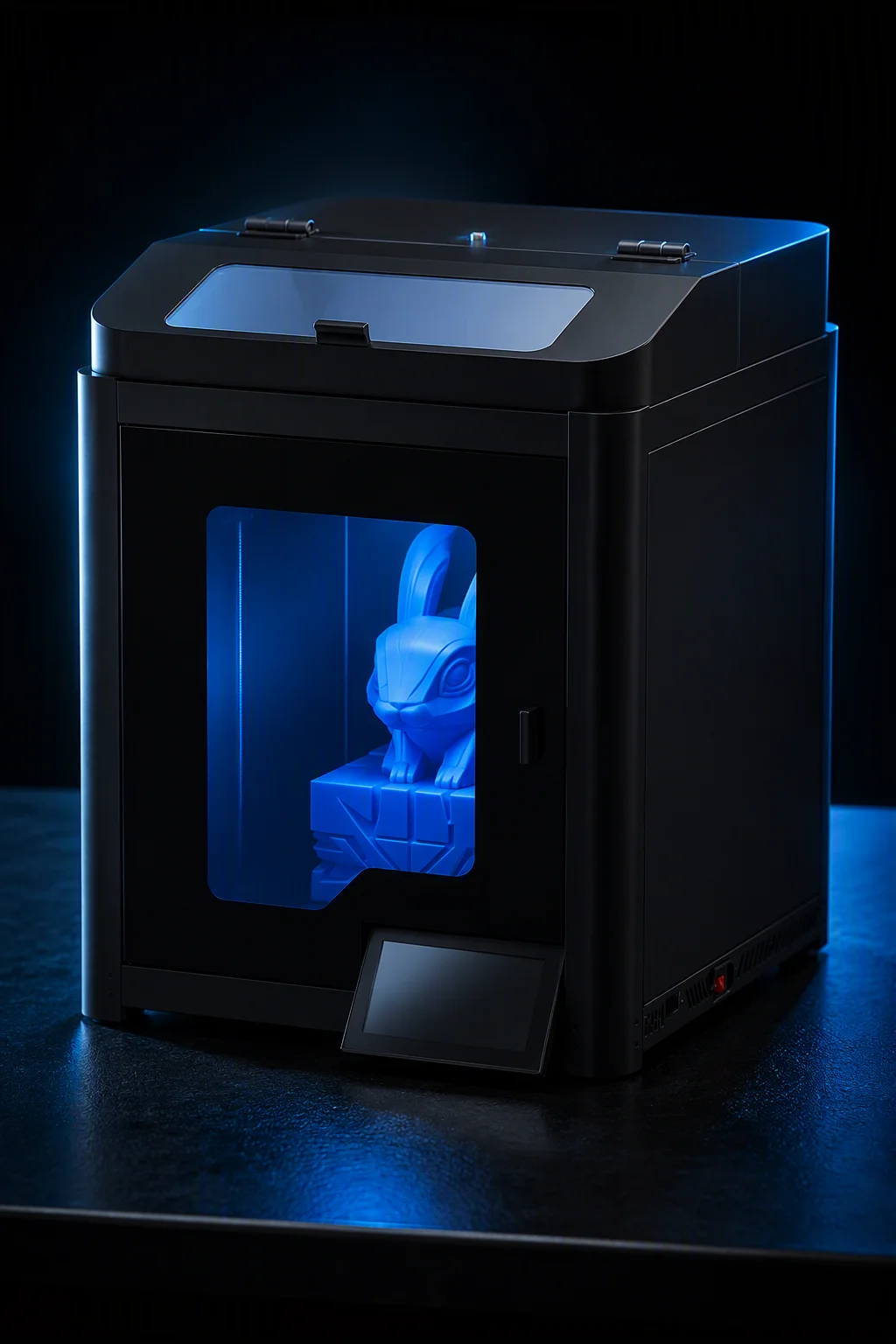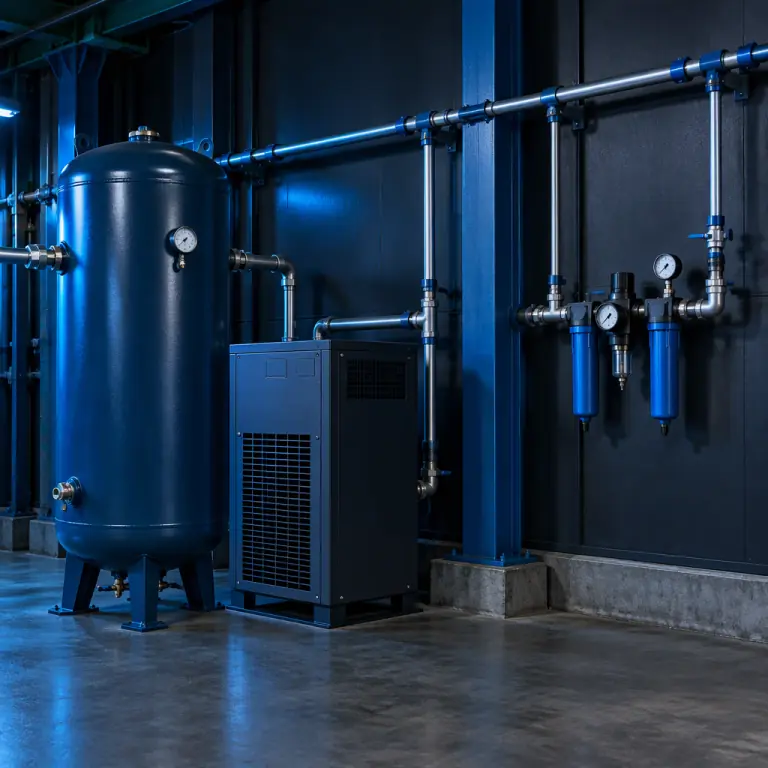
A print cell installed in a leased unit came online eleven weeks behind schedule. The machines arrived on time and passed acceptance individually. The delay was the compressed air: the room had a single 8 mm line shared with a neighbouring tenant, adequate for a blow-off gun and useless for the fifteen pneumatic operations a cell performs per shift. Retrofitting a proper air main and a dryer into a finished room cost more than the original specification would have, and the room had already been painted and racked.
Compressed air and process cooling are the two utilities that get planned last and cost most to add afterwards. This guide covers what a modern print cell actually consumes from each, how to size the plant, and the four failures that follow when they are undersized.
What a Print Cell Actually Uses Air For
Compressed air is not a printing requirement in the way that power is. It is a cell requirement, and the demand comes from the operations around the printer rather than the printer itself.
| Application | Air quality class | Consumption per event | Frequency in a cell |
|---|---|---|---|
| Part cooling for bridging and fine features | Oil-free, dry, filtered to 5 microns | 10 to 40 litres per minute while active | Continuous on engineering materials |
| Blow-off after support removal or cleaning | Filtered, dry | 60 to 120 litres per event | Every part |
| Post-processing tools, airbrushes and spray | Dry to a low pressure dewpoint | 80 to 200 litres per minute | Batch dependent |
| Pneumatic fixtures and clamping | Dry, lightly lubricated if the cylinder allows | 0.5 to 2 litres per cycle | Every load and unload |
| Vacuum generation for pick-and-place or plate handling | Filtered, dry | 40 to 90 litres per minute per ejector | Continuous on automated cells |
The first row is the one that changes machine specification. Part cooling by compressed air, rather than by a fan, gives a much higher local heat-transfer coefficient and is used on machines printing engineering polymers where bridging and overhang quality matter. It also makes the machine dependent on a plant that most customers do not have. A distributor selling into a customer without a proper air main is selling a feature that will be disabled on the first day.
Sizing the Air Plant
Three numbers decide the plant, and the third is where most budgets surprise themselves.
Flow and storage
Sum the simultaneous demand, not the sum of every device's rating. A cell of eight printers with two operators doing blow-off will rarely exceed 300 litres per minute at any instant, but the compressor must be sized for the peak plus a receiver of 100 to 200 litres to absorb it. A compressor rated exactly at peak demand cycles constantly and wears out; the receiver is the cheap part.
Pressure and line losses
Rated at 8 bar at the compressor outlet is not 8 bar at the tool. A 20 metre run of 8 mm tube with four elbows will lose 0.5 to 1 bar, and a small compressor running near its duty limit cannot recover it. The remedy is a ring main in 15 to 22 mm aluminium pipe with drops taken off the top of the main, which is a modest cost at installation and a rebuild afterwards.
Dryness
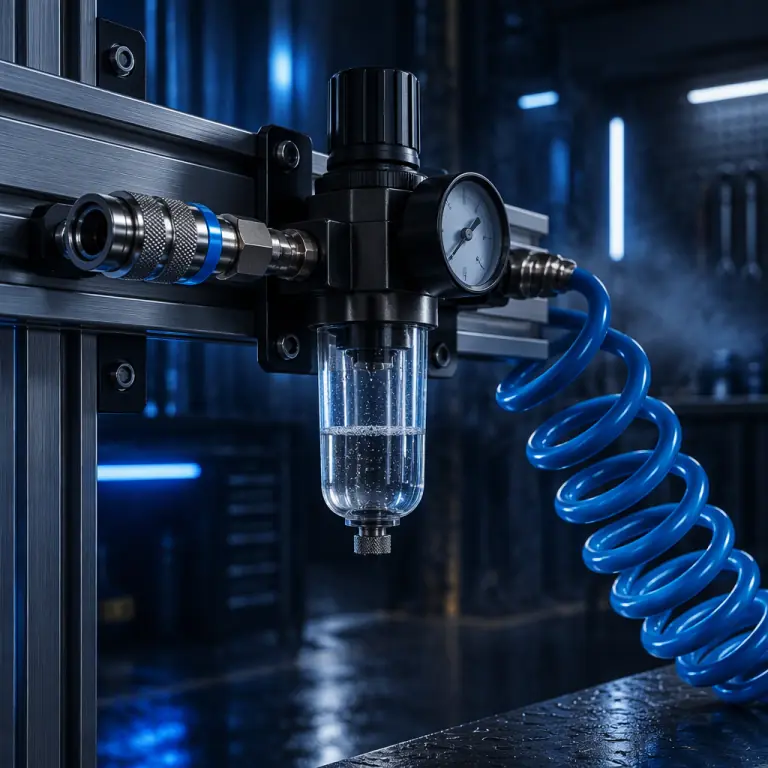
The one that matters most for a print cell, because wet air in a pneumatic system delivers water to cylinders, valves and any surface being blown clean. A refrigerated dryer holds a pressure dewpoint of about 3 C, which suits general blow-off. An airbrush finish or a desiccant-dried specification may need a desiccant dryer and a 0.01 micron coalescing filter, and the cost difference is significant enough to plan rather than discover.
What to check first: whether the site has a dedicated air main and a dryer at all, or a shared line sized for hand tools.
Where Process Cooling Comes In
Three separate cooling loads appear in a print cell, and conflating them is the usual planning error.
- Room cooling. Removes the heat a cell rejects into the space. Every kilowatt of printer power eventually becomes room heat, so twenty machines drawing 400 W average is an 8 kW cooling load before any solar gain, and that is a comfort and stability requirement, not a process one.
- Machine cooling for enclosed and heated-chamber machines. Some machines reject heat from electronic enclosures, drivers and controller cabinets through a dedicated cooling circuit, and a few use liquid-cooled hotends. These need chilled water or a dedicated air path.
- Material and post-process cooling. Annealing ovens, resin washing and curing stations, and any fixture that runs warm. These are intermittent but coincide with the busiest part of a shift.
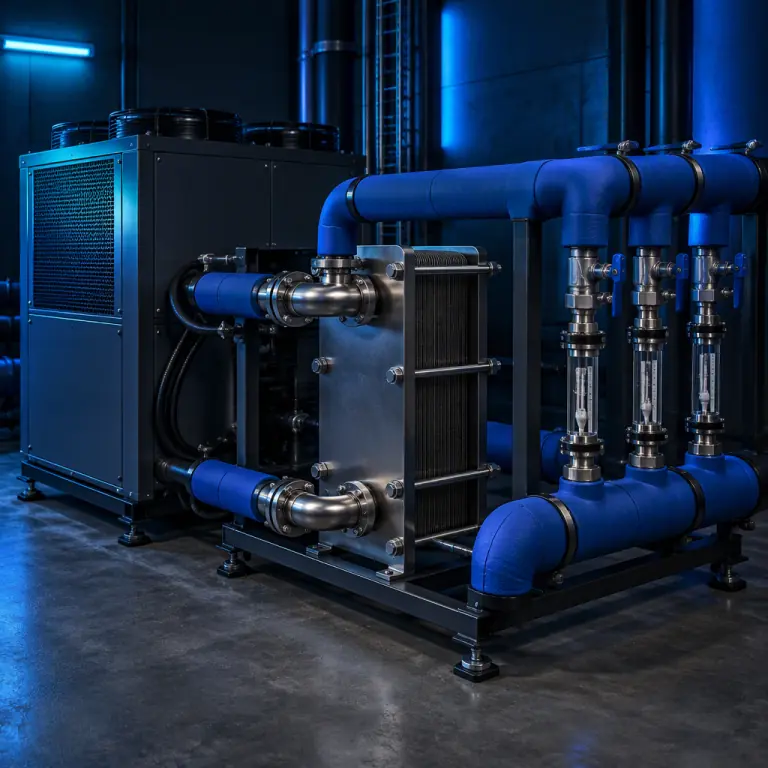
The common mistake is sizing a chiller for the nameplate power of the printers. A chiller removes heat, so it must be sized for the heat actually rejected into the circuit it serves, which for a machine-cooling circuit is a fraction of the total draw. The specification to require from a machine supplier is the heat rejection to the coolant circuit in kilowatts at nominal load, not the machine's input power.
The Four Failures That Follow
Every one of these is a site problem that presents as a machine problem, and each has a signature that resolves the ambiguity in a shift.
| Failure | What the operator sees | Actual cause | Remedy |
|---|---|---|---|
| Wet air reaching pneumatic fixtures | Cylinders sticking, valves leaking, water in filters | No dryer, or a dryer bypassed because it was undersized and restricting flow | Correctly sized dryer and coalescing filter, with a drip leg at each drop |
| Pressure collapse under simultaneous demand | Fixtures fail to clamp on the second and third machine of a batch | Compressor sized on average rather than simultaneous peak, no receiver | Receiver volume first, then compressor capacity |
| Chiller short-cycling | Coolant temperature oscillating, alarms in warm weather | Chiller oversized for the actual rejection load, or undersized for ambient | Match to measured heat rejection, verify ambient rating |
| Condensation on chilled pipework | Water on the floor, corrosion at fittings, slips | Uninsulated chilled lines in a humid room | Closed-cell insulation on all chilled runs and every fitting |
The second row is the most expensive because it appears only under load, which means it appears in production rather than in commissioning. A receiver is cheap. A compressor replacement after the room is finished is not.
The Site Survey Questions That Catch This Early
These belong in the quotation stage, not the installation stage, because each one changes what the customer must budget for before signing.
- Is there a dedicated air main? Not a shared line, not a single hose drop. If not, quote the installation as part of the project rather than leaving it to the customer.
- What dryer is on the system, and is it refrigerated or desiccant? Ask for the pressure dewpoint, not the model name.
- What is the compressor capacity against the planned simultaneous peak, and is there a receiver?
- Does the room have dedicated cooling for the heat the cell will reject, or does it rely on building HVAC sized for occupancy?
- Will any machine need a coolant circuit, and if so what is its heat rejection rating and required flow?
- Where does condensate drain, from the receiver, dryer, filters and any chiller condensate?
These sit alongside the electrical and floor questions in the pre-installation site survey checklist. The floor-loading and vibration side of the same survey is covered separately in our guide to floor vibration and isolation, and the wider room-scale questions for a production floor are in the medium-format manufacturing floor guide.
What It Costs, and What Oversizing Costs
Ranges below are for a cell of eight to twelve printers in an industrial unit, at typical European and North American pricing. They are installation costs, not machine costs.
| Item | Typical range | Notes on sizing |
|---|---|---|
| Compressor and receiver, 1.5 to 2.2 kW | USD 900 to 2,400 | Receiver volume matters more than compressor brand |
| Refrigerated dryer and filtration | USD 600 to 1,600 | Desiccant adds 40 to 100 percent if a low dewpoint is needed |
| Air main in aluminium pipe, 20 to 40 m | USD 1,200 to 3,500 | Ring main with drops from the top; pipe size drives cost more than length |
| Process chiller, 5 to 15 kW | USD 3,500 to 11,000 | Size on measured heat rejection, not machine nameplate |
| Insulated chilled pipework and manifold | USD 800 to 2,600 | Insulation is not optional in a humid room |
| Dedicated room cooling, per kW | USD 250 to 600 per kW installed | Every kW of printer draw becomes room heat |
The oversizing error here is cheaper than the undersizing error, which is unusual and worth stating plainly. An oversized dryer costs a little more in purchase and adds nothing to operating cost. An undersized one gets bypassed by an operator within a month, and then the wet-air failures start and get attributed to the machines. Where a site cannot afford the correct plant, the honest answer is to specify a machine configuration that does not depend on compressed air, rather than to supply one that does.
For distributors, this is also a margin question. A cell that runs reliably because the utilities were planned is a reference installation. A cell that begins with three months of pneumatic faults is a support burden that consumes the margin on the whole order, and the arithmetic of that is visible in any service contract model. Our guide to annual service contract pricing carries the numbers.
Commissioning the Utilities, Not Just the Machines
A site acceptance test that covers the printers and not the plant will pass a cell that cannot run. The utility checks below take an hour and are best done before the first production shift.
- Pressure at the furthest drop under simultaneous demand, not at the compressor outlet. Run the peak load deliberately, then measure.
- Pressure dewpoint reading from the dryer, recorded with the ambient temperature and humidity of the day.
- Condensate drain verification at receiver, dryer, filter and every drip leg, with the drains actually opened rather than assumed.
- Coolant flow and supply temperature at each machine that uses a circuit, against the machine's stated requirement.
- Chilled pipework insulation continuity at every fitting, since that is where condensation appears first.
These belong alongside the electrical and mechanical checks in the site acceptance and commissioning checklist, and the wider commissioning sequence is in the installation and acceptance guide. Where a cell includes local extraction, the ductwork and filtration side of the same utility plan is covered in the fume extraction guide.
One connection worth making explicitly: an air-cooled chiller rejects its heat into the room, and so does every printer. A cell planned without room cooling and then fitted with a chiller has moved the heat rather than removed it, and the room will warm until something derates. The energy and cost consequences of that are in our guide to energy consumption and operating cost, and the OEE impact of a derated cell is in the OEE framework for print cells.
Site Conditions
Plan the Utilities With the Machines, Not After Them
Send the machine count, the materials you intend to run, the post-processing steps and the room's existing air and cooling plant. You will get the air and coolant demand the cell will actually place on the site, the plant sizing that follows from it, and the utility commissioning checks as a one-page sign-off sheet for the installation team.
The summary worth keeping is that a print cell is a small factory with a small factory's utilities, and the two that get planned last are the two that cost most to retrofit. Ask about the air main and the cooling load in the survey, and half the commissioning failures never happen.