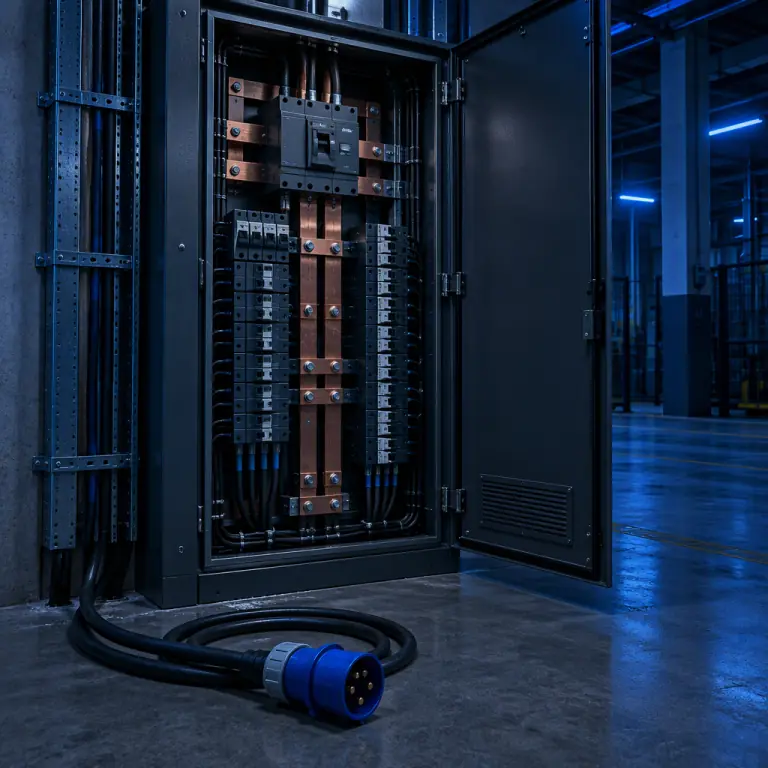
A 16-machine farm in a converted warehouse reported a failure pattern that made no sense by machine: on two or three mornings a week, three or four printers would stop mid-print within a minute of each other, always on the same row, always when the extraction fan bank and the compressor started together. Every affected printer passed bench testing. Two were replaced under warranty, and the replacements failed in the same position. The cause was 14 volts of sag on one phase, measured at the distribution board, lasting about 300 milliseconds on each fan start.
Power quality is the least examined condition in a print farm, and the most expensive to misdiagnose, because its symptoms present as mechanical and firmware faults. This guide covers what to measure, the three faults that account for most farm incidents, and the remedies ranked by cost per machine.
Why Printers Are Unusually Sensitive
A 3D printer is a switching load with a microcontroller that must not lose state. Those two properties conflict, and the conflict gets worse as farms get denser.
The controller runs on 5 V or 3.3 V derived from the main supply, so a dip on the incoming supply propagates through the regulator if the supply's input capacitance is small. The heaters and motors are switched hard, drawing current in bursts rather than continuously. And every printer in a farm is doing this on the same supply at once, so the aggregate switching activity is far more violent than the sum of the individual loads suggests.
| Fault | Duration | Typical symptom | What it damages |
|---|---|---|---|
| Voltage sag | 50 to 500 ms | Mid-print reset, layer shift, controller reboot | The part in progress, and confidence in the equipment |
| Inrush at energising | 5 to 100 ms | Breaker trips when several machines power on together, or on the same circuit | Breakers and relays, through repeated wear |
| Shared neutral overloading | Continuous | Wandering neutral voltage, sensor drift, occasional board failure | Controller boards, and everything downstream of the damaged one |
| Harmonic distortion | Continuous | Overheating transformers and motors, higher neutral current than the phase current | Transformers, and any equipment sharing them |
The first row is the one that gets blamed on the printer. The third row is the one nobody checks, and on a farm wired with shared neutrals it is the most likely cause of the failures that do not resolve when parts are swapped.
Measuring Sag Without an Electrician on Site
A farm can do the first pass itself with a data-logging voltage meter on the distribution board, and the evidence it produces is enough to brief an electrician properly instead of describing symptoms.
- Log the supply voltage for a full shift, at one minute intervals, on the board feeding the print rows. Nominal plus or minus 6 percent is the working tolerance in most 230 V markets; log the actual.
- Log at high sample rate during a known event. Set the meter to record minimum voltage at 10 ms intervals, then start the fan bank or compressor deliberately. The depth and duration of the dip is the number that matters.
- Repeat with printers idle, then with all printers running. A dip that appears only with printers running points to an undersized supply or an overloaded neutral rather than a single bad load.
- Measure neutral-to-earth voltage while the farm runs, at the furthest circuit. More than a few volts here, on a loaded board, indicates neutral impedance or loading problems.
Three things commonly found on the first measurement, in order of frequency: the board was sized for the printers alone and never for the extraction and compressed-air plant that runs alongside them; several printers share one circuit because that was the cheapest way to wire the room; and the building's own supply has a sagging issue upstream that no amount of local protection fully fixes.
What to measure first: minimum voltage at 10 ms resolution on the board feeding the affected rows, during a deliberate start of the suspect plant.
Inrush and the Breaker That Trips on Monday
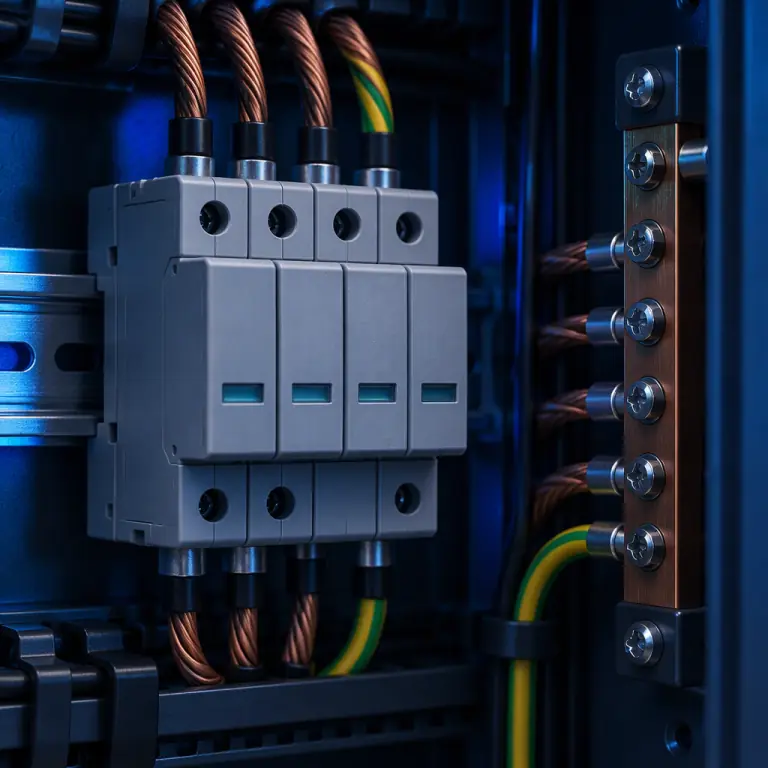
Every printer's power supply draws a large current for the first few tens of milliseconds as its input capacitors charge. That inrush can be five to ten times the running current for tens of milliseconds, and it is invisible to a thermal breaker sized on running load, because the thermal element does not respond that fast. What responds is the magnetic trip, and it fires when several machines energise together.
The practical consequence is a farm that trips a breaker when a row is switched on at the start of a shift, but never trips during operation. Two remedies work, and only one of them is a printer-side decision.
- Stagger the start. Free, and effective: bring rows up in sequence with 10 to 15 seconds between them. A relay timer or even a strict operating procedure handles it.
- Choose motor-rated or D-curve breakers for printer circuits. A domestic B-curve breaker trips far below what a switching load needs, and the thermal rating people size on is not the trip mechanism that fires.
- Specify power supplies with active inrush limiting. This is a machine specification, not a site fix, and it is one of the differences between a supply that costs USD 18 and one that costs USD 45. The criteria for judging them are in our guide to power supply selection and certification.
The third item is the one to carry into a procurement conversation, because it is decided at the factory and cannot be retrofitted economically on a farm. A distributor specifying for a customer who plans to scale beyond ten machines should treat inrush limiting as a requirement rather than a nice-to-have, and should ask for the measured inrush figure rather than a yes-or-no answer.
The Neutral Question
On a three-phase supply with shared neutrals, the neutral carries the imbalance between phases. In a farm of single-phase printers, that imbalance is whatever the last person to distribute circuits left it at, and it drifts as machines are added.
The failure mode is quiet. Neutral-to-earth voltage rises, control electronics see a reference that moves, and the symptoms look like sensor faults: temperature readings that wander, spurious endstop triggers, and boards that fail without a visible cause. Because the fault is in the building rather than the machine, replacing the board fixes it for a while and then it returns.
Two measurements separate this from a printer problem. Log neutral-to-earth voltage at the furthest circuit for a shift; a stable few volts is normal, a value that tracks printer activity is not. Then move one printer to a different circuit on a different phase and see whether the symptom follows the machine or stays in place. If it stays, the fault is in the installation.
What Protection Actually Buys
The market offers three classes of device, and they solve different faults. Buying the wrong one is common, and expensive.
| Device | Fixes | Does not fix | Cost per machine |
|---|---|---|---|
| Surge protection device at the board | Transient spikes, lightning-induced events | Sag, inrush, neutral loading, harmonics | USD 3 to 8, shared across the board |
| Line-interactive UPS | Short sags, brief outages, some surge | Long outages, harmonics, inrush | USD 90 to 220 |
| Online double-conversion UPS | Sag, surge, harmonics, frequency variation, outage ride-through | Nothing entirely, but adds its own losses and a maintenance item | USD 260 to 700 |
| Isolation transformer | Neutral problems and common-mode noise | Sag and inrush | USD 150 to 400, shared |
| Voltage regulator or tap changer | Chronic sustained undervoltage | Fast transients | USD 400 to 1,500, shared across rows |
The useful discipline is to identify the fault before buying the device. A farm with a 300 millisecond sag needs a UPS with adequate ride-through, not a surge protector. A farm with a shared-neutral problem needs the wiring fixed, and a UPS will simply hide the symptom until a board fails anyway.
One cost note that distributors tend to miss: an online UPS rated for a farm's total load adds roughly 4 to 8 percent to the electricity bill through conversion losses, on top of its purchase price. Where the farm's power cost is already a line item in a quote, this is worth modelling rather than absorbing. Our guide to energy consumption and operating cost carries the arithmetic through to a per-hour figure.
Circuit Design for a Farm That Will Grow
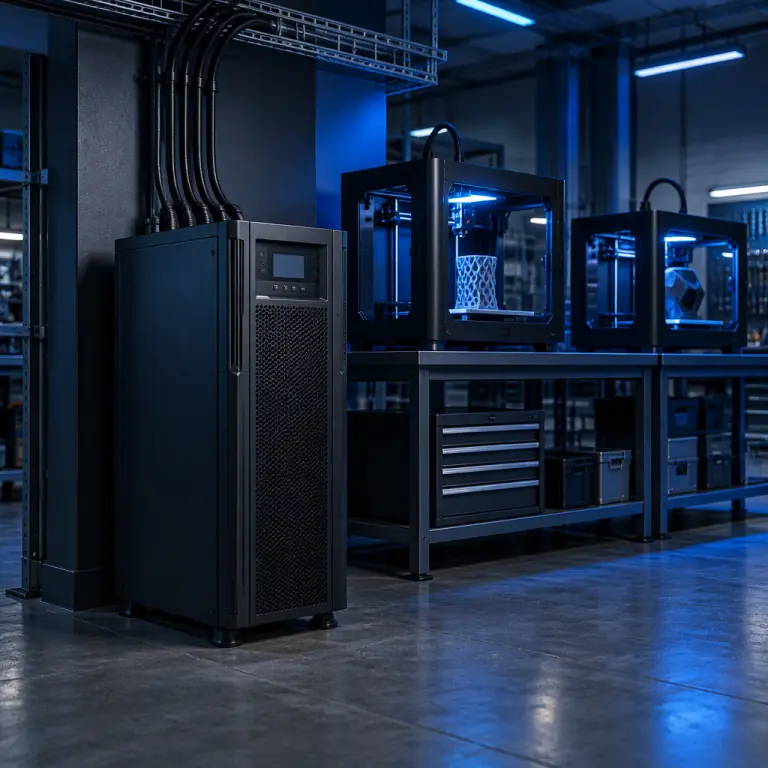
Almost every power problem we see in mature farms was designed in when the room held six machines and would have cost nothing to avoid. These are the decisions worth making before the wiring is installed.
- One circuit per four to six printers, sized for the printers plus their share of ancillary load, with a dedicated circuit for extraction and compressed air.
- Separate the plant from the printers. Fans, compressors, chillers and HVAC on their own board. This single decision removes most sag incidents.
- Size the neutral for the harmonic content, not just the imbalance. On a dense switching load, neutral current can exceed phase current, and a neutral sized to match the phase conductor is undersized.
- Leave 30 percent headroom on each board. Farms grow, and the second half of a growth step is where the complaints start.
- Label circuits by row and machine position. When a fault appears on the same row three times, that label is how anyone notices the pattern.
These are installation decisions, but they belong in a machine supplier's site conversation, because the buyer usually asks the printer vendor rather than an electrician. The electrical section of our pre-installation site survey checklist covers what to record before quoting, and the commissioning sequence that follows is in the installation and site acceptance guide.
Separating a Power Fault From a Machine Fault
The distinction matters because the two have opposite remedies and the wrong one wastes money in both directions. The sequence below resolves it in a shift, without instruments beyond a logging meter.
- Does the fault follow the machine or the position? Swap two printers between suspect and known-good circuits. If the fault follows the machine, it is a printer problem.
- Do multiple machines fail simultaneously? Correlated failures across a row or a circuit cannot be caused by independent printer faults.
- Does the timing correlate with plant activity? Log failures with timestamps for a week. A pattern tied to shift start, compressor cycles or extraction fan operation identifies the source.
- Does the fault disappear on a dedicated circuit? A printer that runs clean on a test circuit is telling you the supply is the problem.
- Is it temperature-correlated instead? Some failures that look electrical are thermal, and the sequence in our print failure diagnosis guide covers those paths.
Where the fault produces a layer shift rather than a reset, two mechanical causes overlap with this territory and are worth ruling out early: belt and drive-train slack, in the belt tensioning guide, and floor-borne vibration, which the vibration and floor isolation guide covers. A shift that appears simultaneously on four machines in the same second is not mechanical.
The Specification Lines That Prevent This
Buyers rarely ask for power quality data, and suppliers rarely volunteer it. Adding these five lines to a purchase specification moves several of these faults from the site to the factory.
- Measured inrush current and duration, at nominal voltage, per machine.
- Power supply input range and brownout tolerance, stated as the minimum voltage and duration the controller survives without reset.
- Harmonic content of the input current, or a statement of the power factor correction stage fitted.
- Controller ride-through, meaning whether the machine resumes a print after a brief interruption and with what procedure. This is a firmware feature as much as an electrical one.
- Recommended circuit sizing per machine, including the derating for grouped installation, since a farm installs machines in groups by definition.
Two of these can be verified in an acceptance test rather than taken on trust. Inrush and brownout ride-through can both be measured with a logging meter and a variable supply, and they belong in the same acceptance test as the mechanical checks. Our site acceptance test checklist describes how to record pass and fail on measurable criteria rather than opinion, and the incoming inspection sampling approach for shipment-level checks is in the receiving inspection guide.
There is a commercial argument here as well, and it is the one that changes specification conversations. A printer that resets and loses a 14-hour print costs the customer far more than the difference between a cheap and a competent power supply: at a part value of USD 40 and a 22 percent failure rate on overnight work, one reset a week on a 20-machine farm is a five-figure annual loss. The machine-hour arithmetic is in our cost-per-part model, and the uptime consequences feed directly into the OEE framework for print cells.
Farm Infrastructure
Specify the Electrical Envelope Before the Building Is Wired
Send the machine count, the planned growth step, the ancillary plant on site and the building's supply type. You will get the circuit layout we recommend for that density, the inrush and brownout figures for the models in question, and the five specification lines above as a clause set you can put into a purchase order.
The summary worth keeping: random resets are a site measurement, not a printer defect, and the cheapest fix is almost always made before the wiring goes in. Log the voltage once, look for correlated failures, and the ambiguity between a faulty machine and a faulty supply resolves itself.