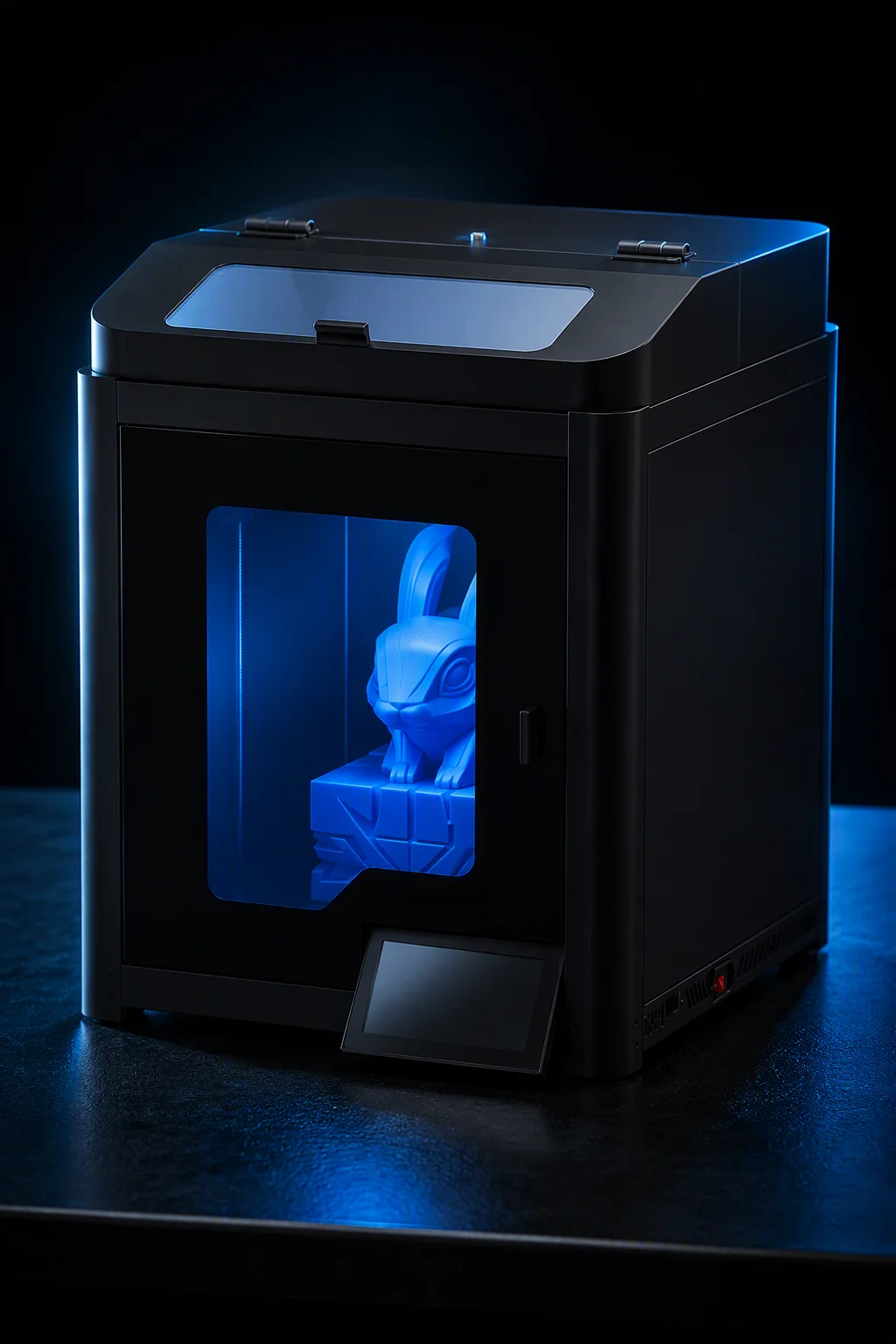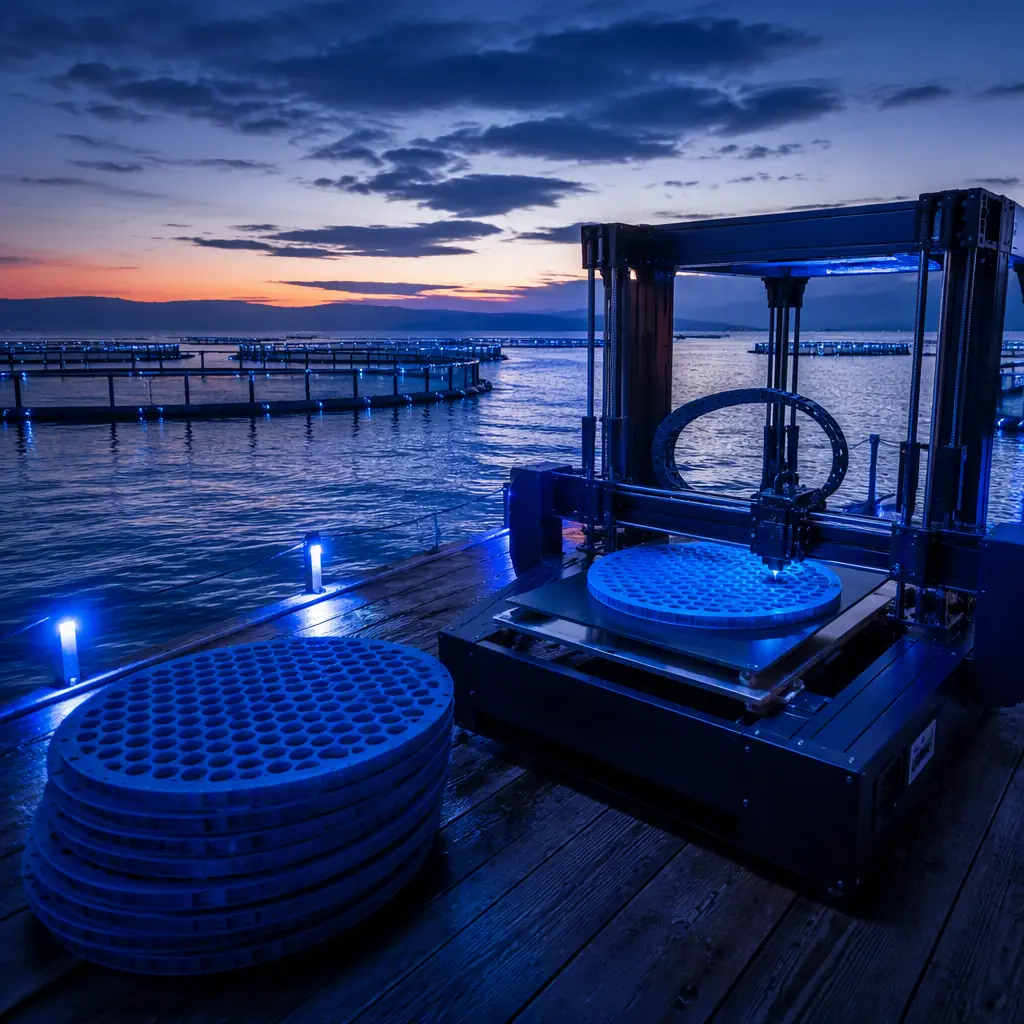
A tilapia farm in Thailand was replacing imported aeration diffuser plates every 5-6 weeks at $140-260 each, plus 3-4 weeks of shipping lead time per order. It bought a large-format FDM printer and a spool of polypropylene filament: each printed diffuser plate now costs $18-35, is replaced in 2-3 days, and the farm's pond-oxygen levels improved because the farm could iterate on hole geometry instead of accepting the OEM design. Aquaculture — fish, shrimp, and shellfish farming — is one of the fastest-growing food-production sectors on earth, and nearly all of its equipment lives in saltwater or humid freshwater environments where standard parts corrode, wear, and fail on schedule. For distributors, it is a replacement-parts market with a permanent consumable stream: every pond, tank, and hatchery tray generates recurring print work.
Why Aquaculture Is a Structural 3D Printing Buyer
Three facts make aquaculture operations exceptional customers. First, corrosion economics: saltwater destroys metal components and degrades standard plastics, so farms replace parts on a predictable cycle — and a printed nylon or PP part often outlasts the OEM part it replaces. Second, remote location logistics: farms are deliberately far from cities and suppliers, so a 3-4 week imported part lead time becomes 2-3 days on a local printer — the single most compelling pitch in this vertical. Third, marginal-cost farming: aquaculture runs on thin margins per kilogram of fish, so farm owners are unusually price-sensitive and unusually receptive to a $20 printed part that replaces a $200 imported one. The environmental-material logic for marine-adjacent settings is covered in our outdoor & weather-resistant printing guide.
The Applications That Actually Buy
Five clusters generate repeat orders. The buyers are farm owners, hatchery managers, aquaculture equipment suppliers, and fisheries research stations.
1. Aeration diffusers and venturi components. The flagship application. Diffuser plates, air-stone housings, venturi injectors, and fine-bubble aeration discs wear out on a 4-8 week cycle in hard water. Printed PP and nylon versions cost a fraction of imports and can be optimized per pond depth and oxygen demand. The material durability logic for submerged parts is documented in our polypropylene filament guide.
2. Feed system components. Auger flights, feed-dispenser cones, sensor mounts, and anti-bridging inserts for automatic feeders. Feeders run 24/7 during grow-out, so wear parts are a permanent consumable stream. Nylon and glass-filled filaments dominate here — the toughness requirements are covered in our nylon filament guide.
3. Water monitoring and aeration mounts. Brackets, floats, probe guards, and mount adapters for dissolved-oxygen sensors, pH probes, and temperature loggers. Every farm retrofits monitoring hardware, and every retrofit needs custom mounting — a low-cost, high-frequency application that wins the farm manager's trust.
4. Hatchery and nursery hardware. Egg-incubation trays, larval rearing cones, grading bars, and tank fittings. Hatcheries are precision environments where custom geometry matters and batch sizes are small — exactly what additive manufacturing does best. The dimensional accuracy requirements are covered in our tolerances & dimensional accuracy guide.
5. On-site tooling and repair parts. Pump impeller replacements, valve handles, guard covers, and jigs for net repair. Farms are remote and self-sufficient by necessity; a printer turns the farm workshop into a parts depot. The tooling and end-use part discipline is detailed in our manufacturing tooling guide.
Materials That Survive Saltwater and Sun
Aquaculture parts face the harshest combination in this guide: continuous submersion, UV exposure, and mechanical wear. The map distributors should stock:
Two traps: (1) saltwater is a solvent for many standard filaments — PLA degrades in weeks, so the material pitch must lead with PP/nylon/ASA, not entry-level PLA; (2) food-contact caution matters for grow-out ponds — parts that contact water holding fish should be printed in food-safe grades and documented, especially where the farm sells to export markets with traceability audits. The documentation expectations of regulated food buyers are covered in our food-safe 3D printing regulatory guide.
Economics: Imported OEM Parts vs Printed Replacements
The comparison that closes aquaculture accounts:
The distributor math is attractive because the purchase is systemic: once a farm validates a printed-replacement workflow, every future failure flows through the same printer, filament, and service supply. A mid-size farm with 40 ponds can consume $4,000-12,000/year in replacement parts, filament, and service — before counting the printer itself. For building this ROI case, use our TCO/ROI calculator guide.
The Distributor Playbook: Entering Aquaculture
The winning playbook has five moves:
1. Anchor on replacement parts, not new equipment. Farms already own pumps, feeders, and aerators; the pitch is "never wait for an import again." Win the diffuser-and-auger replacement workflow first; monitoring hardware becomes the expansion.
2. Lead with lead-time math. The killer argument is not cost — it is the 3-4 week imported lead time collapsing to 2-3 days. Show a side-by-side timeline in every pitch, and stock the two or three most common replacement files ready to print.
3. Partner with equipment suppliers. Aquaculture equipment dealers have the farm relationships but no print capability. A distributor offering print-on-demand for their spare-parts catalog (dealer sends a part, distributor prints and ships in 48 hours) turns a printer sale into a recurring service line. The service economics are developed in our after-sales support strategy.
4. Sell the consumable contract. PP, nylon, and ASA filament are the true margin engine — a farm running 10-20 replacement parts per month consumes 8-15 kg of engineering filament monthly. Bundle a filament subscription with the printer to lock the account.
5. Build a farm-proof case study library. Every replacement part is a documented saving: part name, OEM price, printed price, days saved. Publish one per quarter with the farm's name and real numbers — aquaculture is a tight community where one validated farm recruits the next.
Common Pitfalls in Aquaculture Accounts
Five mistakes account for most failed aquaculture initiatives: (1) selling PLA into a saltwater environment — it degrades in weeks and destroys trust; (2) ignoring the file bottleneck — farms are not CAD shops, so a distributor must offer reverse-engineering or a parts library, not just a printer; (3) underestimating UV — exposed parts in tropical sun need ASA or coated nylon, not standard filament; (4) underselling the service model — the printer is the foot in the door, but filament contracts and print-on-demand are where margin compounds; and (5) skipping food-contact documentation — export-market farms will not touch undocumented parts for grow-out water. The discipline of documenting measurable outcomes mirrors what we teach for end-use parts in our end-use functional parts guide.
Getting Started: The First 90 Days
A 90-day entry plan: Month 1 — stock PP, nylon, glass-filled nylon, and ASA filament with a reverse-engineering partner, and identify 10-15 target accounts (tilapia and shrimp farms, hatcheries, aquaculture equipment dealers) within a 4-hour drive. Month 2 — run two pilot replacement-part projects at cost-plus-10% to build durability evidence and a photo library; document part lifetime vs the OEM original. Month 3 — convert pilots to full accounts with filament subscriptions, publish your first co-branded case study with measured numbers ("aeration plate: $220 imported → $30 printed, 8-week service life"), and exhibit at a regional aquaculture trade show. If you already serve marine or agricultural accounts, our marine & boating guide and agriculture & hydroponics guide show how the same corrosion-resistance and remote-site sales logic transfers directly to aquaculture.
Reviewed by the Precise3D engineering & OEM team. Compliance files that accompany the catalog are auditable at the certification register.
Enter the Aquaculture Market
Ready to Supply Fish Farms & Hatcheries?
Get wholesale pricing on large-format FDM printers, saltwater-safe PP/nylon/ASA filament lines, and the replacement-parts service playbook that wins aquaculture accounts.