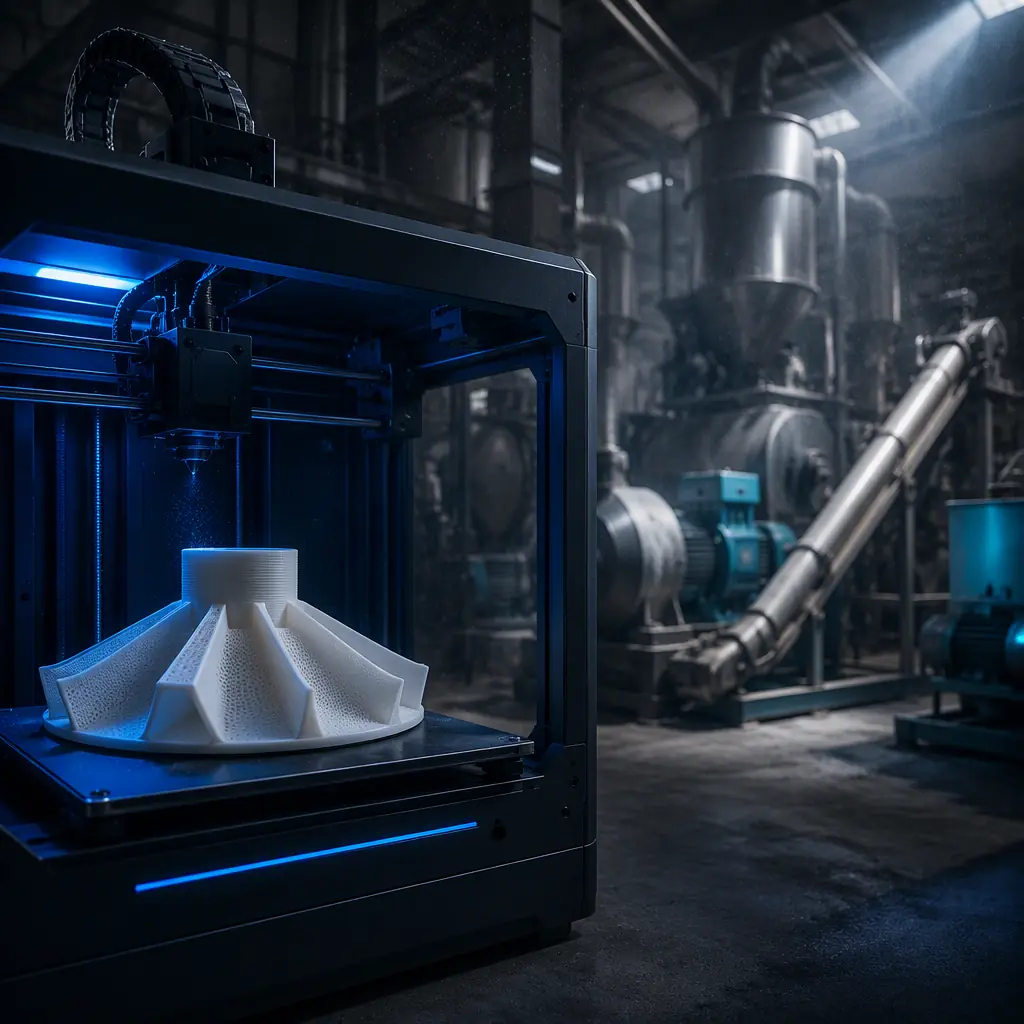
The Animal Feed & Feed Mill Aftermarket
Feed milling creates a distinct parts problem. A medium-size feed mill runs a network of hammer mills, mixers, pellet mills, conditioners, screw conveyors, bucket elevators, and bagging stations that handle hundreds of tonnes of abrasive feed ingredients every day. Corn, soymeal, mineral premix and molasses carry dust, fibre and varying moisture that shred polymer surfaces and accelerate steel wear. The result is constant, predictable wear that plant managers budget for. Yet the OEM channel is slow, expensive and frequently discontinued. This combination, high wear, zero tolerance for downtime, and a fragmented spare-parts market, is precisely where a 3D printing distributor thrives.
The feed-safety angle is a strong opener too. For a deep dive on what materials are genuinely safe for food- and feed-contact surfaces and how the regulatory picture works, see our food-safe 3D printing regulatory guide . Feed millers respond well to a supplier who can speak their compliance and hygiene language.
Pellet Mill Die & Conditioning Components
The pellet mill and its conditioner are the highest-value parts targets in a feed mill. The classic parts are conditioner paddle blades, die-corner guards and fillers, roll-shell alignment shims, anti-bridging knives, and spout/hopper deflectors. Many of these are metal or filled-polymer originals that a good engineering polymer, rigid TPU, PA-CF, or a UHMWPE-compatible HDPE, can complement or outperform, especially where the part must flex, resist abrasive mash, or run food-safe and low-friction.
More importantly, a large share of feed-mill consumables are plastic anyway: pellet-mill spout liners, conditioner paddle tips, die-corner protectors, and magnet/dust guards. These are the low-volume, high-value spares you sell on a repeat basis. For the abrasion-resistant material science that keeps these parts alive, our pumps & valves guide and our nylon PA filament guide cover wear resistance in abrasive particulate service.
Screw Conveyor & Mixer Wear Parts
Screw conveyors and mixers carry mash from stage to stage, generating a near-constant stream of replaceable parts. The winners are screw-conveyor flight segments, trough liners and wear strips, hanger bearings, end-flange seals, and paddle/mixer tipping blades. Because these are frequently UHMWPE or filled-nylon originals, they print exceptionally well and last comparably; the volume is what matters, a single feed mill may run 10–25 conveyors and 3–8 mixers, each needing periodic wear-strip and blade replacement. For the wider bulk/material-handling application, see our warehouse automation & material handling guide.
Bagging Scale & Packaging Spares
Bagging and packaging is the precision element of the vertical. Bagging-spout inserts, clamp/seal pads, gravity-feed gate liners, weigh-hopper deflectors and valve-bag fill spouts are high-wear parts operators replace on a set schedule. Printed versions in rigid TPU or food-safe PETG can outlast the rubber or metal originals because the polymer resists feed dust and fat without tearing. The challenge is dimensional accuracy. A bagging spout that does not seat correctly causes spills and wasted bags. This is where a distributor who can hold tolerance and document it earns the account. For the wider high-wear parts story in process equipment, our packaging industry guide is the relevant read.
What you're looking for: Abrasion → filled nylon or rigid TPU; impact/flex → PC or PA-CF; moisture + fat → PP or HDPE-compatible; and match or exceed the original's durometer and dimensional tolerance.
Dust Collection & Pneumatic Conveying Parts
Every feed mill runs a pneumatic conveying and dust-collection system. Filter-housing gasket rings, rotary-airlock blades, cyclone liner sections, blast-valve diaphragms and diverter-valve flaps are high-consumption parts bought on a standing schedule. Printed versions in TPU or food-safe PETG handle the flexing and dust load well, and they are far cheaper than the OEM injection-moulded spare with a 6-week lead time. Because many of these contact the feed or exhaust stream, the food-safe compliance question from our food-safe printing guide applies directly.
Materials: Food-Safe, Abrasion-Resistant & Tough
This vertical teaches you to think like a materials and compliance engineer. The parts sit in a hostile soup of feed dust, mineral grit, moisture and fat, and any part touching the feed stream may be a feed-contact surface. Build the recommendation matrix: food-safe PETG or PP for anything touching feed; PA-CF (carbon with no brand) for stiff wear parts and structural guides; rigid TPU for anything that must flex, seal, or take a hit; PC for impact and heat; and UHMWPE-compatible HDPE for classic low-friction wear strips. See our food-safe printing guide, our polypropylene filament guide, and our carbon-fibre filled filament guide for the material specifics.
Distributor Economics: High-Cadence Recurring Spares
Unlike consumer printer sales, feed milling is a pure aftermarket, recurring-revenue vertical. The hardware sale opens the relationship; the parts orders are the business. A single feed-mill account can generate $5,000–14,000/year in printed spares once you are trusted. Because wear parts are replaced on a maintenance calendar, not once. The cadence is monthly-to-quarterly, and the margin is excellent: you set the part price, often at 40–60% off the OEM spare, and your material cost is a fraction of it. That means distributor gross margins of 55–72% on printed parts.
The entry plan:
(1) Run a chamber-heated printer with a hardened nozzle for filled materials, and a food-safe rigid-TPU / PETG dual-material setup. (2) Print a demo kit of the fastest-moving spares. A conditioner paddle, a bagging-spout insert, a conveyor flight segment, a dust-filter gasket. (3) Approach local feed mills, integrators, and their MRO resellers. (4) Lead with time-to-part (48-hour turnaround vs. 3–6 weeks) and the fact that a stopped mill line costs the plant far more than the part. Production managers close fast on uptime and on feed-safety paperwork. For positioning a distributor business around a recurring parts model, our after-sales support strategy and our consumables & accessories bundling guide are the relevant reads.
Feed milling is quiet, technical, and remarkably sticky, once a plant validates a printed part and its food-safe material, it orders the same part on schedule for years, and it won't switch. The competitive barrier is almost nil because no one else in your territory has bothered to earn the trust. At Precise3D, our chamber-heated, hardened-nozzle FDM platform with food-safe, carbon-fibre, rigid-TPU and PC material compatibility is built for precisely this: tough, compliant parts that keep the line running, delivered on a 48-hour turnaround. Because in feed milling, the part isn’t the product, uptime and feed safety are.
Reviewed by the Precise3D engineering & OEM team. Compliance files that accompany the catalog are auditable at the certification register.
Enter the Feed Mill Vertical
Ready to Supply Fast-Turnaround Spares to Feed Mills & Animal-Feed Producers?
Join our network of global distributor network. Chamber-heated, hardened-nozzle printers with food-safe, carbon-fibre, rigid-TPU and PC capability, plus a demo kit of the fastest-moving mill spares, everything you need to open the high-cadence feed-mill aftermarket.