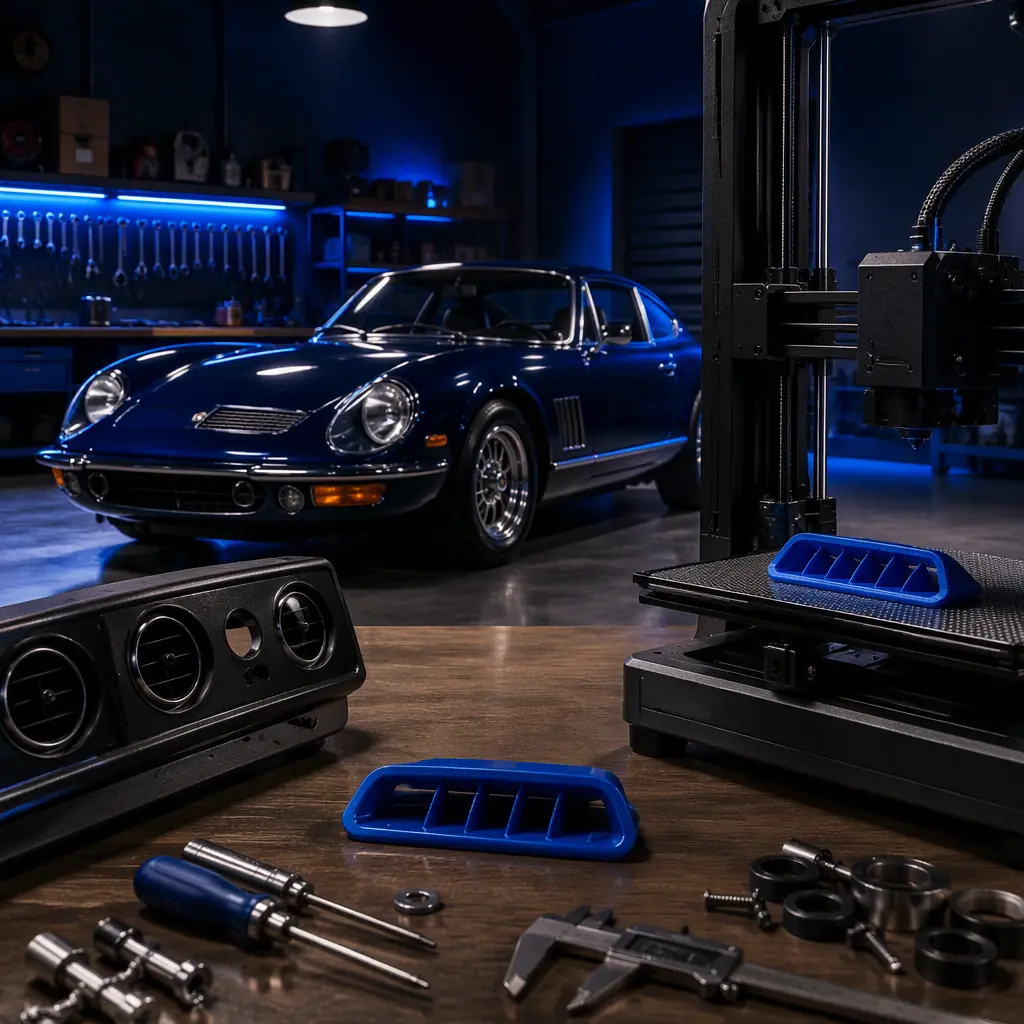
A restoration shop in Arizona needed a dash vent louver for a 1972 Datsun 240Z. A part that had been out of production for 40 years. The only OEM example found online was listed at $380 with cracked mounting tabs. The shop scanned a good example from a customer's car, printed a reinforced PA12 replacement in two days for $14 in material, and charged the customer $160. The customer was delighted, the shop made margin, and the scan now lives in the shop's digital parts library for the next 240Z that rolls in. Classic car restoration is the purest print-on-demand market in the automotive world: the parts are low-volume, the OEM supply is gone, and the buyers are emotionally committed to the vehicle.
The NLA Parts Problem
Every classic car has a list of NLA (no-longer-available) parts: trim clips, vent louvers, switch bezels, sun visor brackets, door handles, emblem bases, duct hoses, and interior trim pieces that the OEM discontinued decades ago. The aftermarket covers the high-volume items (brake parts, gaskets, reproduction sheet metal) but ignores the low-volume plastic bits. Exactly the parts that are cheap to print and absurdly expensive to find. A 1965 Mustang dash pad retainer that cost $2 in 1965 sells for $60-120 today on parts forums. A printed replacement costs $3-8 in material. The economics are compelling at both ends of the market: the restorer saves 70-90% versus sourcing an original, and the distributor earns 50-70% margin on a part that took two hours to model and print.
The scale of the opportunity: the classic car community spans tens of millions of vehicles worldwide, and a single popular model (think Mustang, Corvette, 911, Mini, Beetle, Land Rover) has hundreds of NLA plastic parts per vehicle. A specialist shop serving one model can build a library of 500-2,000 printable parts. For the broader aftermarket opportunity in end-use parts, see our end-use functional parts guide.
The Five Highest-Demand Printed Categories
Focus the catalog on five categories that dominate restoration demand:
1. Trim clips and fasteners. The single highest-volume category: every restoration needs dozens of clips (door panel clips, bumper trim clips, headliner retainers). Printed in PA or ASA, they cost $0.50-2 each versus $3-15 for NOS (new old stock) examples, and a shop burns through 50-200 per restoration.
2. Interior trim and bezels. Vent louvers, switch bezels, speaker grilles, ashtray doors, and dash inserts. These are visible parts, so print quality and finish matter, resin printing or vapor-smoothed FDM produces the smooth surface restorers expect. For the finishing techniques, see our post-processing guide.
3. Under-hood and engine bay parts. Fluid caps, hose brackets, cable clips, relay covers, fuse box lids. Engine bay heat and vibration demand engineering materials, see the material section below.
4. Exterior trim and emblems. Grille sections, badge bases, mirror housings, and trim strips. UV exposure and weather resistance are critical here; ASA or PA with UV-stabilized grades is the baseline.
5. Hard-to-find small mechanical parts. Gear shift knobs, window crank handles, pedal pads, door striker spacers, and interior latch components. These often have no reproduction source at all. A printed part is the only option besides paying collector prices.
Material Selection: Matching the Part to the Environment
Restoration parts live in three environments, each with a material answer:
Two practical notes: (1) original parts were usually injection-molded ABS or nylon. Printed PA (nylon) or ASA are the closest modern equivalents for most applications; (2) visible interior parts benefit from resin printing or vapor smoothing, because restorers judge quality by surface finish. For the engineering material lineup, see our engineering filaments guide and our PEEK/PEI/PPSU guide for the extreme-duty cases.
The Scan-Print-Catalog Workflow
The profitable restoration workflow has three stages:
1. Scan. A good example of the part (from a customer's car, a parts donor, or a friendly restoration shop) is captured with a handheld 3D scanner, a 15-30 minute job for parts up to 30 cm. The scanner ecosystem is covered in our 3D scanner selection guide and the bundle strategy in our scanner + printer bundle guide.
2. Print. The scan is cleaned up and printed in the right material for the environment. Most shops run one FDM printer for functional parts (PA/ASA) and one resin printer for visible interior parts.
3. Catalog. Every part is added to a searchable digital library with photos, material, and pricing. The library is the business: a customer searches "240Z vent louver," finds the part, and orders a print. Catalog growth compounds: each restoration adds 20-50 new parts to the library.
The library economics: at 200 parts with a $40 average print-service price and 60% margin, the library generates $4,800 in annual margin per shop with essentially no ongoing material cost beyond filament. For the service pricing framework, see our pricing strategy guide.
Selling to Restorers and Specialist Shops
Three customer types buy restoration printing:
1. Restoration and body shops. They have the cars and the customers but rarely the scanning or printing capability. Sell them a printer + scanner bundle with a day of training, and they amortize it over 5-10 jobs. This is the same OEM-partner qualification dynamic described in our OEM partner guide . Adapted to small shops.
2. Independent restorers. Hobbyists restoring their own car buy print services first (via your library) and printers once they hit 10+ parts. They are price-sensitive but loyal, and they evangelize on forums, one good 240Z part post reaches thousands of owners.
3. Parts vendors and specialist suppliers. Reproduction parts dealers that currently machine or injection-mold low-volume parts can print them instead at 1/10th the tooling cost. Selling them a production printer with a material program converts them into recurring volume buyers. For the production workflow, see our print farm operations guide.
Common Pitfalls in the Restoration Vertical
Watch for five recurring failures: (1) printing under-hood parts in PLA or PETG, cabin temperatures and engine heat warp them within a season; match the material to the environment or the part fails publicly; (2) skipping the scan library, including each job that isn't cataloged is a job that must be rescanned for the next customer; (3) underselling print service, restorers compare against $380 NOS parts, so $40-160 for a printed part is easily justified; price for the value, not the material cost; (4) ignoring UV for exterior parts, non-UV-stabilized PA and ASA chalk and crack within a year of Florida sun; and (5) modeling without verifying fit, a part that doesn't fit is a returned part and a lost reputation; always print a test fit before finishing. For the QC discipline that keeps parts trustworthy, see our factory audit & QC checklist.
Getting Started: The First 90 Days
Month 1 . Assemble the restoration kit (one FDM printer for PA/ASA functional parts, one resin printer for visible trim, a handheld scanner, and a 5-material starter program), and partner with 2-3 local restoration or body shops. Month 2 . Build the first 50-part library from partner shop jobs; publish before/after case studies (\"240Z vent louver: $380 NOS vs $14 printed\"); start the model-specific forum presence. Month 3 . Launch the online parts library storefront, sign the first parts-vendor production account, and add ASA and PA12 UV-stabilized grades to the program. Restoration pairs naturally with the wider automotive aftermarket, see our automotive jigs & fixtures guide for the production-line side of the market.
Reviewed by the Precise3D engineering & OEM team. Compliance files that accompany the catalog are auditable at the certification register.
Enter the Restoration Vertical
Ready to Sell Printing to Classic Car Shops?
Get wholesale pricing on printers, handheld scanners, and PA/ASA/UV-stabilized material programs, plus the scan-print-catalog workflow that turns restorers into recurring accounts.