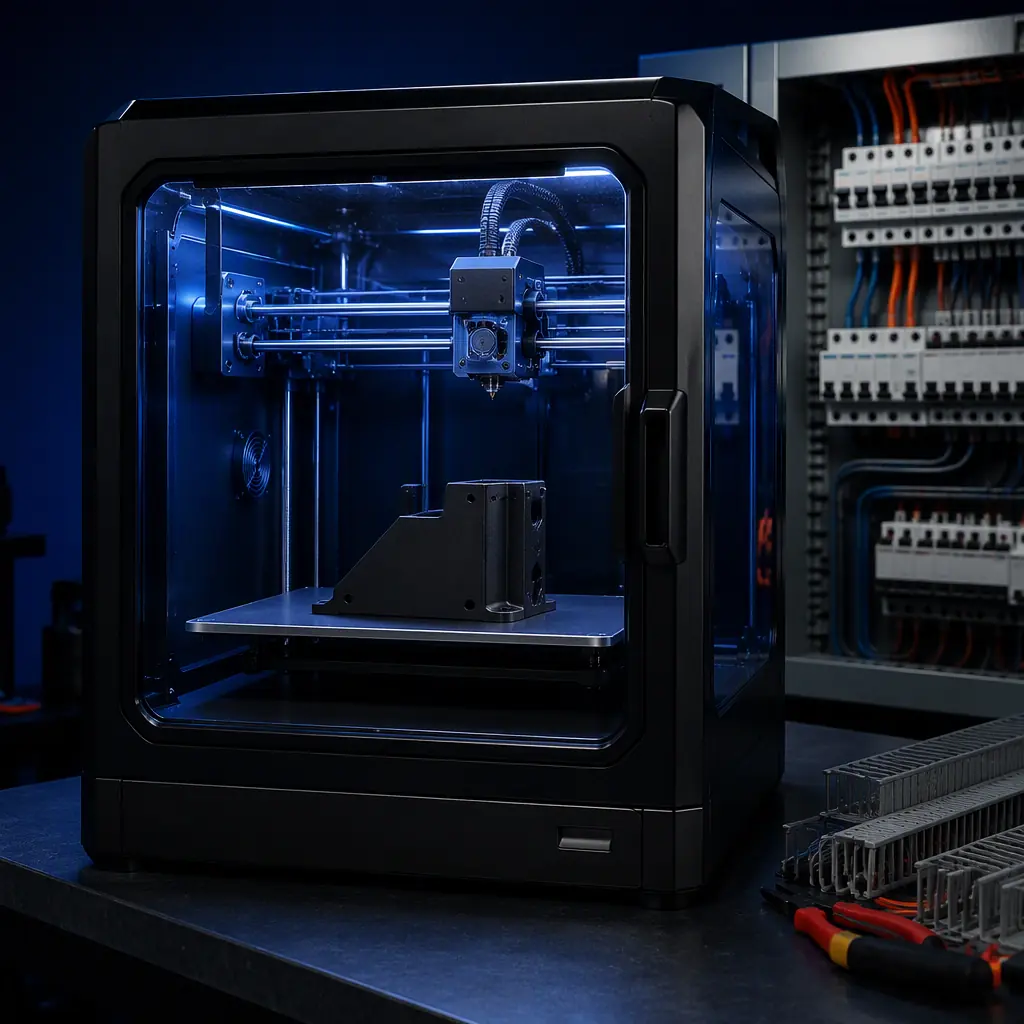
The electrical distribution and switchgear vertical spans industrial plant maintenance teams, electrical distributors and wholesalers, panel builders and control panel fabricators, utility MRO departments, data center facilities teams, electrical contractors, and switchgear OEM service divisions. Three structural facts drive the opportunity. First, the installed base is decades old: switchgear and distribution panels routinely run 25-40 years, and OEM support for a given breaker or panel line typically ends long before the hardware does. Second, safety culture demands documented materials: anything that goes near energized equipment must carry flame-retardant ratings, which separates this vertical from every hobbyist print job. And that separation is exactly why qualified distributors win. Third, the parts are small, simple and expensive: breaker handles, escutcheons, insulators, covers and gland plates are mostly non-current-carrying plastic parts that cost $20-200 OEM and $200-900 when only a retrofit kit exists. Every one of those gaps is a print job, and the economics are laid out in our TCO & ROI calculator guide.
Why Electrical Distribution Is Buying 3D Printing
Four forces are converting electrical businesses into printer buyers. First, the obsolescence crisis: breaker and panel OEMs consolidate lines constantly, and facilities with 10-30 year old gear routinely face parts that are "no longer manufactured", the aftermarket logic is covered in our spare parts & aftermarket revenue guide. Second, retrofit sticker shock: when an OEM does offer a path, it is often a $500-2,000 retrofit kit plus engineering review, versus a $10-60 printed part that preserves the existing installation. Third, panel builder margin pressure: panel shops build custom enclosures daily and pay $50-300 for drill templates, gland plates and cable management hardware that print for $5-30, the tooling economics are in our manufacturing tooling guide. Fourth, safety compliance drives documentation: arc flash studies require labeled, identifiable components; printed parts with documented material data sheets fit compliance workflows better than unlabeled salvaged parts. A mid-size industrial plant maintains 20-60 distribution panels and replaces dozens of plastic components per year; an electrical distributor serving 500 contractors can sell 300-800 printed parts a month at $8-60 each.
The Applications That Actually Buy
Six clusters generate the orders. The buyers are plant maintenance departments, electrical distributor counter staff, panel shop owners, utility MRO teams, and data center facilities engineers.
1. Legacy switchgear spare parts. The highest-value application: breaker handles, escutcheon plates, mechanical interlock links, door latches, handle mechanisms and indicator covers for discontinued molded-case and insulated-case breakers. Printed in UL 94 V-0 flame-retardant PA-CF or PETG, these restore function without re-engineering the panel, the flame-retardant material selection is in our engineering filaments guide. A breaker handle that costs $40-120 OEM (when available) or $300-900 as a retrofit kit prints at $8-25.
2. Busbar insulation, spacers & covers. Busbar insulators, phase separators, end caps, cover plates and wire barriers for low- and medium-voltage assemblies. Printed in flame-retardant PETG or PA-CF with documented CTI (comparative tracking index) values, these replace aged phenolic and epoxy parts, the electrical-grade material rules are in our filament stocking guide. An insulator that costs $15-60 OEM prints at $2-8 with a same-day turnaround.
3. Panel builder tooling & hardware. Drilling and punching templates, gland plate blanks, DIN rail end stops, terminal block bridges, wire duct dividers, cable entry grommets and labeling jigs for control panel fabrication. Printed in PETG or ABS, these cut build time on every panel, the jig-and-fixture logic is in our manufacturing tooling guide. A panel shop building 10-20 enclosures per month consumes dozens of these parts per build.
4. Arc flash & safety tooling. Insulated tool cradles, racking handle adapters, breaker test jumpers housings, lockout/tagout tag holders, danger label frames and hot-stick accessory mounts. Printed in flame-retardant materials with documented ratings, these support the safety workflow that utilities and data centers run daily, the safety-material discipline mirrors our printer safety features guide, applied to the customer's own equipment.
5. Metering, enclosure & control parts. Meter bezels, enclosure gland plates, junction box covers, pushbutton legend holders, selector switch skirts and control station replacement parts. These are cosmetic-to-moderate-stress parts with high documentation value, printed in ASA or flame-retardant PETG with a clean finish, using the workflow in our post-processing & finishing guide. A meter bezel that costs $25-80 OEM prints at $3-10.
6. Cable management & retrofit accessories. Custom cable tray clips, busway end caps, conduit adapters, surge protector mounting brackets and retrofit sensor mounts for energy monitoring retrofits. As facilities add metering and automation to legacy panels, the mounting hardware rarely exists off the shelf, the retrofit-fitting workflow connects to our enclosure modification & upgrade guide. Every energy retrofit is an excuse to print a dozen small parts.
Materials & Compliance Reality
Electrical parts live under one non-negotiable rule: the material must be documented. Five material families dominate:
Three compliance realities dominate. First, flame-retardant is a verified rating, not a label: confirm the UL 94 class (V-0 for most in-panel parts) and CTI value on the supplier's data sheet before quoting any part that sits inside or on an enclosure, the data sheet discipline is in our engineering filaments guide. Second, current-carrying parts are off limits: this vertical prints mechanical, insulating and cosmetic parts. Never conductive or arc-interrupting components; a distributor that understands this boundary is trusted, one that crosses it is gone. Third, documentation wins tenders: utilities and data centers buy on paperwork, material data sheets, print settings, revision notes and test records, so the workflow in our incoming QC & inspection guide is not overhead, it is the product.
From Broken Handle to Documented Spare: The Replacement Workflow
The workflow that wins electrical accounts has five stages, and compliance runs through every one. Assess . Confirm the part is mechanical, insulating or cosmetic (never current-carrying), identify the failure mode, and check whether a certified OEM path exists; if it does, quote that too and let the customer choose. Model . Scan the intact sibling part with a $300-800 handheld scanner in 15-30 minutes or model from calipers; for safety parts, keep a revision history of every model change, the scanner path is in our scanner & printer bundle guide. Print . Use flame-retardant material with documented ratings, print with verified settings, and keep the print log. Verify . Check dimensions against the original, test mechanical function (handle throw, interlock engagement) on a de-energized panel, and record the result, the verification checklist is in our incoming QC & inspection guide. Document and deliver . Hand over the part with its data sheet, print settings and verification record; that paperwork is what makes the part acceptable to a plant engineer or utility auditor. The full cycle, broken part to documented spare, runs 1-3 days versus 2-8 weeks for OEM or retrofit paths, and one qualified print service sustains 5-15 electrical part jobs per week.
Budget Reality: Printed vs OEM vs Retrofit
The comparison that opens electrical accounts:
The distributor math compounds because electrical parts are consumed by compliance cycles: panels are audited, retrofits are staged, and facilities standardize on documented spares. The recurring stream is the same margin engine as our accessories revenue guide, and the printer investment model that justifies the customer's own machines, and your demo fleet, is in our TCO & ROI calculator guide.
The Distributor Playbook: Entering Electrical Accounts
Five moves win electrical accounts:
1. Target the right segments. Panel builders are the fastest entry, they buy tooling and hardware every week and already understand documentation. Industrial plant maintenance teams are the second tier (highest-value, slowest cycle), and electrical distributors are the third, sell to them as a print-service supplier, not a competitor. Build a list of 40-80 accounts in your territory.
2. Lead with the compliance story, not the price. Walk in with flame-retardant sample parts, their data sheets and a printed verification record, the documentation is the differentiator. The consultative selling framework is in our B2B sales demo playbook.
3. Sell the obsolescence rescue service. Position printed parts as the answer to discontinued gear: "if it existed once and is no longer made, we can print a documented replacement." The service-revenue model is in our repair service center guide.
4. Demo with a real panel part. Ask a panel builder for their most-ordered custom part (gland plate, drill template, end stop), print it during the demo and deliver it documented. The pilot structure is in our B2B sales demo playbook.
5. Bundle the vertical material set. Flame-retardant PA-CF, flame-retardant PETG, ABS, ASA and TPU lines, plus a filament dryer, an enclosed printer and a scanner bundle, with margin in materials and consumables. The bundling mechanics are in our accessories revenue guide. The unifying rule: electrical buyers purchase certainty, documented materials, verified function, reproducible results, and the distributor who delivers paperwork with every part owns the account.
Common Pitfalls in Electrical Accounts
Five mistakes cost distributors electrical business: (1) printing current-carrying or arc-interrupting parts . This is the one unforgivable error; mechanical, insulating and cosmetic parts only, and the boundary must be stated in every proposal; (2) claiming flame-retardant without a data sheet . A verbal "it's flame retardant" is worthless in an audit; UL 94 class and CTI values must come from the supplier's printed documentation, with the data-sheet discipline in our engineering filaments guide; (3) skipping mechanical verification . A breaker handle that doesn't throw the mechanism fully is a safety hazard, not a quality issue; verify every interlock on a de-energized panel, using the checklist in our incoming QC guide; (4) ignoring dimensional accuracy . An insulator 0.5 mm oversize can reduce clearance below spec; verify critical dimensions against the original every time; and (5) treating utilities and data centers like small shops . Enterprise buyers need supplier qualification, documentation formats and revision control; the procurement discipline is in our B2B RFQ & proposal playbook. Two quieter mistakes compound these: under-pricing documented parts (the paperwork is half the value) and skipping the panel-builder segment because it feels small (they are the highest-frequency buyers in the vertical).
Getting Started: The First 90 Days
A 90-day entry plan: Month 1 . Identify 40-80 target accounts across panel builders, plant maintenance teams and electrical distributors; stock the vertical material set (flame-retardant PA-CF, flame-retardant PETG, ABS, ASA, TPU) plus a filament dryer, build plates and finishing consumables; and print a sample board of the 15 most-requested electrical parts (breaker handles, insulators, gland plates, end stops) with their data sheets attached. Stock one enclosed demo printer with a heated chamber, flame-retardant nylon parts warp without it, and the chamber case is in our heated chamber guide. Month 2 . Run two pilots: one panel builder (print 20-30 real parts across two weeks with documentation) and one industrial plant (replace three discontinued breaker or enclosure parts with verified, documented spares); document both in a service template. Month 3 . Convert the pilots into a documented-spares supply agreement, publish your first measured case study ("Plant: $900 discontinued breaker handle retrofit replaced by an $18 documented V-0 PA-CF print, verified and installed in 2 days"), and open one electrical distributor account as a print-service supplier. Throughout the quarter, log every part with panel/breaker model, material, data-sheet reference, cost and verification result, that log becomes your compliance library, your discontinued-parts catalog, and your proof for the next 40 accounts. The printer economics that justify the distributor's own fleet are in our TCO & ROI calculator guide.
Reviewed by the Precise3D engineering & OEM team. Compliance files that accompany the catalog are auditable at the certification register.
Enter the Electrical Distribution Market
Ready to Supply Electrical & Panel Professionals?
Get wholesale pricing on enclosed printers with heated chambers, flame-retardant PA-CF and PETG material lines, ABS, ASA and TPU, filament dryers, 3D scanners, and the documented-spares playbook that wins electrical accounts.