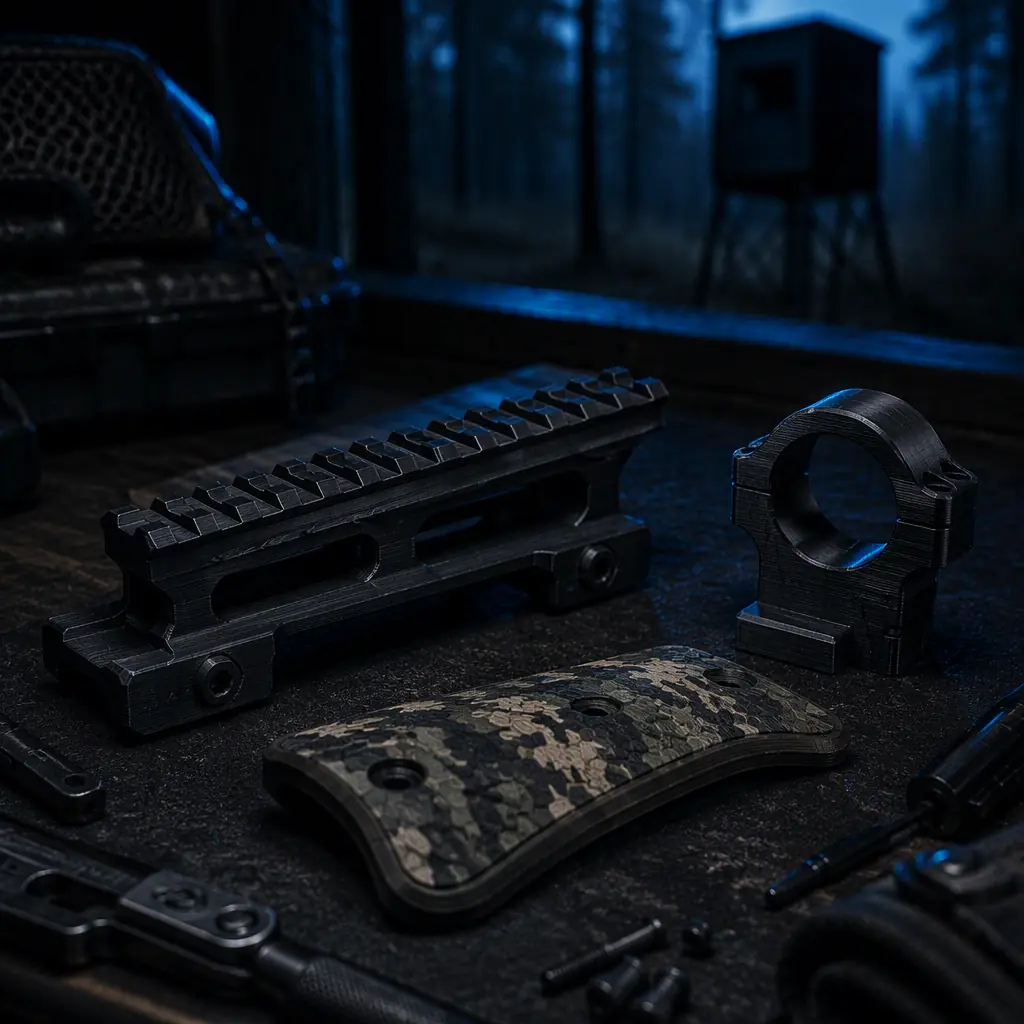
The Hunting & Outdoor Gear Market Opportunity
The outdoor recreation economy is a multi-hundred-billion-dollar market, and within it the hunting, shooting-sports and outdoor-gear segments are structurally perfect for additive manufacturing. Three traits define it: SKU velocity (brands release new camo patterns, new accessory fitments and new optics mounts every season), small batch economics (a mount or decoy might sell 500–5,000 units, far too few to justify an injection mould, but perfect for an FDM farm), and material demands (gear lives in the rain, mud, snow and heat, so impact resistance, UV stability and water resistance are non-negotiable).
For the broader gear-manufacturing picture, where the same tough-material and short-run logic applies, see our sports equipment manufacturing guide and our camping & outdoor recreation guide, which cover the durable-goods angle in depth.
Firearm Accessories & Optics Mounts
Firearm and optics accessories are one of the largest and most profitable segments of this vertical. The breadth of opportunity is enormous: optics and sight mounts (Picatinny and M-LOK rail accessories, scope rings, offset mounts, red-dot risers), sling and bipod adapters, cheek risers and buttstock spacers, rail covers and handstop, magazine followers and baseplates, and grip panels and foregrips. These are small, load-bearing, frequently-updated parts that are ideal for carbon-fibre-filled nylon.
The key technical requirement is dimensional stability and rail tolerance.
A Picatinny or M-LOK interface has a tight spec; a part that does not index properly is a reject. The answer is a carbon-fibre or glass-fibre-filled nylon (PA-CF / PA-GF) printed with a hardened nozzle, plus proper annealing to lock the dimensions. Our carbon-fibre-filled filament guide and our annealing heat-treatment guide cover exactly how to deliver that reliability. The secondary benefit: run-to-order means no dead inventory. A brand that test-markets a new mount in 300 units can scale to 3,000 with a printer farm without committing capital to an injection tool.
Bow, Crossbow & Archery Components
Archery is a smaller but fiercely loyal market. The parts are precision positioning components: arrow rest arms, sight and pin mounts, stabilizer adapters, bow-string dampeners, peep-sight housing, and release-aid jigs. Bow hunters also buy caller and decoy accessories. These are typically low-volume, high-value parts where a single archer will happily pay for a custom fitment. The same CF-nylon and PETG chemistry applies, and the ability to iterate quickly on a string-dampener profile based on real shooting data is a genuine competitive advantage for a brand that would otherwise wait 8 weeks on a mould.
Decoys, Blinds & Field Gear
Waterfowl and turkey decoys are a fascinating case study because they show the limits of what to not print. The decoy body itself, large, hollow, needs to look right at a distance and float, is usually better in roto-moulded HDPE. But the decoys’ motion, stand and accessory parts are a sweet spot for 3D printing: motion-motor housings, stake adapters, head-swivel joints, feather-televised action bases, and decoy-carrying rods. Blinds and field gear (seat straps, camo-clip grids, feeder units, camera mounts) also produce high-value rugged parts.
Because all this gear lives outdoors, material choice is a durability decision. UV-resistant PETG for outdoor exposure, TPU for anything that flexes, and PA-CF for load paths. Our weather-resistant outdoor printing guide is the definitive reference here, and our flexible filament guide covers the rubber-like joints and dampeners.
What you're looking for: UV-rated PETG for simply weather-exposed parts, PA-CF for anything load-bearing, TPU for flex and impact, and a recommend to anneal or tint for UV longevity.
Materials: CF-Nylon, Weather-Resistant & Flexibles
The material stack for this vertical is small and well-defined, which is good for a distributor who wants to stock a tight, capital-efficient product list. Carbon-fibre filled nylon (PA-CF): the workhorse for mounts, brackets, and structural accessories; high stiffness-to-weight, excellent dimensional stability, and a matte black finish customers like. PETG (UV-stable): for weather-exposed, non-structural parts; cheap, tough, easy to print, and available in camo-adjacent colours. TPU/TPE: for any joint, dampener, grip or flexible part. Polycarbonate (PC): for high-impact clear-adjacent optics covers. Our polycarbonate filament guide rounds out the family.
Compliance & "Firearm Parts", Know the Line
Because this vertical touches firearms, a distributor must be precise about what is and is not a regulated part. Accessories and mounts (rail, grips, optics, sling adapters, baseplates, stocks' cosmetic spacers) are generally not serialized firearm components and are treated as parts and accessories, but the line varies by jurisdiction, and the rules change. A part that affects the function of a firearm's action or safety may be regulated as a firearm component. The safe rule for a distributor: sell parts and accessories with a clear "not a firearm part" classification, do not sell anything that modifies the trigger, barrel, bolt, receiver or action, and keep documentation of the parts' intended use. If a customer asks you to print an action element or a suppressor component, decline. The commercial upside here is entirely in accessories, which is both the larger and the safer market.
This is also a business with export and marketing nuances, you are selling durability and fitment, not firepower. For the trust and liability framing that comes with selling into safety-adjacent and regulated sectors, see our distributor insurance & liability guide.
The Distributor Playbook: Entry & Margins
The outdoor-gear distributor model is high-velocity and relationship-driven. A single small brand that ships custom mounts and grips through 200–500 units per SKU will order 3–6 times per year, and the average order on an FDM farm can be $400–2,500 at 60–70% gross margin (because you set the part price, not an OEM catalog, and material cost is a fraction of that). The pattern to look for: a brand that is already selling 500–2,000 units of a printed part is a recurring account; a brand still prototyping on an external bureau is a hardware sale waiting to happen.
The entry plan:
(1) Run a printer with a hardened nozzle and a heated chamber for PA-CF, plus a two-material setup for PETG/TPU. (2) Print a demo board of the highest-demand parts, a Picatinny mount, a scope ring, a grip panel, a decoy motion base. (3) Target local shooting ranges, gun stores, outdoor retailers and the small brands they stock. (4) Lead with fitment and material toughness, and close on run-to-order inventory. The market rewards technicians who can prove dimensional accuracy (use a bore gauge or rail gauge demo) much faster than it rewards a sales pitch. To scale a farm that serves a batch-heavy customer like this profitably, see our print farm economics guide and our print-farm automation guide.
Hunting and outdoor gear is a durable, high-margin, low-competition vertical where the printer replaces tooling, not the product. Brands here are chronically short on capacity and quality parts suppliers, and they will pay for a distributor who can turn a 2-week mould wait into a 24-hour print. At Precise3D, our chamber-heated, hardened-nozzle FDM platform with open carbon-fibre and TPU material compatibility is built for exactly this: tough, weather-resistant, dimensionally accurate gear parts, produced run-to-order at a margin that makes the vertical worth owning.
Reviewed by the Precise3D engineering & OEM team. Compliance files that accompany the catalog are auditable at the certification register.
Enter the Gear Vertical
Ready to Supply Run-to-Order Parts to Hunting & Outdoor Gear Brands?
Join our network of global distributor network. Chamber-heated, hardened-nozzle printers with carbon-fibre, weather-resistant and TPU capability, plus a demo gate of the highest-demand gear parts, everything you need to open the outdoor-sports aftermarket.