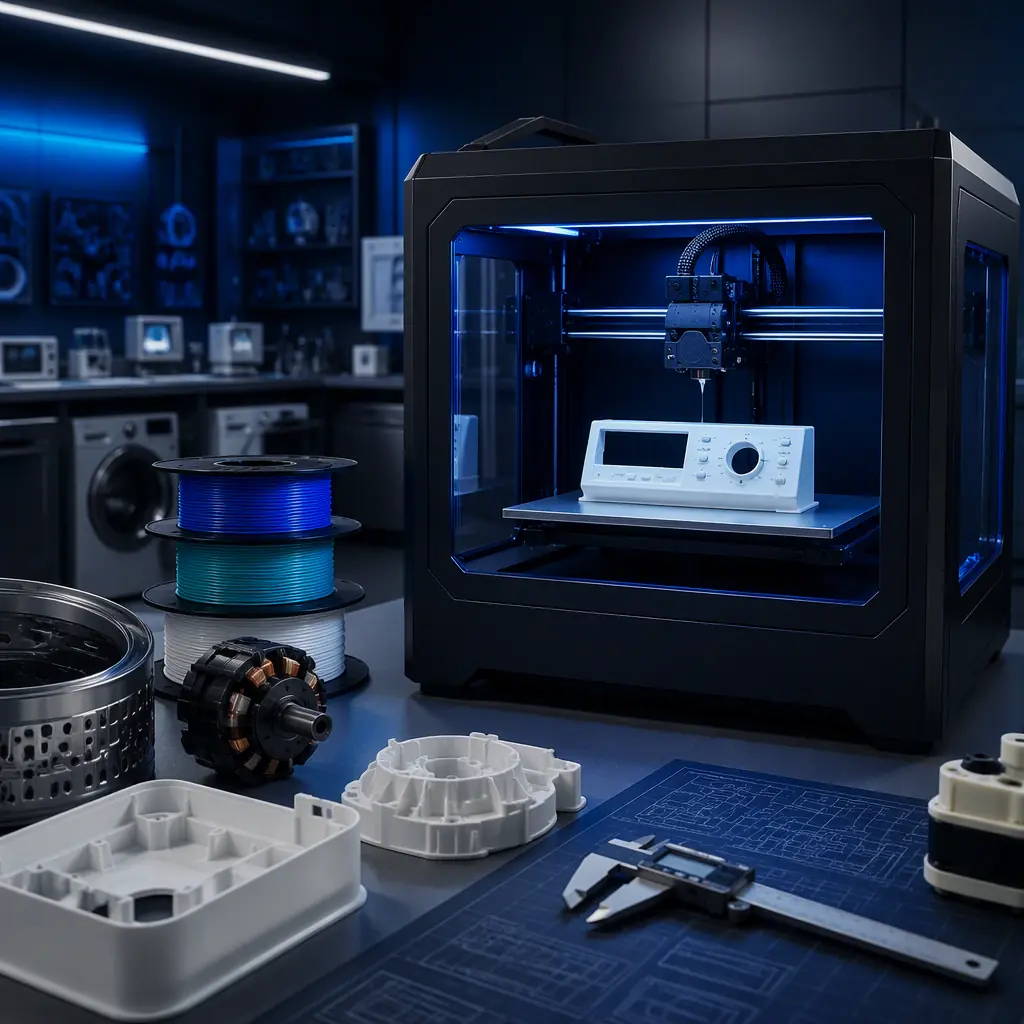
The home appliance industry splits into four segments with different buying patterns. Appliance OEMs (major appliances: refrigerators, washing machines, dishwashers, air conditioners) buy for design validation, custom housings, and assembly tooling across their R&D and manufacturing groups. Tier-1 component suppliers (motors, compressors, control boards, plastic subassemblies) buy for prototypes, jigs, and test fixtures that support the components they ship to OEMs. After-sales service networks buy for replacement parts: appliance brands are legally and commercially bound to support products for 7-10 years, and printed-on-demand service parts replace warehoused inventory. Small appliance brands (blenders, kettles, air fryers, vacuum cleaners) buy for fast product iteration and small-batch custom runs. Each segment is a repeatable account with a different entry application. For how these fit into a balanced portfolio, see our portfolio strategy guide.
The Appliance Customer Segments and Their Entry Applications
Appliance OEMs are the highest-volume segment: an R&D group validating a new washing machine design prints 20-60 prototype components per model, and every tooling iteration saved is direct cost. Tier-1 component suppliers are the fastest-close segment: their prototypes and test fixtures ride the OEM's product calendar, and a fixture printed in-house saves days of waiting on outsourced machining. After-sales service networks are the margin segment: a replacement knob, hinge, or control panel cover that cost $0.50-3 to print sells at $8-25 as a service part, and the 7-10 year support obligation guarantees demand for a decade. Small appliance brands are the agility segment: a blender brand that iterates a housing design weekly instead of monthly gets to market three times faster. For the sales methodology that opens these accounts, see our B2B sales demo playbook.
Appliance OEMs and after-sales service networks are the priority segments: OEMs buy on iteration volume and service networks buy on the 7-10 year support obligation. A service network that prints a replacement part for $1 instead of stocking it for $8 in warehouse cost recovers the printer in the first 200 parts. For the consumables bundling model that maximizes per-account revenue, see our consumables bundling guide.
The Appliance Application Stack: Housings, Tooling, and Service Parts
Appliance printing revenue clusters in four application groups. Design prototypes are the entry application: control panels, door handles, vent grilles, and internal brackets printed in days for design review and fit testing. Custom housings are the R&D application: low-volume enclosures and bespoke components for test rigs, pilot lines, and niche models that never justify injection tooling. Assembly tooling is the factory application: jigs, fixtures, press-fit aids, and QC gauges that save seconds per operation across a production line running 1,000+ units per day. Service parts are the recurring application: discontinued knobs, feet, hinges, and covers printed on demand instead of warehoused — the application that makes the appliance vertical uniquely sticky. For the tooling angle, see our manufacturing tooling guide; for the spare parts angle, see the spare parts aftermarket guide.
What you're listening for: The warehoused SKU count and the out-of-stock list are the ROI script. A brand supporting 3,000 service part SKUs is paying real money for shelf space on parts that may sell once a year — every one of those is a print-on-demand candidate. The second question is flame-retardant requirements: parts near electrical components need FR-rated material, which is a higher-margin consumable story.
Flame-Retardant Materials: The Appliance Consumables Story
The appliance material conversation is dominated by flame retardancy and heat resistance, and that is good news for the distributor: FR-rated and engineering materials carry higher margins than commodity filament. ABS is the workhorse — impact-resistant, paintable, and available in UL 94 V-0 flame-retardant grades for housings near electrical components. PC (polycarbonate) adds heat resistance for parts near motors and heating elements, with a glass-transition temperature around 147°C versus ABS's 105°C. PA-CF (carbon-fiber nylon) handles structural tooling: jigs and fixtures that see repeated force and abrasion on the assembly line. PETG covers the parts that need chemical resistance and toughness without the printing difficulty of ABS. For the full material lineup, see our engineering filaments guide, the polycarbonate filament guide, and the certification & compliance guide.
Flame retardancy is not a nice-to-have in appliances — it is a safety requirement. Housings and covers near electrical components are expected to meet UL 94 V-0 or equivalent, and the certification story is part of the sales conversation: the distributor who stocks certified FR-rated ABS and PC is selling compliance, not just plastic. The margin on FR-rated filament is 10-20 points higher than commodity PLA, which makes the appliance vertical one of the most profitable consumables stories in the portfolio. For the regulatory framework, see our regulatory compliance guide.
Printer Requirements for Appliance R&D and Factories
Appliance printing splits between the R&D lab and the factory floor. For R&D labs: enclosed 256 mm-class printers capable of ABS and PC — enclosure temperature control is non-negotiable for warp-prone PC and large ABS parts. For factory floors: larger build volumes (300×350 mm or bigger) for full-size control panels and door components, hardened nozzles for PA-CF, and the unattended reliability suite — thermal runaway protection, filament runout detection, power-loss recovery — because jigs and service parts are printed overnight between shifts. Flame-retardant material printing should happen in ventilated enclosures, and PC requires chamber temperatures of 60°C+ to avoid warping. For the complete selection criteria, see our build volume guide, the heated chamber guide, and the fume extraction & filtration guide.
Build volume in appliances splits into two tiers. Control panel housings, service parts, and jigs fit a 256 mm cube. Full-size components — a washing machine control panel, a refrigerator door handle assembly, an AC vent grille — need 300×350 mm or bigger, and a 300 mm-class printer handles both the largest housings and batches of small service parts per overnight run. The pilot application that opens an appliance account is almost always a service part or a jig for the factory's own line: zero risk, printable overnight, and demonstrably cheaper than the outsourced part or fixture it replaces. For the operational scaling picture, see our print farm operations guide.
The Distributor Go-to-Market Playbook for Appliances
Appliance procurement is engineering-led and obligation-driven, and the distributor playbook matches that rhythm. (1) Enter through the service parts door: the 7-10 year support obligation is a guaranteed demand story, and a printed-on-demand pilot for the five most out-of-stock SKUs is a low-risk entry that demonstrates savings in a month. (2) Sell the tooling math: "this CNC-machined fixture costs $800 and takes 2 weeks; this printed fixture costs $15 and takes 6 hours, and you can iterate the design tomorrow." (3) Move into R&D with housings and prototypes: once the factory is printing, the R&D group needs the same capability for design validation. (4) Build the FR-material line: certified flame-retardant ABS and PC at higher margins is the consumables layer that makes appliance accounts profitable. Sales cycles run 2-6 months, with the service-parts door closing fastest because the demand is already quantified. For the recurring revenue models that lock in appliance accounts, see our maintenance plans & extended warranty guide and the trade show strategy guide.
Recurring Revenue: Service Obligations Are a Demand Forecast
Appliance consumable revenue is the most forecastable in the portfolio because the demand is contractual. A service network supporting 3,000 SKUs prints 100-300 parts per month at $0.50-3 of material each — and the parts that sell justify the machine, while the parts that do not sell justify print-on-demand over warehousing. R&D groups consume ABS, PC, and PA-CF at 20-50 kg per month during development cycles. Add FR-rated filament at 15-25% higher margin, spare nozzles (PA-CF wears brass), and PEI build sheets, and an appliance account becomes a $2,000-8,000 monthly revenue stream at 45-60% gross margins. The switching cost is structural: once a service network has a qualified print profile for its SKU library, changing suppliers means re-qualifying every part and re-testing every material. For the market sizing and trend context, see our 2026 market trends report and the consumer electronics vertical guide.
Bottom Line
The home appliance industry is the most obligation-driven vertical in manufacturing, and that makes it the most predictable 3D printing customer. The 7-10 year service part obligation is a contractual demand forecast: every warehoused SKU that sells slowly is a print-on-demand candidate, and every discontinued part is a revenue stream, not a write-off. Appliance OEMs buy on iteration volume and tooling savings; service networks buy on the support obligation and are the fastest entry; both consume ABS, PC, and FR-rated materials on a schedule a distributor can forecast. A distributor with 10 appliance accounts averaging 3 printers each builds $60,000-150,000 in annual recurring consumable revenue at 45-60% margins — plus the hardware margin on large-format and heated-chamber machines. The distributor who puts a printer in the service parts operation and an FR-material line behind it will own the appliance aftermarket before the injection molders quote the job.
Reviewed by the Precise3D engineering & OEM team. Compliance files that accompany the catalog are auditable at the certification register.
Start Your Partnership
Ready to Bring home appliances industry to Your Market?
Start with the home appliances industry spec sheet, then validate every claim against the certification register.