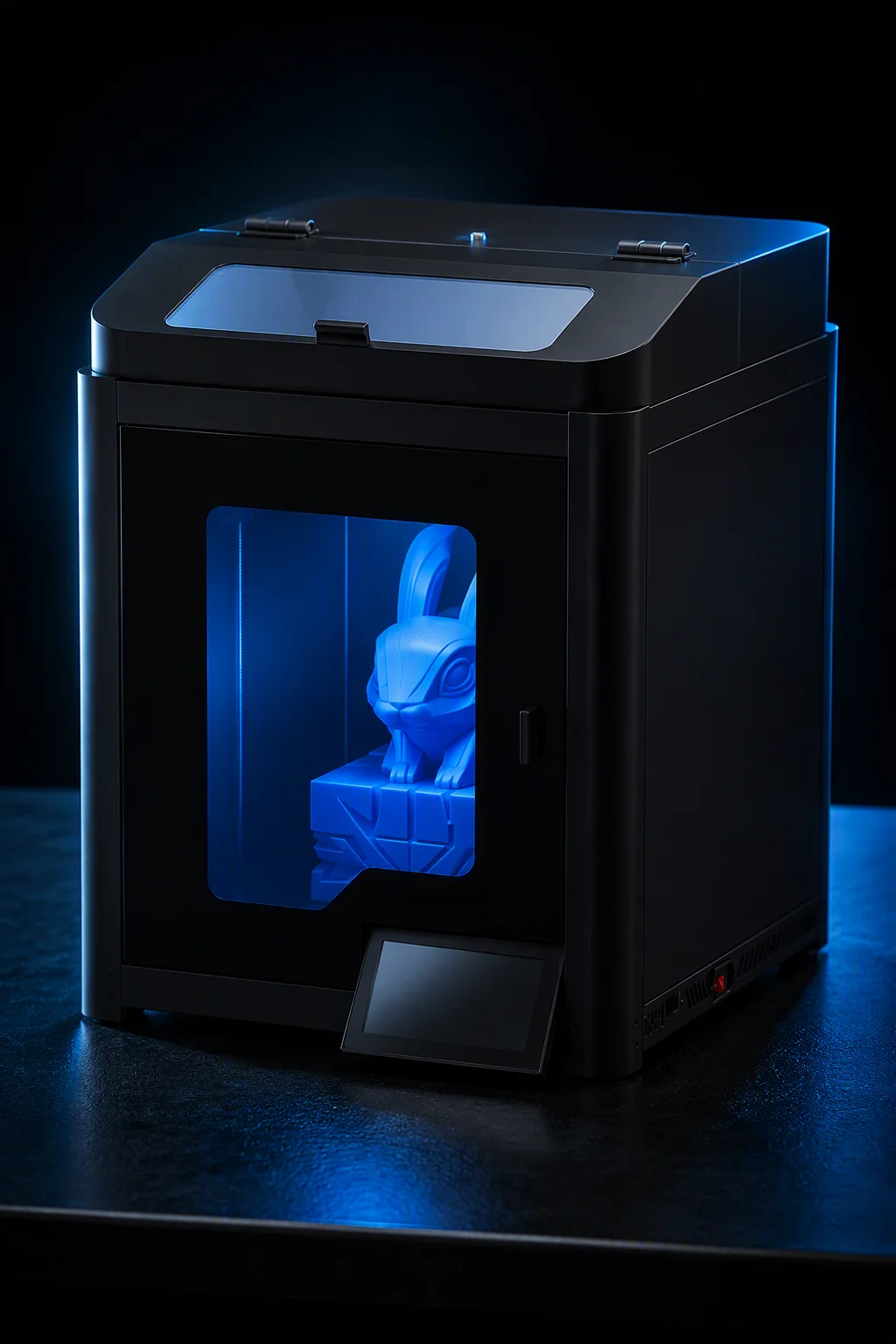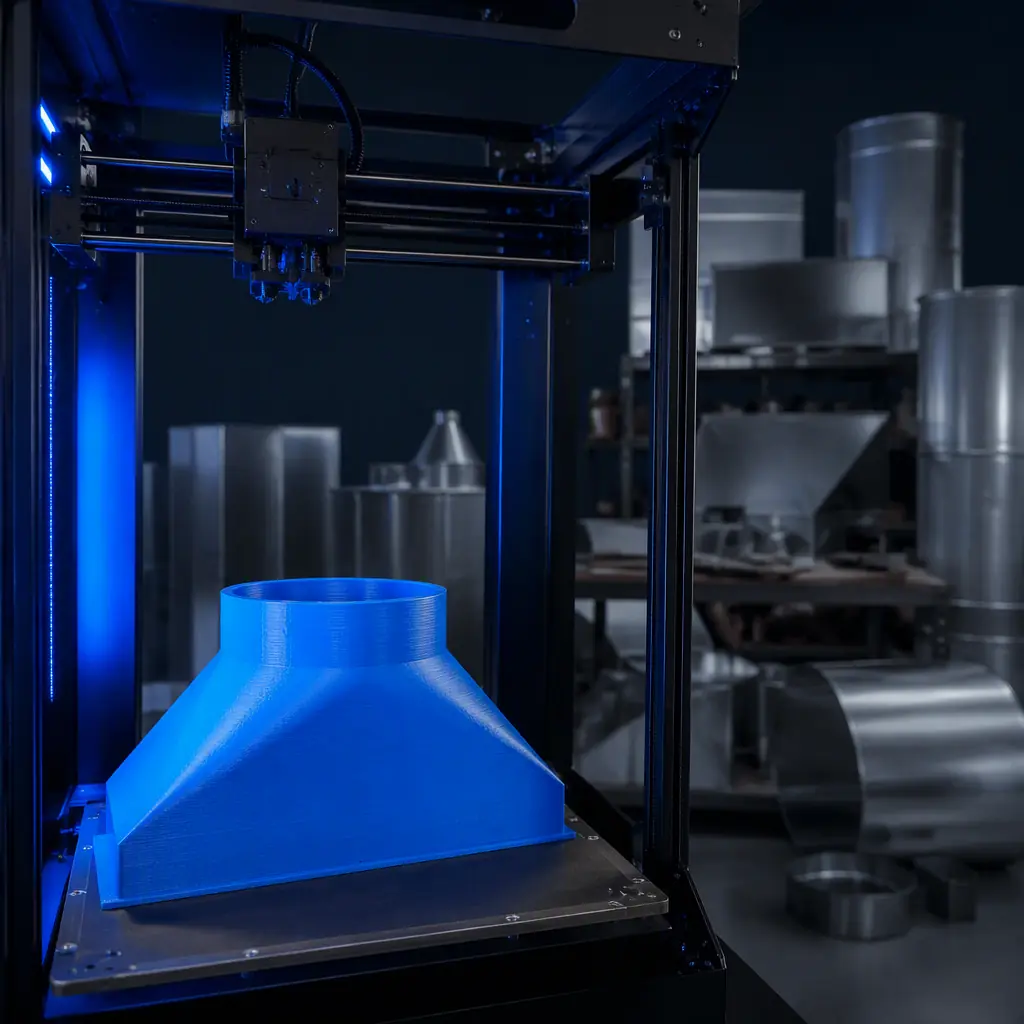
A commercial HVAC contractor in Texas keeps a Creality K2 Plus on a shelf in its sheet-metal shop. Last quarter it printed 47 custom duct transitions for a hospital retrofit: every one of them an odd angle or offset that the local metal fabricator quoted at $180-420 each with a 3-week lead time. The contractor's total material cost for 47 parts: $214 in ABS, average print time 9 hours, and the job closed a week early. That pattern, one-off, geometrically awkward, urgently needed, is why HVAC is one of the most dependable verticals for 3D printer distributors: the buying is recurring, the parts are hard to source, and the alternative (custom sheet metal) is slow and expensive.
Why HVAC Is a Recurring Buyer, Not a One-Off
HVAC is a maintenance-driven industry: the installed base of commercial HVAC equipment in the US alone is roughly 5.4 million rooftop units, and every one of them will need a damper actuator bracket, a sensor mount, or a control cover that the OEM no longer stocks within its 15-20 year service life. Three structural facts make the vertical attractive for distributors. First, urgency beats price: when a chiller is down, a $40 printed bracket beats a $12 part with a 6-week backorder. Second, custom geometry is the norm: ductwork is installed in real buildings with real obstacles, so transition pieces and offsets are almost never off-the-shelf. Third, the buyers are already technical: HVAC techs use CAD-based layout software daily, so the jump to printing replacement parts is shorter than in almost any other trade. For the general commercial pattern behind this, see our manufacturing tooling guide.
The Six Application Clusters That Buy
Do not pitch "3D printing" to an HVAC company, pitch these six specific applications, each with its own buyer and material:
1. Custom duct transitions and fittings. Offset transitions, odd-angle elbows, reducer adapters, and plenum takeoffs that sheet-metal shops quote slowly. ABS and ASA are the workhorses (heat deflection 95-100°C, UV-stable ASA for rooftop exposure). A mid-size contractor prints 10-30 of these per month.
2. Damper and actuator linkage. Couplers, crank arms, linkage rods, and actuator mounting brackets for pneumatically and electronically actuated dampers. These are high-wear, high-replacement parts. A single building automation job can consume 20-60 printed linkage parts. Print them in nylon or glass-filled PETG for strength. See our engineering filaments guide for the material comparison.
3. Service tooling. Drill guides for flue pipe, access-panel clips, coil-fin straightening tools, vacuum-formed service aids. Tools wear out and get lost, which makes them a self-renewing SKU.
4. Hard-to-source OEM replacement parts. Control board covers, thermostat housings, condensate trap bodies, fan blade spacers, and sight-glass retainers for equipment whose OEM parts are discontinued or backordered. This is the highest-margin cluster: a distributor can sell a $0.80 print for $25-60 because the alternative is a $400 minimum-order OEM part or a full component replacement.
5. Refrigeration-specific parts. Evaporator fan shrouds, defrost drain pans, door gasket retainers, and thermostat wells for walk-in coolers and display cases. These see cold, condensation, and occasional food contact, PP and PETG handle the environment. The food-safety regulatory context is covered in our food-safe printing guide.
6. Air-quality and filter hardware. Custom filter housings, MERV filter adapters, sensor mounting plates for IAQ monitors. The IAQ retrofit wave (schools, offices, healthcare) is generating steady custom-housing demand through 2027.
Materials That Survive the Mechanical Room
HVAC environments punish the wrong material: rooftop heat, condensation, UV, vibration, and occasional chemical exposure. The material map distributors should stock:
Two traps: (1) standard PLA is a disqualifier in this vertical. One rooftop-melted part ends the relationship, so never recommend it for anything structural; (2) flame-retardant grades (UL 94 V-0) are required for parts inside plenums or air-handling units in most US jurisdictions, which is exactly the certification territory covered in our certification & compliance guide.
Economics: Why Custom Sheet Metal Loses
The buying decision almost always comes down to comparing a printed part against a sheet-metal or machined quote. The numbers that close the sale:
For the distributor the math is even better: HVAC customers are price-insensitive to $25-60 printed parts because the alternative is downtime measured in days. And because the parts are printed on machines the distributor sold, every order reinforces the hardware investment. The TCO framework for proving this to a contractor is in our TCO/ROI calculator guide.
The Distributor Playbook: SKUs and Support Model
Based on HVAC accounts that convert, the winning playbook has five moves:
1. Sell an ASA/PETG starter kit, not a machine pitch. Bundle printer + 8 spools (3 ASA, 3 PETG, 1 nylon, 1 PP) + a parts library of 50 ready-to-print HVAC parts (linkage couplers, sensor mounts, vent covers). Time-to-first-print under one hour closes contractors who have no patience for onboarding. The bundling mechanics are covered in our consumables bundling strategy.
2. Target the service manager, not the owner. Service managers own the parts budget and the downtime pain; owners care about fleet-level ROI. A demo that prints a real damper coupler in 40 minutes, and hands it to the service manager, beats any slide deck.
3. Offer the "discontinued parts" rescue service. Position printing as the solution for OEM parts that no longer exist. Keep a growing library of scanned/reverse-engineered legacy parts; this becomes your moat and your recurring lead source.
4. Price on uptime, not on material. A printed part that keeps a chiller running is worth 10-20x its material cost. Coach dealers to price at 30-50% of the alternative's cost (including expedite fees), not at cost-plus.
5. Add an annual service contract. HVAC shops abuse machines, dusty environments, long unattended prints, impatient operators. A $600-1,200/year service plan (hotend kits, calibration, remote monitoring setup) attaches at high rates because uptime is the whole value proposition. The after-sales economics are detailed in our after-sales support strategy.
Common Pitfalls in the HVAC Vertical
Five mistakes account for most failed HVAC initiatives: (1) selling PLA for rooftop or plenum parts, one heat failure destroys credibility; (2) ignoring flame-retardant requirements for plenum-space parts, which can fail inspection and void insurance; (3) promising ductwork replacements for pressurized main runs, printed parts suit transitions, fittings, and low-pressure zones, not 2,000 CFM mains; (4) underestimating UV and moisture on rooftop parts, ASA or painted ABS only; and (5) skipping the parts library, contractors buy solutions, not machines, and a library is what turns a printer into a parts department. For the material science behind choosing the right engineering grade, review our PEEK/PEI/PPSU industrial materials guide.
Getting Started: The First 90 Days
A 90-day entry plan: Month 1 . Select two material lines (ASA and PETG), build the 50-part starter library, and identify 10 target accounts (commercial HVAC contractors, refrigeration service companies, building automation firms) in your region. Month 2 . Run two pilot accounts at cost-plus-10% to gather reference parts and failure stories; document one "downtime rescue" case study. Month 3 . Convert pilots to full contracts with service plans, publish the case study, and begin attending local ASHRAE chapter meetings where the service managers actually are. If you already sell into building trades, our architecture & construction guide shows how the same account strategy transfers across the construction vertical.
Reviewed by the Precise3D engineering & OEM team. Compliance files that accompany the catalog are auditable at the certification register.
Enter the HVAC Vertical
Ready to Build an HVAC Parts Line?
Get wholesale pricing on enclosed printers, ASA/PETG/nylon filament lines, and the 50-part HVAC starter library that turns a printer into a parts department for contractors.