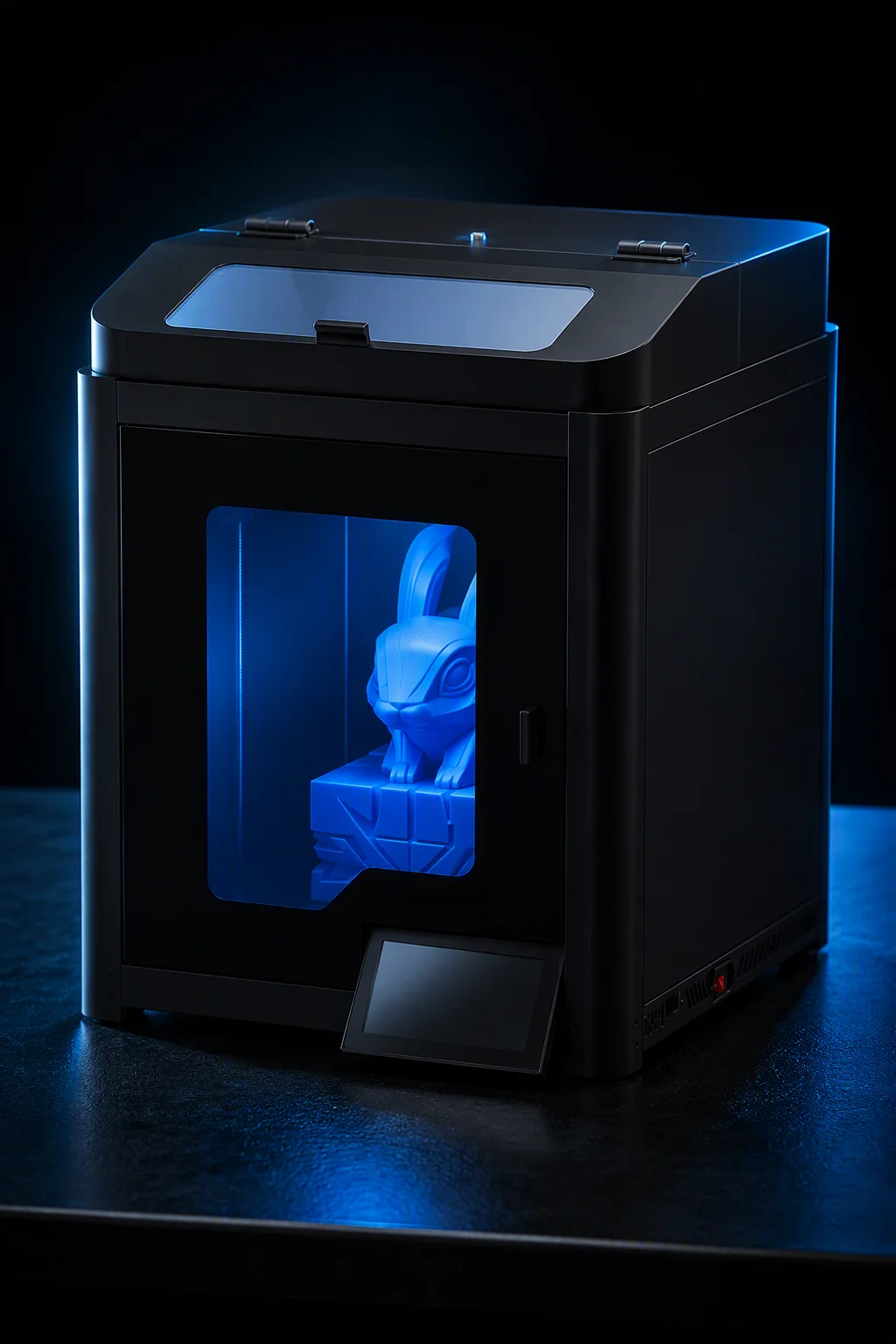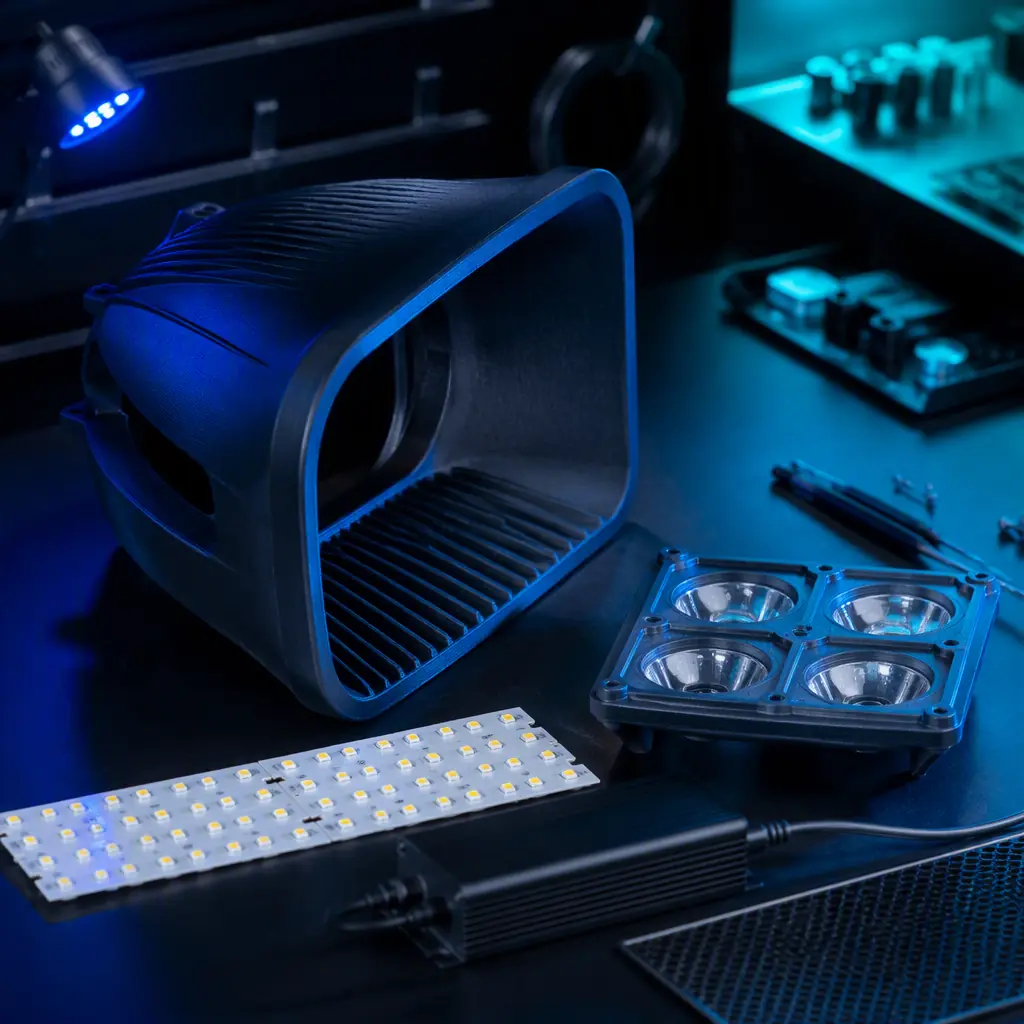
A luminaire manufacturer in the Netherlands specializing in architectural pendant lighting was spending $4,000-8,000 and 4-6 weeks per new fixture prototype with CNC and sheet-metal suppliers — and half of those prototypes never reached production. After adopting an in-house large-format FDM workflow, the studio now prints full-scale fixture bodies, optics holders, and driver housings in 2-3 days for $80-400 in material: design iterations dropped from two per month to five per week, and the studio cut time-to-market on a custom hospitality collection from 14 weeks to 5. Lighting is one of the most design-driven verticals in 3D printing — luminaire manufacturers release hundreds of new SKUs a year, architectural projects demand one-off custom fixtures, and LED thermal management drives geometry that only additive manufacturing can produce economically at low volume. For distributors, it is a prototyping-plus-production market where design speed, not part price, closes the sale.
Why Lighting & Luminaires Are Structural 3D Printing Buyers
Three facts make lighting customers exceptional. First, design velocity: a mid-size luminaire manufacturer launches 50-200 new fixtures per year, each requiring multiple design iterations before tooling — printed prototypes compress that cycle from weeks to days. Second, customization density: architectural, hospitality, and retail projects increasingly demand one-off or short-run fixtures that match a space, and printed housings make custom geometry economical at quantities of 1-100. Third, LED thermal geometry: LED drivers and COB modules need heat sinks, optics holders, and airflow channels with geometries that are expensive to cast or machine at low volume but cheap to print. The thermal and mechanical engineering requirements are covered in our engineering filaments guide.
The Applications That Actually Buy
Five clusters generate repeat orders. The buyers are luminaire design engineers, product managers, lighting design firms, and architectural specifiers.
1. Prototyping and design validation. The flagship application. Full-scale fixture bodies, diffuser housings, and mounting geometry printed for design review, photometric testing, and customer sign-off before tooling commitment. Printed prototypes are the fastest way to validate form, fit, and light distribution. The dimensional control for validated prototypes is covered in our tolerances & dimensional accuracy guide.
2. Optics holders and light-control components. Lens holders, reflector seats, baffles, louvers, and diffusion frames. These parts must hold optics in precise registration with the LED source, and printed tolerances of ±0.2-0.3 mm are sufficient for most optical assemblies. Heat-set inserts for driver mounting are covered in our heat-set inserts guide.
3. Heat sinks and thermal management. LED driver housings, heat-sink fins, airflow baffles, and passive cooling geometry. Aluminum is still the thermal champion, but printed polymer heat sinks with optimized fin geometry handle 5-15 W driver loads, and printed housings with integrated airflow channels solve convection problems that stamped housings cannot. The thermal design discipline is detailed in our data center cooling guide.
4. Custom and architectural fixtures. One-off pendants, wall sconces, retail display lighting, and hospitality fixtures designed to match a specific space. Architectural projects routinely specify 5-50 identical custom fixtures; printed housings make that quantity economical without tooling. The finishing options that make printed fixtures client-ready are covered in our post-processing & finishing guide.
5. Jigs, fixtures, and production tooling. Lens-press fixtures, driver test stands, photometric test mounts, and assembly guides for the luminaire production line. Custom tooling is one-off by nature — exactly what additive manufacturing does best. The tooling discipline is detailed in our manufacturing tooling guide.
Materials and Finish for Luminaire Production
Luminaire parts must satisfy both thermal demands and aesthetic expectations. The map distributors should stock:
Two traps: (1) electrical safety is non-negotiable — driver housings and mains-adjacent parts must use flame-rated material with a UL 94 V-0 data sheet, and luminaire manufacturers will not risk a UL/CE audit on a non-rated part; (2) surface finish is part of the product — clients judge fixtures visually, so printed surfaces need sanding, vapor smoothing, or paint for production units, not just prototypes. The finishing side of producing client-ready fixtures is covered in our post-processing & finishing guide.
Economics: CNC/Injection Prototyping vs Printed
The comparison that closes luminaire accounts:
The distributor math is attractive because the purchase is systemic: once a luminaire studio validates a printed prototyping-and-short-run workflow, every new product launch flows through the same printer, filament, and finishing supply. A mid-size manufacturer can consume $12,000-30,000/year in filament, finishing consumables, and printed production parts — before counting the printer itself. For building this ROI case, use our TCO/ROI calculator guide.
The Distributor Playbook: Entering Lighting & Luminaires
The winning playbook has five moves:
1. Anchor on design speed, not part price. The pitch is "five design iterations a week, not two a month" — cost savings are the confirmation, velocity is the decision. Lead with the time-to-market math in every presentation.
2. Offer print-to-production service. Design studios do not want to run a print farm in-house. A distributor offering prototype-and-short-run service (studio sends CAD, distributor prints, finishes, and ships production-quality fixtures in 3-5 days) turns a printer sale into a recurring service line. The service economics are developed in our after-sales support strategy.
3. Speak certification language. Every production fixture must satisfy UL/CE and the customer's photometric requirements. Provide material data sheets, flame-rating documentation, and finish samples — the studio's own compliance culture becomes your sales collateral.
4. Stock the luminaire material set. UL 94 V-0 flame-rated line, PETG, ASA, and glass-filled nylon are the true margin engine, plus finishing consumables (primers, paints, vapor-smoothing fluids). A studio producing 20-40 printed fixtures per month consumes 10-20 kg of filament monthly; a filament-plus-finishing subscription locks the account.
5. Build the design-library flywheel. Every validated fixture geometry becomes an asset: build a catalog of print-tested luminaire components (with the customer's permission) and offer print-on-demand across the studio's entire product line. One validated studio recruits the next — lighting designers talk constantly at Lightfair, Euroluce, and regional design-industry events.
Common Pitfalls in Luminaire Accounts
Five mistakes account for most failed initiatives: (1) selling non-rated materials into mains-adjacent applications — driver housings without UL 94 rating are rejected by the studio's certification engineer; (2) ignoring finish quality — clients judge fixtures visually, so raw-layer surfaces must be finished before delivery; (3) underselling the thermal question — LED heat management is real, so thermal design support and heat-resistant materials must be part of the offering; (4) underselling the consumable model — the printer is the foot in the door, but filament contracts and finishing-supply retainers are where margin compounds; and (5) neglecting the design-iteration bottleneck — studios are not print shops, so a distributor must offer print-to-production service, not just a printer. The discipline of documenting measurable outcomes mirrors what we teach for end-use parts in our end-use functional parts guide.
Getting Started: The First 90 Days
A 90-day entry plan: Month 1 — stock UL 94 V-0 flame-rated filament, PETG, ASA, and glass-filled nylon with full data sheets, plus primers and finishing consumables, and identify 10-15 target accounts (luminaire manufacturers, lighting design firms, architectural specifiers, hospitality lighting suppliers) within a 3-hour drive. Month 2 — run two pilot prototype projects at cost-plus-10% to build documentation evidence and a finish-sample library; document iteration speed and certification acceptance. Month 3 — convert pilots to full accounts with filament-and-finishing subscriptions and print-to-production retainers, publish your first co-branded case study with measured numbers ("fixture prototype: $6,000 CNC → $250 printed, 3-day turnaround, UL-reviewed"), and exhibit at a regional lighting or design-industry event. If you already serve consumer electronics or hospitality accounts, our consumer electronics guide and hospitality & retail fixtures guide show how the same prototyping-plus-short-run logic transfers directly to luminaire and architectural lighting.
Reviewed by the Precise3D engineering & OEM team. Compliance files that accompany the catalog are auditable at the certification register.
Enter the Lighting Market
Ready to Supply Luminaire Manufacturers?
Get wholesale pricing on large-format FDM printers, UL 94 V-0 flame-rated and engineering filament lines, and the print-to-production service playbook that wins lighting and luminaire accounts.