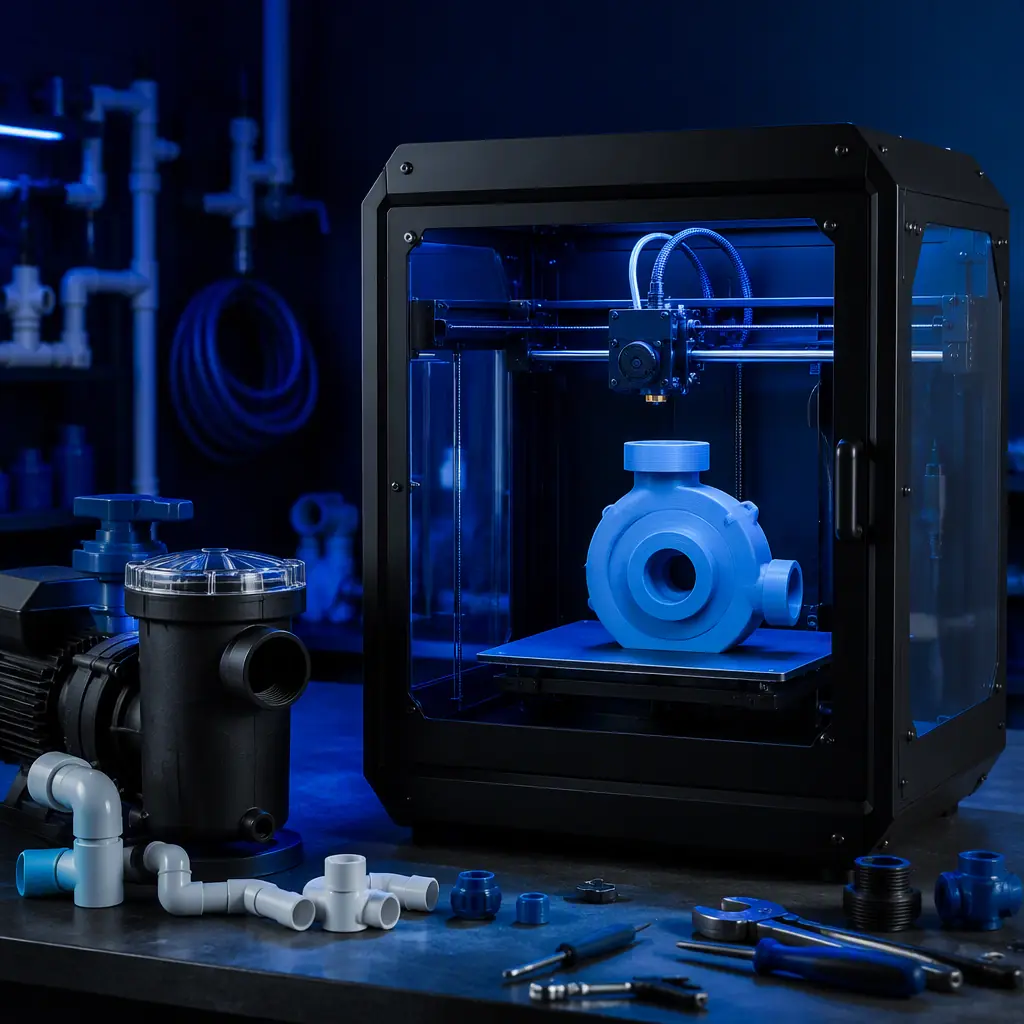
The pool and spa equipment vertical spans pool service and maintenance companies, pool equipment distributors and dealers, spa and hot tub manufacturers, aftermarket parts sellers, commercial pool operators (hotels, resorts, community centers), and pool builders. Three structural facts drive the opportunity. First, the installed base is enormous and aging: residential pools alone number in the tens of millions in North America alone, and a typical pool pump, filter or heater is 5-15 years old. Deep into aftermarket territory where OEM parts are slow, expensive or discontinued. Second, seasonality compresses decision windows: an impeller that fails in June cannot wait three weeks for a part; pool season makes lead time the dominant buying criterion. Third, chemical exposure is brutal: chlorine, salt (salt-chlorine generators), UV and ozone attack plastics, so parts fail on a predictable cycle. And predictable failure is exactly what a print-on-demand supply model exploits. The economics that make these replacements rational are laid out in our TCO & ROI calculator guide.
Why the Pool & Spa Industry Is Buying 3D Printing
Four forces are converting pool-adjacent businesses into printer buyers. First, the parts availability gap: pool equipment OEMs consolidate product lines constantly, and a pump sold five years ago may have no listed spare today, the aftermarket angle is covered in our spare parts & aftermarket revenue guide. Second, seasonal urgency: a commercial pool at a hotel that is down for a week loses revenue and reputation; a $20 printed part delivered in hours protects a much larger service contract. Third, chemical wear is predictable: impellers, valve seats, gaskets and fittings degrade on 1-4 year cycles depending on chlorine load, which creates a scheduled replacement stream that fills the slow months, the same recurring-revenue logic as our accessories & revenue multiplier guide. Fourth, customization and retrofit demand: pool owners retrofit automation, LED lighting and custom water features, and the fittings for those retrofits are rarely off the shelf. A pool service company with 200-500 accounts replaces or repairs 30-80 plastic parts per month; a parts seller can list printed spares for 50 discontinued pump models and sell them passively at 40-60% gross margin.
The Applications That Actually Buy
Six clusters generate the orders. The buyers are pool service technicians, equipment distributor parts managers, spa manufacturer engineering teams, and commercial pool operators.
1. Pump wear parts. The highest-frequency application: impellers, diffusers, volute gaskets, shaft seals housings, lid o-rings and strainer baskets for centrifugal pool pumps. Impellers printed in PA-CF or glass-filled nylon balance durability against the 1-3 HP motor loads, the engineering filament selection is in our engineering filaments guide. An impeller that costs $30-80 from the OEM with a 1-3 week wait prints at $4-12 and can be on the truck the same day.
2. Filter components. Multiport valve handles, pressure gauge adapters, filter grid frames, cartridge end caps and air relief valve parts for sand, cartridge and DE filters. Printed in ASA or ABS for UV and chlorine resistance, the exterior-grade material logic is in our filament stocking guide. A multiport valve handle that snaps in July costs $25-60 OEM; a printed ASA handle costs $3-6 and is printable overnight.
3. Skimmers, fittings & plumbing parts. Skimmer baskets, weir doors, eyeball return fittings, return jet assemblies, drain covers, unions and custom PVC adapter rings for the 1.5-2 inch plumbing that runs every pool. Printed in ASA or PETG, these replace brittle OEM plastics that yellow and crack under UV, the fitting geometry work follows the same discipline as our plumbing & sanitary ware guide. A skimmer basket that costs $12-25 in a retail store costs $2-4 printed, and service companies bundle them into spring-opening kits.
4. Spa jets, manifolds & shell parts. Spa jet bodies, eyeball inserts, air control knobs, manifold fittings, filter lid handles and shell repair plates for hot tubs. Spa water runs hotter (38-41°C) and more heavily chlorinated than pool water, so materials must resist both, ASA and PA-CF dominate. The spa manufacturing angle connects to the tooling economics in our manufacturing tooling guide: a spa maker printing jet housings and mold tooling in-house cuts lead time on every new model.
5. Heater, chlorinator & automation parts. Heater control knobs, manifold covers, flow switch housings, salt cell end caps, chlorinator lids, timer dials and automation controller bezels. These are low-stress parts with high cosmetic importance. Printed in ASA or PETG with a clean finish, the finishing workflow is in our post-processing & finishing guide. A salt cell end cap that costs $45-90 OEM with a 2-week lead prints at $5-12 in 6 hours.
6. Service tools, jigs & accessories. Custom wrenches for union nuts, filter cartridge pullers, test kit holders, skimmer net replacement heads, return line thread protectors, and cable clips for robotic cleaners. Every service van ends up carrying printed tools that never existed in any catalog, the fleet tooling logic mirrors our demo lab setup guide, applied to a service van instead of a showroom.
Materials & Processing Reality
Pool and spa parts live in a soup of chlorine, salt, UV and heat. Five material families dominate:
Two environmental realities dominate. First, UV kills plastics: PLA and PETG yellow and embrittle outdoors within a season, so anything exposed to sunlight must be ASA or UV-stabilized, the material rules are in our filament stocking guide. Second, wetted parts need smooth surfaces: a rough printed impeller or fitting collects algae and scale; vapor smoothing or sanding-and-sealing is part of the deliverable for any part that stays submerged, with the full workflow in our post-processing & finishing guide. And because service happens outdoors in heat, an enclosed printer with a heated chamber prints ASA and nylon without warping, the case for the chamber is in our heated chamber guide.
From Failed Part to Installed Spare: The Replacement Workflow
The workflow that wins pool accounts has five stages. Diagnose . Identify the failed part and its failure mode: cracked, worn, embrittled or missing; the failure mode dictates the material (UV embrittlement = ASA, mechanical wear = PA-CF). Model . For common parts, pull from a printed-parts library; for uncommon ones, scan the original with a $300-800 handheld scanner in 10-20 minutes or model from calipers, the scanner path is in our scanner & printer bundle guide. Print . Orient impellers and vanes for surface quality, print functional faces on the build plate or with supports removed cleanly. Finish . Sand or vapor-smooth wetted parts, seal if required. Fit and verify . Check the part against the pump or filter on site before closing the job; pressure-test where relevant, using the checklist in our incoming QC & inspection guide. The full cycle, failed part to installed spare, runs 2-12 hours for most parts, versus 1-4 weeks for OEM orders, and one service van printer sustains 3-6 emergency part jobs per week during season.
Budget Reality: Printed vs OEM vs Retail
The comparison that opens pool accounts:
The distributor math compounds because the pool year is a cycle: spring opening kits, summer emergency repairs, fall winterization parts, and year-round chemical system spares. Each phase reorders printed parts. That recurring stream is the same margin engine as our accessories revenue guide, and the printer investment model that justifies the customer's own machines, and your demo fleet, is in our TCO & ROI calculator guide.
The Distributor Playbook: Entering Pool & Spa Accounts
Five moves win pool and spa accounts:
1. Target the right segments. Pool service companies with 100+ accounts are the fastest entry. They buy parts weekly and their vans can carry a printer. Equipment distributors and dealers are the second tier, and spa manufacturers with in-house engineering are the third. Build a list of 40-80 accounts in your territory.
2. Lead with the failure catalog. Walk in with a printed sample board of the 15 most-failed parts (impellers, valve handles, skimmer baskets, salt cell caps) and a price sheet showing printed vs OEM with lead times. The consultative framework is in our B2B sales demo playbook.
3. Sell the van-print model. A service company with a printer in the van converts emergency back-orders into same-visit fixes, a customer-retention advantage that pays for the machine in one season. The fleet tooling logic is in our demo lab setup guide, adapted for mobile.
4. Demo with a real failed part. Ask the prospect for the three most-common failed parts in their fleet, print replacements during the demo, and leave functional spares. The pilot structure is in our B2B sales demo playbook.
5. Bundle the vertical material set. ASA, PA-CF, PETG, ABS and TPU lines, plus a filament dryer, an enclosed printer with a heated chamber and a scanner bundle, with margin in materials and consumables. The bundling mechanics are in our accessories revenue guide. The unifying rule: pool businesses buy uptime in a season where weeks are unaffordable, the distributor who delivers parts in hours owns the account.
Common Pitfalls in Pool & Spa Accounts
Five mistakes cost distributors pool business: (1) using UV-unstable materials outdoors . A PETG valve handle in direct sun embrittles in a season and fails, killing trust; ASA or UV-stabilized materials are non-negotiable for exterior parts, with the rules in our filament stocking guide; (2) under-speccing wear parts . An impeller that cavitates and cracks in a month is a product failure, not a material choice; PA-CF or glass-filled nylon is the floor for anything rotating, per our engineering filaments guide; (3) ignoring surface finish on wetted parts . Rough submerged parts grow algae and scale; smooth and seal everything that stays wet, following our post-processing guide; (4) skipping pressure and fit verification . A union that leaks or an impeller that doesn't clear the volute fails on site; verify every fit before the truck leaves, with the checklist in our incoming QC guide; and (5) ignoring the commercial segment . Hotels, resorts and community pools are higher-value accounts with standing maintenance contracts and zero tolerance for downtime; they buy in bulk and reorder on schedule, the same account dynamics as our HVAC & refrigeration guide describes for facility operators. Two quieter mistakes compound these: under-pricing emergency parts (a part that saves a hotel pool's weekend is worth far more than its material cost) and treating the printed part as disposable when the customer expects OEM-grade durability.
Getting Started: The First 90 Days
A 90-day entry plan: Month 1 . Identify 40-80 target accounts across pool service companies, equipment distributors and spa manufacturers; stock the vertical material set (ASA, PA-CF, PETG, ABS, TPU) plus a filament dryer, build plates and finishing consumables; and print a sample board of the 15 most-failed pool parts for demos. Stock one enclosed demo printer with a heated chamber for ASA and nylon, the chamber case is in our heated chamber guide. Month 2 . Run two pilots: one pool service company (print 20-30 real parts across two weeks, measure response time vs their old ordering process) and one equipment distributor (list printed spares for 10 discontinued pump models on their counter); document both in a service template. Month 3 . Convert the pilots into a seasonal parts-supply agreement (spring opening kit, summer emergency stock, winterization set), publish your first measured case study ("Service Co.: $240 OEM impeller back-order replaced by a $9 PA-CF print, pool running same day"), and open one commercial pool account. Throughout the quarter, log every part with equipment model, material, cost and survival time, that data becomes your case-study library, your discontinued-parts catalog, and your proof for the next 40 accounts. The printer economics that justify the distributor's own fleet are in our TCO & ROI calculator guide.
Reviewed by the Precise3D engineering & OEM team. Compliance files that accompany the catalog are auditable at the certification register.
Enter the Pool & Spa Market
Ready to Supply Pool & Spa Professionals?
Get wholesale pricing on enclosed printers with heated chambers, ASA, PA-CF, PETG, ABS and TPU material lines, filament dryers, 3D scanners, and the parts-playbook that wins pool service and spa manufacturing accounts.