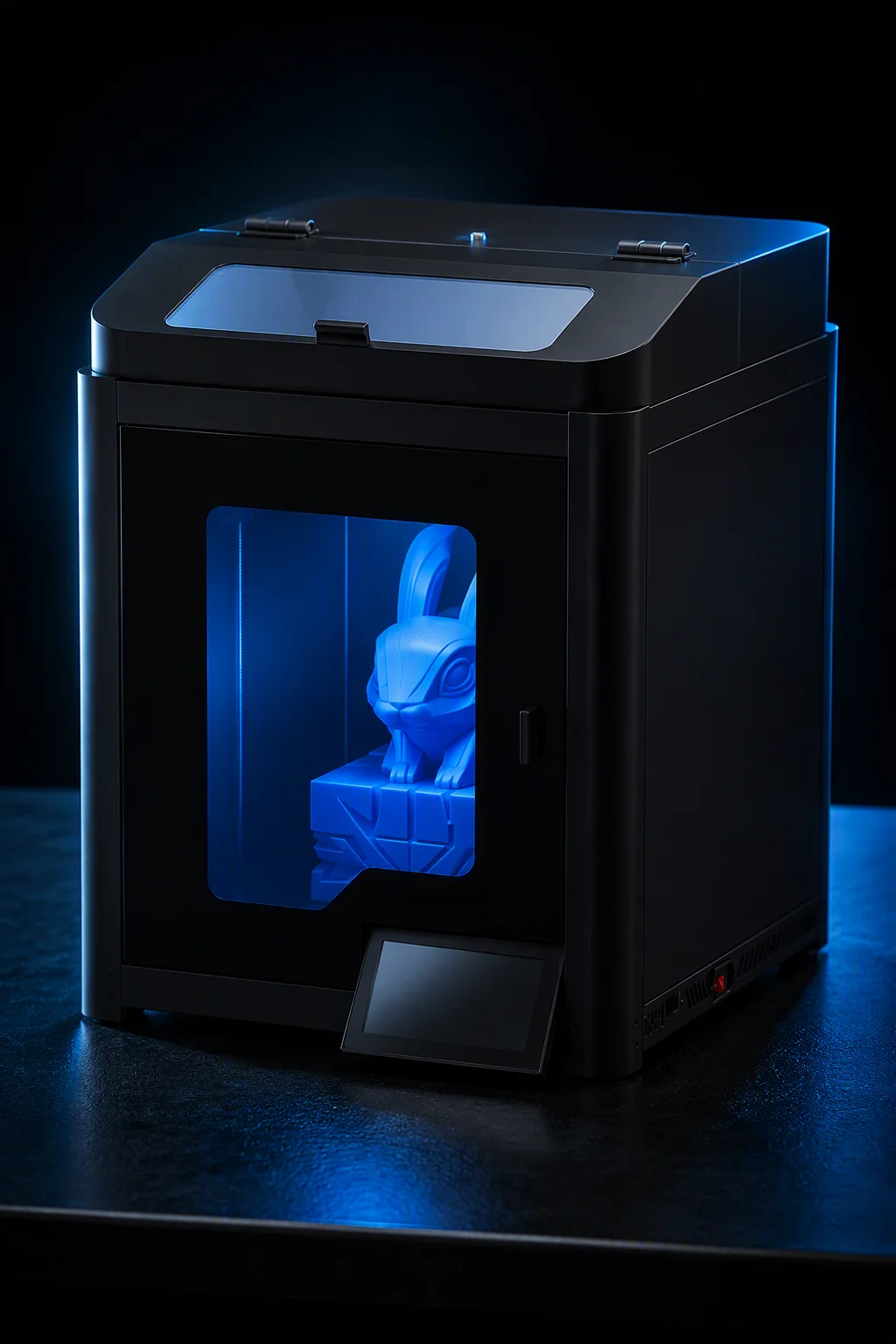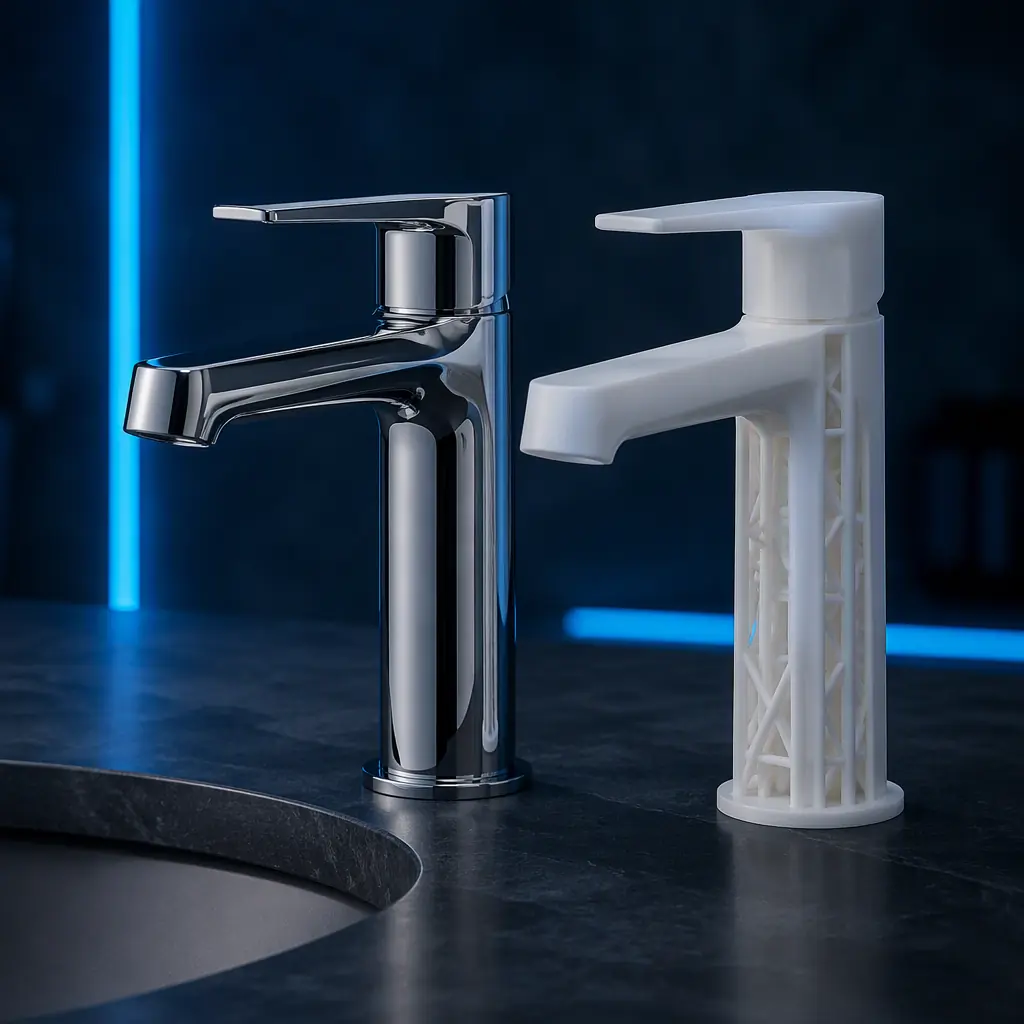
The plumbing and sanitary ware market is a $150+ billion global industry that splits into four buyer groups: faucet and fittings manufacturers (brass foundries, sanitary ware brands, and the OEM tier that supplies global hardware brands), building-services contractors and MEP firms that install and maintain commercial plumbing, spare-parts and aftermarket distributors that serve legacy fittings, and custom bathroom hardware brands that sell designer fixtures. Every group shares one structural trait: plumbing products are regulated, water-contact safety matters, and the industry is dominated by metal forming and injection molding. Which makes prototype lead times long and custom parts uneconomical. 3D printing attacks exactly those two bottlenecks, and the vertical is early enough that a distributor who enters now can own the education conversation.
Why Plumbing Is Buying 3D Printers
Four structural facts make plumbing a durable buyer. First, prototype economics: a faucet body prototype traditionally requires CNC machining or wax-casting patterns, 6-12 weeks and $15,000-40,000 per iteration, while a resin-printed prototype costs $100-400 and ships in 72 hours; the iteration-speed logic is the same one we map in our rapid prototyping & R&D guide. Second, mold-master production: every faucet, shower head, and sanitary part is made from a mold, and 3D-printed master models cut mold-development time and cost dramatically. The investment-casting and mold-making workflow is covered in our industrial foundry & investment casting guide. Third, legacy spare parts: buildings 20-50 years old contain millions of discontinued fittings, and property managers routinely pay $50-200 for a single replacement handle or cartridge trim; printed equivalents cost $2-15. Fourth, customization: designer bathroom hardware, accessible-design fixtures, and hospitality projects demand unit-of-one or short-run parts that no mold can serve economically, the small-batch economics are in our portfolio strategy guide.
The Applications That Actually Buy
Six clusters generate the orders. The buyers are faucet manufacturers, sanitary ware brands, MEP contractors, spare-parts distributors, custom hardware brands, and accessible-design specialists.
1. Faucet and fitting prototypes. The flagship application: functional prototypes of faucet bodies, handles, shower heads, and valve trims for design validation and customer approval. A printed prototype costs $100-400 and ships in 3 days; the CNC or cast prototype costs $15,000-40,000 and takes 6-12 weeks. The prototype-to-production path is detailed in our injection molding vs 3D printing guide.
2. Mold masters for casting and molding. Print masters for silicone molds, investment-casting patterns, and RTV mold positives. Faucet manufacturers use printed patterns to test casting geometry before committing to steel tooling. The pattern and mold workflow is covered in our foundry & investment casting guide.
3. Legacy spare parts. Handle inserts, cartridge trims, aerator housings, shower-head faceplates, and valve-knob adapters for discontinued fittings. A printed trim piece costs $2-15 and ships in a day; the OEM part costs $50-200 and is often simply unavailable, the aftermarket economics are developed in our spare parts & aftermarket revenue guide.
4. Custom and accessible hardware. Lever handles for accessibility retrofits, custom shower-head faceplates, color-matched trim kits, and designer hardware for hospitality projects. These are unit-of-one or short-run parts. The print-farm economics for batch production are in our print farm operations guide.
5. Jigs and assembly tooling. Cartridge-press fixtures, seal-installation tools, torque-test jigs, and QC gauges for manufacturing lines. Plumbing plants use printed tooling to cut assembly errors and testing time, the tooling economics mirror our manufacturing tooling guide.
6. Display and sales samples. Showroom samples, trade-show display faucets, and cutaway models for training. Manufacturers and distributors print lightweight, durable display parts that survive shipping and handling.
Materials for Plumbing & Sanitary Ware
Plumbing buyers work in three material worlds, water-contact, structural, and visual:
Two realities dominate material conversations. First, water contact: parts that carry drinking water must meet potable-water standards, and parts that carry hot water face thermal cycling. The compliance framework for regulated materials is in our certification & compliance guide. Second, finish expectations: plumbing buyers compare prototypes against chrome and brushed-nickel finishes, so post-processing is not optional; the finishing workflow (sanding, polishing, electroplating-ready surfaces) is fully covered in our post-processing & finishing guide.
From Sketch to Mold-Ready Master: The Plumbing Workflow
The workflow that wins plumbing accounts has five stages. Design or scan . Manufacturers arrive with CAD, while spare-parts buyers arrive with a broken sample; pair printer sales with a 3D scanner bundle using the playbook in our scanner + printer bundle guide. Print the prototype . Resin for detail parts, nylon for structural parts; iterate the design overnight. Validate fit and flow . Test threads, seals, and water paths on the actual assembly; the qualification workflow is in our incoming QC guide. Match the finish . Sand, polish, and prepare surfaces so the prototype holds its own against a chrome sample. Master and tool . Use the approved print as a silicone mold master or casting pattern, then move volume to a print farm; when a launch scales, the farm economics in our print farm economics guide take over.
Budget Reality: Printed vs Tooled
The comparison that closes plumbing accounts:
The distributor math compounds because plumbing prototyping is resin-hungry: a busy fittings manufacturer can consume 20-60 liters of resin per month, plus build plates, FEP film, and finishing consumables, the recurring-revenue model is developed in our consumables & accessories bundling guide.
The Distributor Playbook: Entering Plumbing
Five moves win plumbing accounts:
1. Target the manufacturers and MEP contractors. Faucet and fittings manufacturers, sanitary ware brands, and large MEP firms are the highest-intent buyers. Build a target list of 20-30 accounts. This vertical is dense with mid-size manufacturers in China, Italy, Germany, and Mexico.
2. Lead with the prototype-speed pitch. The pitch is "functional faucet prototype in 72 hours, mold master in a week." Bring a finished demo piece: a resin faucet prototype and a castable-wax pattern. Plumbing buyers approve what they can hold and test.
3. Bundle the resin ecosystem. A resin printer is the anchor, but the margin is in standard, engineering, and castable resins, FEP film, build plates, wash-and-cure stations, and finishing supplies. The bundling mechanics are in our consumables bundling guide.
4. Offer prototype-to-master services. Many manufacturers want printed masters they can hand to a mold maker. A distributor that pairs printer sales with master-model know-how captures the account before tooling spend starts, the after-sales stickiness logic is in our after-sales support strategy.
5. Work the product-launch calendar. Bathroom fittings launches cluster around trade fairs (ISH, KBIS, Canton Fair) and spring/summer renovation season. Time outreach to the 8-10 weeks before each show, and pair hardware with the seasonal inventory planning playbook from our seasonal inventory guide.
Common Pitfalls in Plumbing Accounts
Five mistakes cost distributors plumbing business: (1) selling FDM for faucet prototypes . Layer lines and low detail fail the chrome-finish comparison; resin is the honest recommendation for anything customer-facing; (2) ignoring water-contact safety . Potable-water parts need documented material compliance, and a contamination or leaching incident ends the account (the framework is in our certification & compliance guide); (3) skipping finish work . A raw resin prototype reads as "cheap" next to a chrome sample; sell post-processing and plating-prep from day one; (4) treating spare-parts buyers like hobbyists . A property-management company replacing 200 trim pieces a year is a commercial account with real resin and service demand; and (5) ignoring thread and seal tolerance . Plumbing parts must mate with standard threads (G1/2, G3/4, NPT), so print-to-print consistency matters; document tolerances using the framework in our tolerances & dimensional accuracy guide.
Getting Started: The First 90 Days
A 90-day entry plan: Month 1 . Identify 20-30 target accounts (faucet manufacturers, sanitary ware brands, MEP contractors, spare-parts distributors) and stock the plumbing material set: standard resin, one engineering resin, castable resin, nylon, PETG, plus FEP film, build plates, wash-and-cure stations, and finishing consumables. Month 2 . Produce a finished demo piece (a polished faucet prototype with a silicone mold master) with its material datasheet, run two pilot jobs at cost-plus-10% (a prototype batch and a legacy-trim run), and offer prototype-to-master services to one manufacturer. Month 3 . Convert pilots to full accounts with resin subscriptions and a 72-hour prototype SLA, publish your first measured case study ("faucet prototype: 8 weeks → 3 days, $180"), and open one MEP contractor account. The printer investment model that justifies the distributor's own machines is in our TCO & ROI calculator guide. The sustainability angle also resonates with modern sanitary brands. The recycled and low-waste filament playbook is in our sustainable & recycled filament guide.
Reviewed by the Precise3D engineering & OEM team. Compliance files that accompany the catalog are auditable at the certification register.
Enter the Plumbing & Sanitary Market
Ready to Supply Plumbing & Sanitary Ware Companies?
Get wholesale pricing on resin printers, standard and castable resin lines, wash-and-cure stations, FEP film, build plates, finishing supplies, and the plumbing-market playbook that wins manufacturers and MEP contractors.