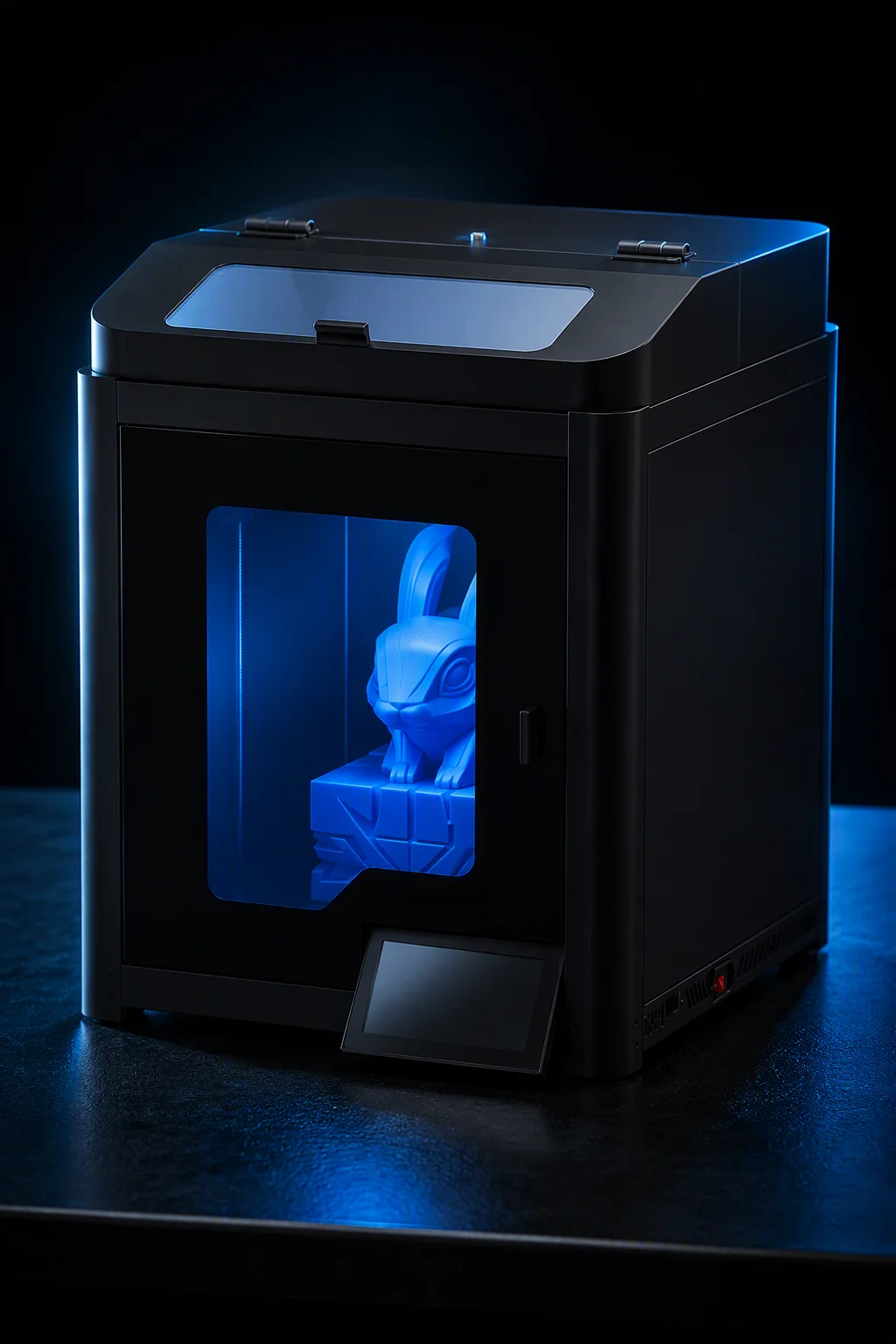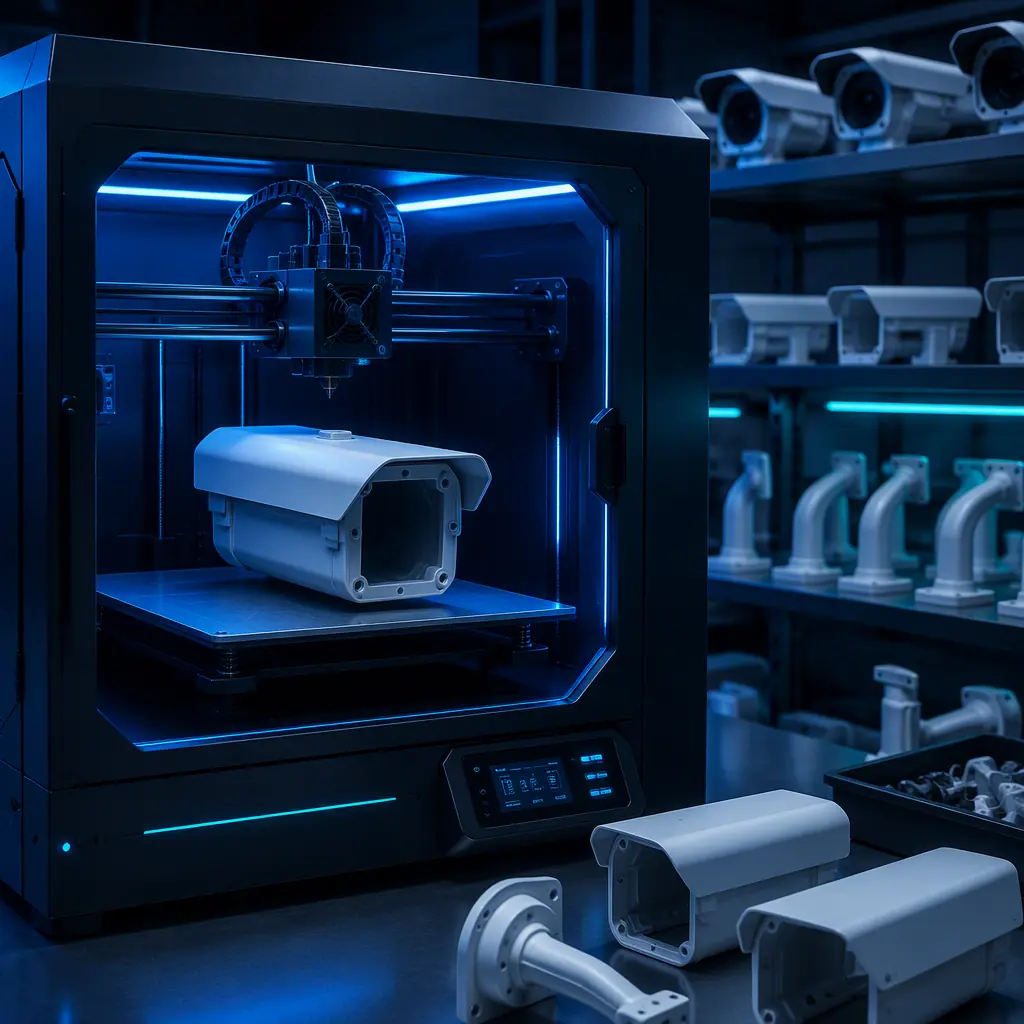
A surveillance OEM in Guangdong producing fixed-dome cameras for export was paying $3,500-6,000 and 5-7 weeks per new housing prototype with CNC and injection suppliers — and a full 40% of those prototypes were scrapped after field trials. After bringing a large-format FDM workflow in-house, the company now prints functional camera housings, PTZ mount brackets, and control-box enclosures in 3-4 days for $60-300 in material: design cycles jumped from one iteration per month to four per week, and a new outdoor bullet camera went from concept to IP66-rated field test in 9 weeks instead of 26. Security and surveillance is one of the most specification-driven verticals in 3D printing — every product must meet IP ratings, UV stability requirements, and often NDAA or regional compliance standards, which means geometry changes are frequent and tooling commitments are expensive. For distributors, it is a prototyping-plus-short-run market where compliance support, not part price, closes the sale.
Why Security & Surveillance Are Structural 3D Printing Buyers
Three facts make surveillance customers exceptional. First, specification churn: a mid-size camera manufacturer launches 10-30 new SKUs per year, and every housing revision — new lens diameter, different IR window, added heater pocket — forces a prototype round that printed parts compress from weeks to days. Second, outdoor geometry density: IP66/IP67-rated housings, sun shields, cable glands, and PTZ gimbal parts need complex overhangs and sealed channels that are expensive to machine at low volume but cheap to print. Third, low-volume customization: integrators and system houses routinely spec 20-500 custom mounting solutions per project, and printed parts make custom geometry economical at those quantities. The material discipline behind outdoor-rated parts is covered in our outdoor weather-resistant printing guide.
The Applications That Actually Buy
Five clusters generate repeat orders. The buyers are surveillance OEMs, camera integrators, drone manufacturers, system houses, and facilities teams managing large site deployments.
1. Camera housings and enclosures. The flagship application. Fixed-dome, bullet, and PTZ housings printed for design validation, thermal testing, and IP-rating trials before tooling commitment. Printed prototypes are the fastest way to validate sealing geometry, cable routing, and IR window placement. The dimensional control for validated housings is covered in our tolerances & dimensional accuracy guide.
2. PTZ mounts and gimbal components. Pan-tilt-zoom brackets, gear housings, and slip-ring retainers. These parts must hold motors and cameras in precise registration, and printed tolerances of ±0.2-0.3 mm are sufficient for most PTZ assemblies. Threaded interfaces for metal inserts are covered in our heat-set inserts guide.
3. Drone and UAS components. Gimbal mounts, camera payload brackets, antenna housings, and landing-gear parts for surveillance drones. Weight is the currency here — printed parts save 30-50% versus machined aluminum on non-structural brackets. The wider opportunity in UAV manufacturing is detailed in our drone & UAV manufacturing guide.
4. Control boxes and NVR housings. Junction boxes, PoE switch enclosures, power-supply housings, and recorder chassis. These are short-run, high-customization parts where printed production runs of 50-500 units beat sheet-metal fabrication on lead time. Flame-rated material compliance is a hard requirement here — see the certification section below.
5. Custom site mounting and retrofit parts. Pole mounts, wall brackets, conduit adapters, sun shields, and retrofit covers for existing camera lines. Every large site deployment generates dozens of one-off mounting needs, and printed parts solve them same-week instead of same-month. The tooling discipline that applies to site-specific parts is detailed in our manufacturing tooling guide.
Materials and Finish for Surveillance Production
Surveillance parts must survive outdoors for years and satisfy certification reviewers. The map distributors should stock:
Two traps: (1) UV stability is non-negotiable for anything mounted outdoors — ASA or UV-stabilized PC, never bare PLA, or housings will chalk and crack within 18 months; (2) IR window geometry matters — the printed window frame must hold the IR-transmissive cover with a precision fit, and the surrounding wall must not obstruct the LED field, so print orientation and shrinkage control are part of the design service, not optional. The finishing side of producing client-ready housings is covered in our post-processing & finishing guide.
Economics: CNC/Injection Prototyping vs Printed
The comparison that closes surveillance accounts:
The distributor math is attractive because the purchase is systemic: once a surveillance OEM validates a printed prototyping-and-short-run workflow, every new camera launch flows through the same printer, filament, and finishing supply. A mid-size manufacturer can consume $10,000-28,000/year in filament, finishing consumables, and printed production parts — before counting the printer itself. For building this ROI case, use our TCO/ROI calculator guide.
The Distributor Playbook: Entering Security & Surveillance
The winning playbook has five moves:
1. Lead with compliance, not cost. The pitch is "IP-rated, UV-stable, flame-rated parts with full material data sheets" — cost savings are the confirmation, specification confidence is the decision. Bring UL 94 documentation and UV-exposure test data to every presentation.
2. Offer print-to-production service. Surveillance OEMs do not want to run a print farm in-house. A distributor offering prototype-and-short-run service (customer sends CAD, distributor prints, finishes, and ships production-quality housings in 4-7 days) turns a printer sale into a recurring service line. The service economics are developed in our after-sales support strategy.
3. Speak the integrator language. Integrators quote against drawings, not against part prices. Provide DXF/STEP files, print-orientation notes, and tolerance reports for every prototype — the integrator's own quoting workflow becomes your sales collateral. The certification landscape that applies across export markets is covered in our certification & compliance guide.
4. Stock the surveillance material set. ASA, flame-rated ABS, PC-ABS, glass-filled nylon, and PETG are the true margin engine, plus finishing consumables (primers, UV-clear coats, vapor-smoothing fluids). An OEM producing 30-60 printed housings per month consumes 15-30 kg of filament monthly; a filament-plus-finishing subscription locks the account.
5. Build the site-deployment flywheel. Every completed site mounting job becomes a reference: build a catalog of print-tested pole mounts, wall brackets, and retrofit parts (with the customer's permission) and offer print-on-demand across the integrator's entire installed base. One validated integrator recruits the next — security teams talk constantly at ISC West, IFSEC, and regional security-industry events.
Common Pitfalls in Surveillance Accounts
Five mistakes account for most failed initiatives: (1) selling non-rated materials into outdoor or mains-adjacent applications — bare PLA housings fail UV testing and non-flame-rated NVR boxes are rejected by the certification engineer; (2) ignoring IR window fit — a housing that blocks the camera's IR field is worthless no matter how cheap it printed; (3) underselling the environmental question — thermal cycling, humidity, and direct sun are real, so weather-resistant materials and sealing support must be part of the offering; (4) underselling the consumable model — the printer is the foot in the door, but filament contracts and finishing-supply retainers are where margin compounds; and (5) neglecting the integrator channel — OEMs are not the whole market, so a distributor must also serve system houses and site-deployment teams with print-to-production service, not just a printer. The discipline of documenting measurable outcomes mirrors what we teach for end-use parts in our end-use functional parts guide.
Getting Started: The First 90 Days
A 90-day entry plan: Month 1 — stock ASA, flame-rated ABS, PC-ABS, glass-filled nylon, and PETG with full data sheets, plus primers and UV-clear coats, and identify 10-15 target accounts (camera OEMs, integrators, drone manufacturers, system houses, large facility teams) within a 3-hour drive. Month 2 — run two pilot prototype projects at cost-plus-10% to build documentation evidence and a finish-sample library; document IP-rating trial results and certification acceptance. Month 3 — convert pilots to full accounts with filament-and-finishing subscriptions and print-to-production retainers, publish your first co-branded case study with measured numbers ("camera housing: $4,500 CNC → $220 printed, 4-day turnaround, IP66 field-tested"), and exhibit at a regional security or industrial-technology event. If you already serve electronics or outdoor-equipment accounts, our consumer electronics guide and outdoor weather-resistant guide show how the same prototyping-plus-short-run logic transfers directly to surveillance.
Reviewed by the Precise3D engineering & OEM team. Compliance files that accompany the catalog are auditable at the certification register.
Enter the Security Market
Ready to Supply Surveillance Manufacturers?
Get wholesale pricing on large-format FDM printers, ASA and flame-rated engineering filament lines, and the print-to-production service playbook that wins security and surveillance accounts.