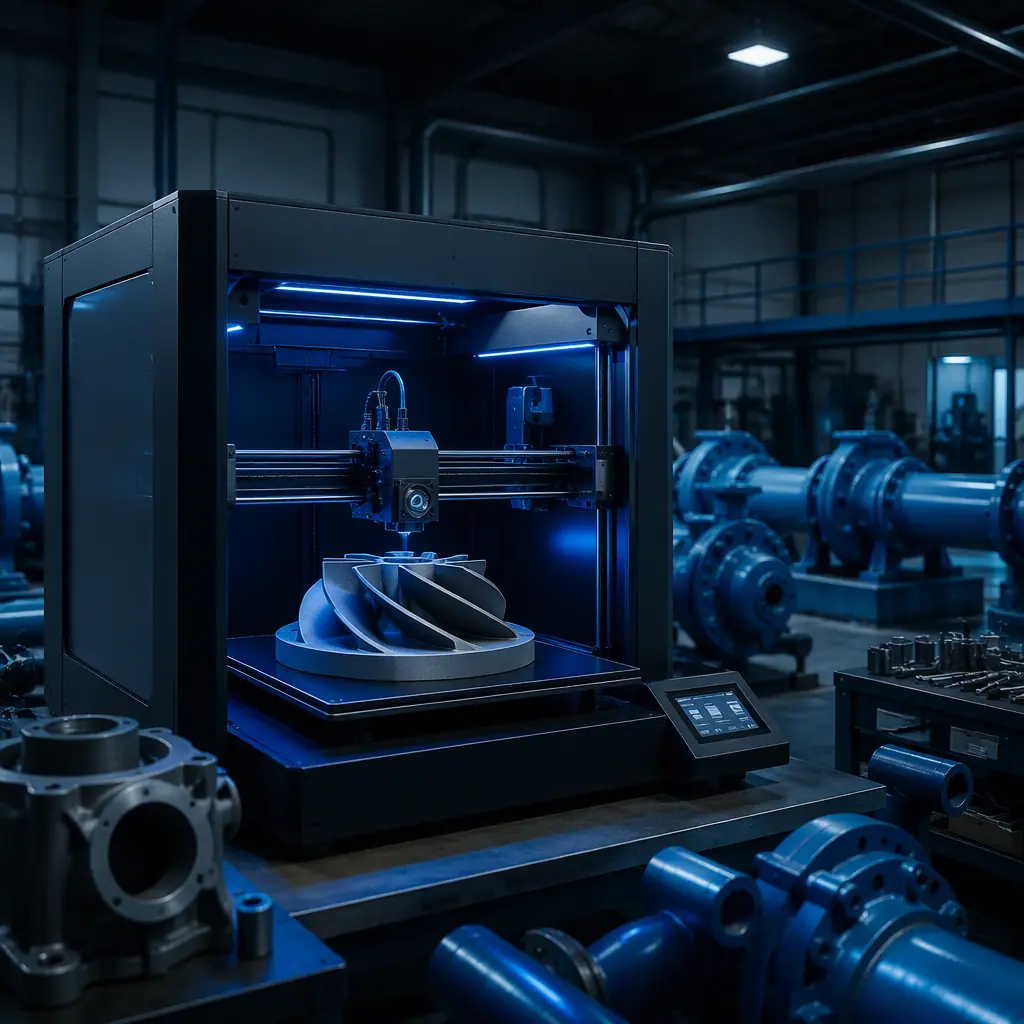
A municipal wastewater plant in Ohio lost its primary lift-station pump to a failed impeller in 2025. The original-equipment replacement was quoted at $14,000 with a 16-week lead time; the plant's permit allowed 30 days of reduced flow before regulators stepped in. A distributor scanned the worn impeller, printed a PETG prototype in two days for $180, and validated the geometry on a test stand. The final PP-GF impeller shipped in six days for $1,900. And the plant has since ordered 11 more impellers, valve stems, and wear rings across four pump stations. Water and wastewater treatment is a $200B+ global market with aging infrastructure, strict compliance pressure, and a maintenance culture that buys on documented performance. For a 3D printing distributor, it is the most overlooked industrial vertical in North America.
Why Treatment Plants Are Ready for Printed Parts
Four structural features make water and wastewater the easiest industrial vertical to enter with FDM printing. First, obsolete equipment: treatment plants run pumps and valves with 20-40 year service lives, and OEMs discontinue parts for half of that installed base, printed replacements are often the only practical source. Second, chemical specificity: plants handle chlorine, sodium hypochlorite, sulfuric acid, and polymers, so corrosion-resistant plastics already dominate the parts ecosystem; FDM materials like PP and PVDF fit the existing material culture. Third, compliance-driven urgency: permit limits make downtime a regulatory event, so a 6-day printed part beats a 16-week OEM quote regardless of price. Fourth, documented culture: plant engineers keep test reports and material data on every part, which means a distributor with real data wins, and one without it gets nowhere. For the wider opportunity in industrial spare parts, see our spare parts aftermarket guide.
The buyers sit in three tiers: municipal utilities (treatment plants, lift stations, distribution networks), industrial facilities (food processing, chemical, and manufacturing plants with their own pretreatment systems), and pump/valve service contractors who maintain the installed base. All three are chronically under-served by fast part supply.
The Five Highest-ROI Applications
Focus the pitch on five applications where printed parts consistently beat OEM supply or machining:
1. Pump impellers. Open and semi-open impellers for lift-station, sludge, and effluent pumps. Impellers are geometry-critical, low-volume, and constantly wearing, the ideal FDM profile. Printed PP-GF or PA-GF impellers cost 10-20% of OEM cast parts and ship in days; validate performance on a test stand and document flow curves.
2. Valve repair parts. Stems, wear rings, seats, and handwheel components for gate, butterfly, and plug valves. A $40 printed stem keeps a $4,000 valve in service, and valve parts are standardized enough that a library of 20-30 files covers most plants.
3. Chemical-resistant fixtures and dosing parts. Polymer dosing nozzles, diffuser caps, weir inserts, and flocculation baffles exposed to aggressive chemicals. PP and PVDF-grade materials handle chlorine and acid exposure that would destroy generic PLA parts, see our PP filament guide for the chemical-resistance map.
4. Obsolete and legacy spares. Gears, levers, guards, and housings for aging equipment where OEM spares no longer exist. This is the highest-margin printed category, there is no alternative supplier to price against.
5. Maintenance tooling and safety hardware. Wrench fixtures, tagout covers, sensor mounts, and inspection gauges. Low drama, high volume, and a reliable recurring order base that keeps the account warm between emergencies.
Materials for Water and Wastewater
Treatment chemistry drives material selection harder than any other vertical:
Three practical notes: (1) chemical resistance is material-specific, a PP part that survives hypochlorite may fail in concentrated sulfuric acid; publish a chemical compatibility table with every quote; (2) impellers and wear parts should be printed with 100% infill or a structural profile and validated on a test stand before install; and (3) PA-GF is hygroscopic, dry before printing and include a dryer in the bundle. For the wider engineering materials picture, see our engineering filaments guide.
The Economics: Printed vs OEM vs Machined
The numbers that close maintenance contracts:
Price is not the primary argument, availability is. When the OEM quote is 16 weeks and the permit clock is 30 days, the printed part is not a cheaper alternative; it is the only option. For the financial framework to put in front of a plant superintendent, see our TCO/ROI calculator guide.
How Distributors Enter the Treatment Vertical
There are three distinct routes to treatment-plant revenue:
Route 1, The municipal utility channel.
City and county utilities buy through formal bidding, but urgent repairs and service contracts are awarded to responsive vendors. Start with emergency impeller and valve service at 2-3 plants, document every job, and convert to an annual maintenance parts agreement.
Route 2, The industrial pretreatment channel.
Food, chemical, and manufacturing plants run their own pretreatment systems with less bureaucracy than municipalities. They buy on speed and data, deliver a chemical compatibility table and a test report with every part. The maintenance relationship that sustains these accounts is covered in our maintenance guide.
Route 3, The service contractor channel.
Pump and valve service companies maintain hundreds of plants and buy parts in volume. Win one contractor with a reliable printed-parts program and you reach every plant they service. The QC discipline contractors expect is covered in our factory audit & QC checklist.
The Distributor Playbook and Margin Structure
The proven model:
1. Carry a four-material plant kit. PP-GF, PA-GF, PETG, and a specialty PVDF-grade where chlorine dosing is heavy. Bundle with a dryer, a hardened nozzle set, and a chemical compatibility chart laminated for the plant's chemical list.
2. Offer emergency service first, hardware second. Most plants will not buy a printer until printed parts have survived a season of service. A $200-1,500 emergency part fee with a 3-5 day SLA converts into printer + material contracts in 6-12 months.
3. Build a plant parts library. Catalog every printed part by pump model, valve size, and plant. When a pump fails at 2 AM, the file is ready. The reprint is an overnight job and a $150-400 invoice. The library turns emergencies into recurring revenue.
4. Publish test data. Flow curves for impellers, cycle counts for valve stems, chemical compatibility tables. This is the single strongest differentiator in a vertical that buys on documentation. For the testing discipline, see our filament quality evaluation guide.
Treatment plants pair naturally with the energy infrastructure that powers them, see our energy & renewables guide for the parallel opportunity.
Common Pitfalls in the Treatment Vertical
Watch for five recurring failures: (1) promising chemical resistance without data, one hypochlorite failure ends the account; publish a compatibility table per plant chemical list; (2) selling printed impellers without test-stand validation, an unvalidated impeller that underperforms its flow curve destroys credibility; always ship with a test report; (3) ignoring drying for PA grades, wet PA-GF parts delaminate under pump vibration; the dryer is part of the bundle; (4) competing with OEM on standardized high-volume parts, printed parts win at low volume, obsolescence, and geometry complexity, not at commodity scale; and (5) treating every job as a one-off, the margin is in the parts library and the recurring agreement, not in individual emergencies. For the corrosion and materials context that industrial plants share, see our oil & gas guide.
Getting Started: The First 90 Days
Month 1 . Assemble the four-material plant kit, print sample impellers and valve stems, and target 10 accounts: municipal utilities, industrial pretreatment facilities, and pump/valve service contractors in your region. Month 2 . Launch the 3-5 day emergency part service with two pilot plants; document every job with a chemical compatibility note and a test report. Month 3 . Convert pilots to printer + material contracts, publish a case study with a compliance number ("replaced a 16-week OEM impeller in 6 days"), and begin the plant parts library. Treatment plants are the quietest large vertical in industrial 3D printing, and the most defensible once you hold the files and the data. For the agricultural water market that shares this chemical-resistance logic, see our agriculture & hydroponics guide.
Reviewed by the Precise3D engineering & OEM team. Compliance files that accompany the catalog are auditable at the certification register.
Enter the Treatment Vertical
Ready to Sell 3D Printing to Water & Wastewater Plants?
Get wholesale pricing on industrial printers, the PP-GF / PA-GF / PETG / PVDF-grade material program with compatibility data, and the parts-library workflow that wins maintenance contracts.