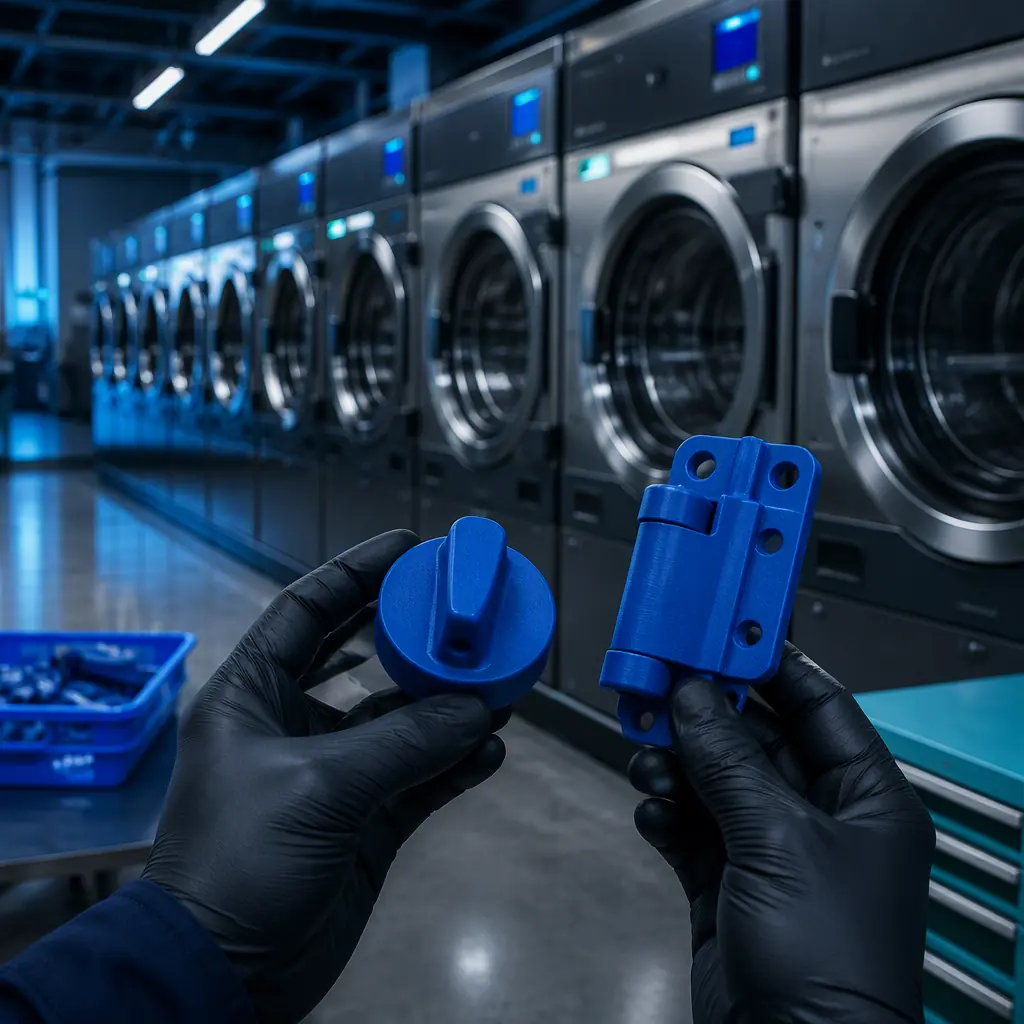
The commercial laundry market splits into four buyer groups: coin-operated laundromat operators (self-service stores with 20-100 machines), on-premise laundry plants (hotels, hospitals, and industrial laundries running large washer-extractors and dryers), dry-cleaning stores (professional garment care with specialized finishing equipment), and equipment service firms that maintain all of the above. One structural trait unites them: commercial washers and dryers are designed for 15-25 year service lives, while manufacturers only commit to spare-parts availability for 7-10 years. The result is an enormous installed base of productive machines running on expensive, scavenged, or simply unavailable parts. 3D printing lets a local operator or service firm produce those parts on demand at unit-of-one cost, no mold, no minimum order, no 3-week OEM wait.
Why Commercial Laundry Is Buying 3D Printers
Four structural facts make laundry a durable buyer. First, discontinued parts: the average laundromat has machines from three or four manufacturers and vintages, and a single discontinued knob can bench a machine that earns $40-80 per day. The aftermarket economics are the same ones we map in our spare parts & aftermarket revenue guide. Second, brutal wear cycles: commercial washers run 8-14 cycles per day, 365 days a year; control knobs, door latches, lint filters, and coin mechanisms wear out on a predictable calendar, which means predictable reorder demand. Third, vibration and moisture: laundry environments destroy standard parts, so operators constantly need rugged replacements, the material selection logic is covered in our engineering filaments guide. Fourth, service-speed economics: a down machine loses revenue every day, so operators pay a premium for same-day parts; a printer in the back room turns a 2-week OEM wait into an overnight fix.
The Applications That Actually Buy
Six clusters generate the orders. The buyers are laundromat operators, hotel and healthcare laundry plants, dry cleaners, and the service firms that maintain their equipment.
1. Control knobs and dials. The highest-frequency part: washer and dryer control knobs, temperature dials, and timer bezels. A printed knob costs $0.50-3 and prints in hours; the OEM part costs $8-25 and takes 1-3 weeks. The part-level economics are developed in our spare parts revenue guide.
2. Door latches, hinges, and handles. Door components take brutal abuse in commercial settings: broken latches, worn hinge pins, and cracked handles are constant. Printed nylon replacements routinely outlast the original ABS parts. The wear-resistant material choices are covered in our material selection guide.
3. Coin mechanisms and payment parts. Coin slots, token bezels, card-reader mounts, and cash-door parts for self-service machines. These are security-sensitive parts with precise dimensions, the tolerance framework is in our tolerances & dimensional accuracy guide.
4. Lint filters, vents, and gaskets. Lint filter frames, exhaust vent louvres, and TPU gaskets for dryer doors. These are consumable-ish parts with steady replacement demand, the flexible-material options are covered in our flexible filaments guide.
5. Jigs and service tooling. Bearing-press fixtures, drum-balance test jigs, and calibration tools for machine service. Service firms use printed tooling to cut repair time, the tooling economics mirror our manufacturing tooling guide.
6. Custom and accessibility parts. ADA-compliant raised-control kits, custom color-matched trim for renovated laundromats, and proprietary parts for machines whose OEM went out of business. These are unit-of-one parts, the small-batch economics are in our portfolio strategy guide.
Materials for Commercial Laundry
Laundry buyers work in three material worlds, touch, moving, and moisture-exposed:
Two realities dominate material conversations. First, heat exposure: dryer components see sustained 60-90°C operating environments, so PLA is never acceptable and PC/ABS is often required, the heat-performance framework is in our heated chamber guide. Second, moisture and chemicals: laundry chemicals (bleach, detergent, perchloroethylene in dry-cleaning) attack many plastics, so chemical-resistance testing matters before a part is trusted in service; the compliance framework for regulated materials is in our certification & compliance guide.
From Broken Part to Installed Replacement: The Field-Service Workflow
The workflow that wins laundry accounts has five stages. Capture . Operators arrive with a broken knob or latch, not CAD; pair printer sales with a 3D scanner bundle using the playbook in our scanner + printer bundle guide. Reverse-engineer and model . Model the part with correct shaft geometry, splines, and mounting holes; the dimensional framework is in our tolerances & dimensional accuracy guide. Print the replacement . Nylon for latches and hinges, ABS for knobs, TPU for gaskets; iterate fit overnight. Validate on the machine . Test the part in the actual washer or dryer, checking actuation, heat exposure, and chemical resistance; the qualification workflow is in our incoming QC guide. Stock and reorder . Once validated, the part becomes a stock item for the operator's fleet, and the recurring-revenue model is developed in our consumables & accessories bundling guide.
Budget Reality: Printed vs OEM
The comparison that closes laundry accounts:
The distributor math compounds because laundry parts fail on a predictable calendar: a 60-machine laundromat can consume 100-300 printed parts per year, and every part drives filament, build-plate, and service revenue. The printer investment model that justifies the operator's own machines, and your demo fleet, is in our TCO & ROI calculator guide.
The Distributor Playbook: Entering Commercial Laundry
Five moves win laundry accounts:
1. Target operators and service firms. Laundromat operators with 20+ machines, hotel and healthcare laundry plants, and equipment service companies are the highest-intent buyers. Build a target list of 20-30 accounts. This vertical is dense with mid-size operators in the US, UK, Germany, and Australia.
2. Lead with the downtime pitch. The pitch is "down machine back online overnight, parts under $5." Bring a printed knob and a door latch to every meeting. Operators approve what they can snap into a machine on the spot.
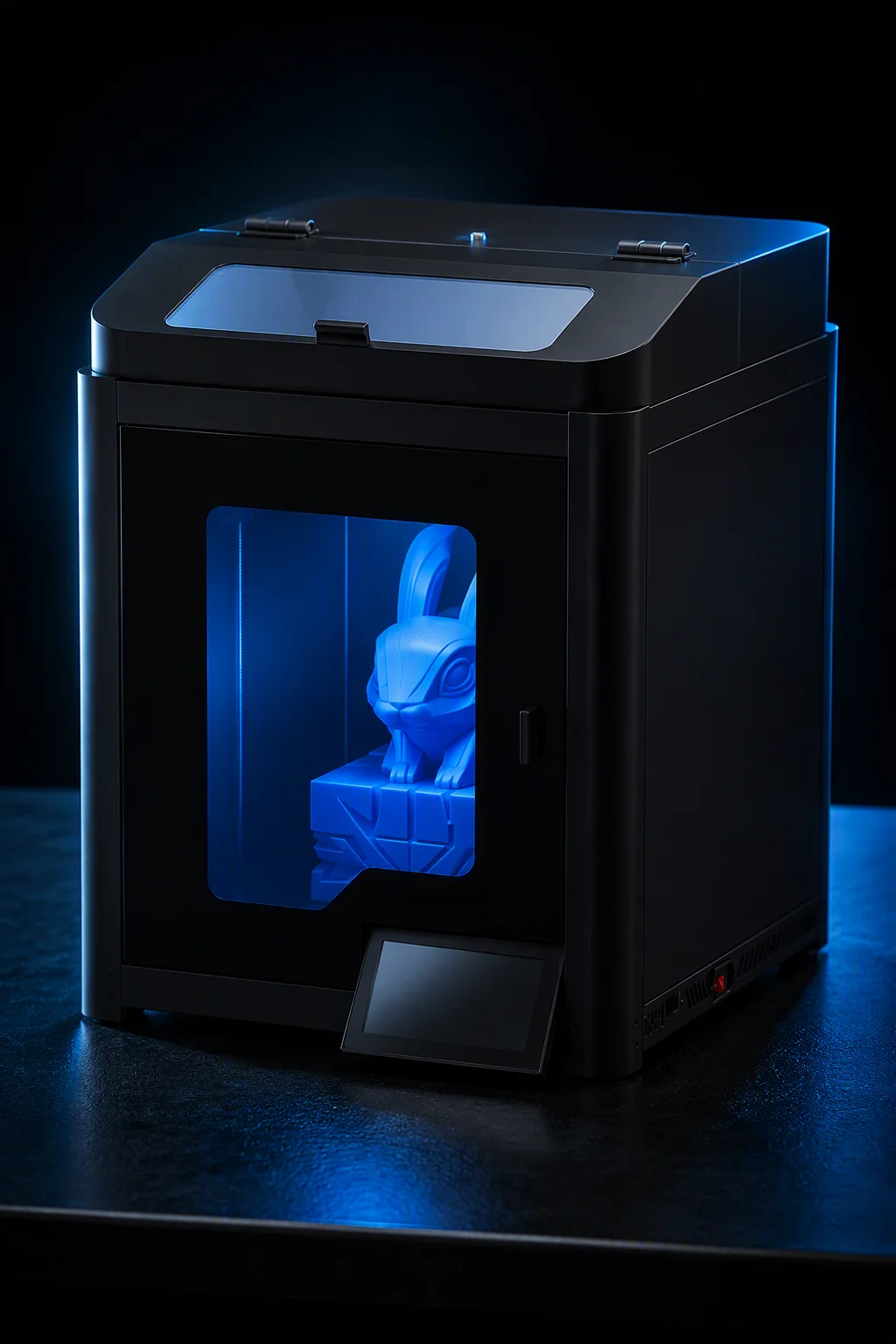
3. Bundle the field-service ecosystem. An enclosed FDM printer is the anchor, but the margin is in nylon, ABS, ASA, PETG, TPU, and PC filaments, build plates, and a laundry parts starter kit. The bundling mechanics are in our consumables bundling guide.
4. Offer a part-digitization service. Most laundromats have decades of orphaned machines with no CAD. A distributor that scans, models, and validates parts for a fixed fee captures the account before hardware discussion starts, the service-revenue logic is in our repair service center guide.
5. Work the replacement cycle. Commercial washers have a 15-25 year life and parts fail on a predictable wear calendar; sell annual parts-service contracts alongside printers, using the framework in our annual service contracts guide.
Common Pitfalls in Laundry Accounts
Five mistakes cost distributors laundry business: (1) selling PLA for any machine part . Laundry environments are hot, moist, and chemical-laden; PLA fails fast and discredits the whole pitch (the honest recommendation is nylon, ABS/ASA, or PC depending on the zone); (2) ignoring chemical resistance . A part that degrades in bleach or perc exposes the operator to downtime and liability; test material compatibility before promising service life; (3) skipping heat testing on dryer parts . Dryer-door components face sustained heat, and an untested part warps and jams; the heat-performance framework is in our heated chamber guide; (4) treating coin-mechanism parts as cosmetic . Payment parts are security-sensitive and dimensionally critical; document tolerances with the framework in our tolerances guide; and (5) skipping validation . A part that jams a dryer door costs the operator a service call; validate on the actual machine using the workflow in our incoming QC guide.
Getting Started: The First 90 Days
A 90-day entry plan: Month 1 . Identify 20-30 target accounts (laundromat operators, laundry plants, dry cleaners, service firms) and stock the laundry material set: nylon PA12, ABS, ASA, PETG, TPU, PC, plus build plates and a parts starter kit. Month 2 . Produce a finished demo piece (a scanned and printed control knob with its validation photos), run two pilot jobs at cost-plus-10% (a knob batch and a door-latch run), and offer part-digitization services to one operator. Month 3 . Convert pilots to full accounts with parts-service contracts and a 24-hour parts SLA, publish your first measured case study ("60-machine route: $9,000/yr → $700/yr in printed parts"), and open one hotel laundry-plant account. The printer investment model that justifies the distributor's own machines is in our TCO & ROI calculator guide. The sustainability angle also resonates with modern operators. The recycled and low-waste filament playbook is in our sustainable & recycled filament guide.
Reviewed by the Precise3D engineering & OEM team. Compliance files that accompany the catalog are auditable at the certification register.
Enter the Commercial Laundry Market
Ready to Supply Laundry & Dry-Cleaning Companies?
Get wholesale pricing on enclosed FDM printers, nylon and engineering filament lines, build plates, parts kits, and the laundry-market playbook that wins operators and service firms.