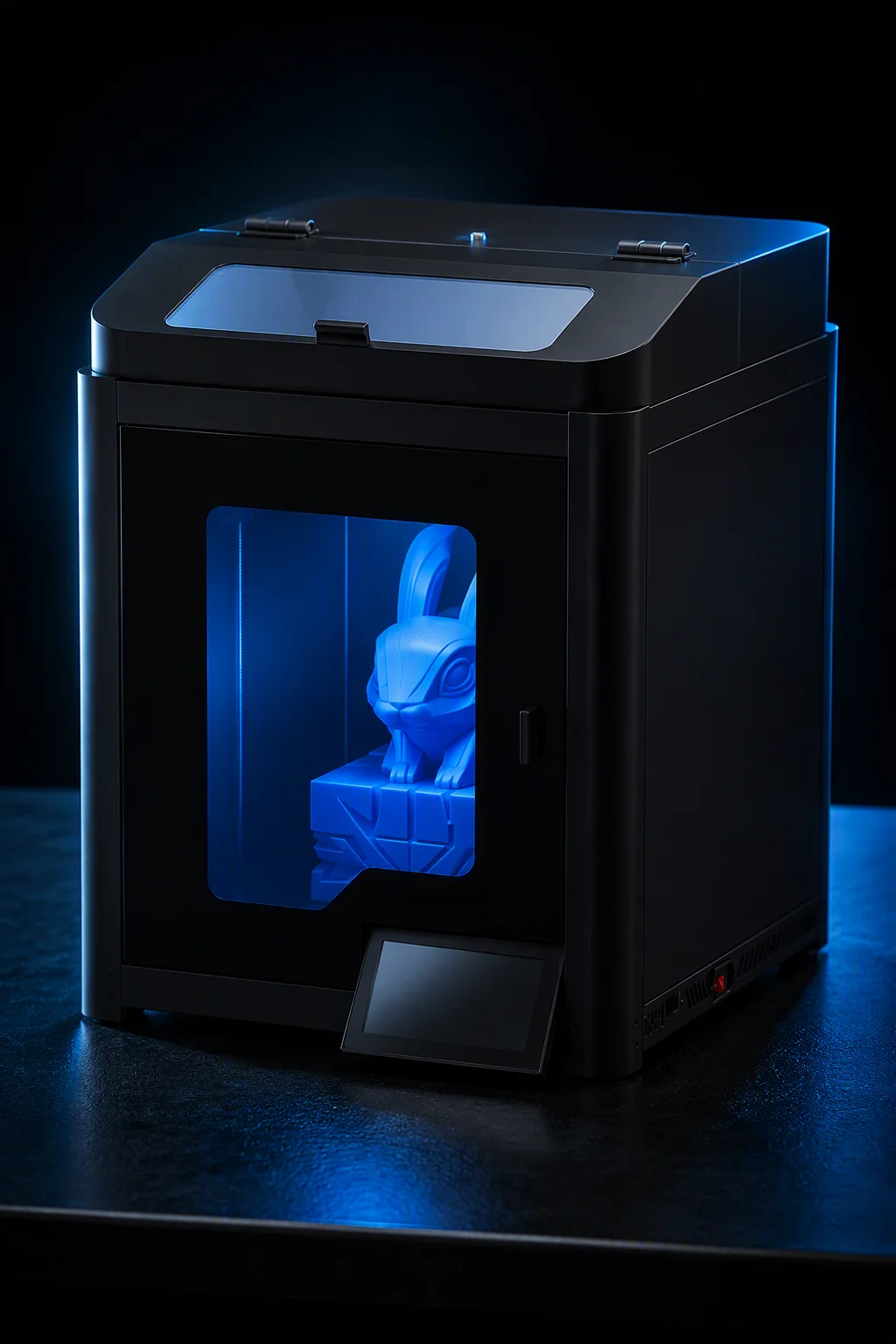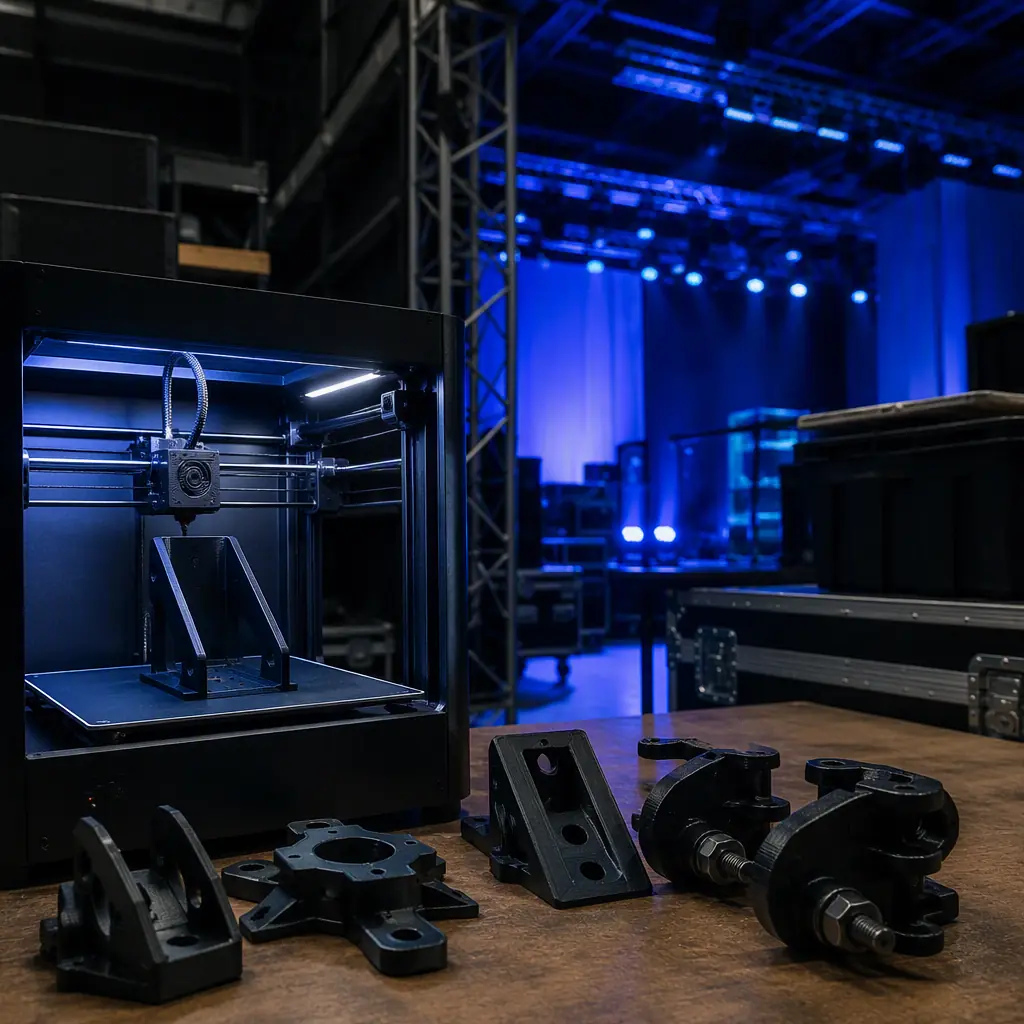
The events and live production vertical spans event production companies, staging and rigging firms, AV rental houses, festival and concert organizers, exhibition booth builders, and theater companies. One structural fact drives the opportunity: event deadlines are measured in days, custom geometry is one-off by definition, and rental fleets carry thousands of parts whose OEM spares are expensive or discontinued. A truss clamp knob costs $3-8 to print versus $25-60 to buy; a moving-head barn-door spare costs $6-15 printed versus $40-120 machined; a booth product stand costs $12-40 printed versus $80-400 fabricated. Every event season burns through knobs, caps, brackets, adapters and connectors. And every one of them is a print job. A single national tour can consume 300-600 printed parts per season, and most of those parts are out of production within five years of the gear's release. Distributors who treat events as a seasonal MRO business rather than a one-off hardware sale compound repeat revenue across the whole calendar. The printer investment model that justifies the machines is developed in our TCO & ROI calculator guide.
Why Live Events & Production Buy 3D Printing
Four structural facts make events and live production durable buyers. First, deadlines measured in days: a festival stage opens Friday, the set piece arrives Tuesday, and the fix has to exist by Wednesday, overnight prints win jobs that machining and fabrication cannot touch. Second, one-off geometry by definition: every show, tour and booth is a new design, and printing beats machining at quantities below a few dozen units. Third, rental fleets with discontinued spares: an LED panel or mixer from five years ago has no OEM parts anymore, but the fleet must stay on the road; printed replacements keep $15,000 speakers and $40,000 lighting rigs working. Fourth, the cost of downtime during a show: a broken knob or bracket mid-show can shut down a set, burn a day rate and damage the client relationship, the failure-analysis mindset is covered in our film & TV production guide, which shares the same buyers and spares economics. The segment map that shows where events fits in your portfolio is in our portfolio strategy guide.
The seasonal rhythm reinforces the buying case. Q4 holiday events, the spring-summer festival circuit and the trade show season create three distinct peaks when production teams suddenly need dozens of parts within days. And the same printed parts that save a show in November are reordered in near-identical volume the following May. A staging company running 60-120 shows a year treats a load-tested printed clamp as standard inventory, not a novelty. The same fleet economics, spares categories and 48-hour deadlines drive film and TV production, which we cover in our film & TV production guide.
The Applications That Actually Buy
Six clusters generate the orders. The buyers are production managers, master electricians, riggers, booth project managers and rental fleet leads, the same buyers who purchase signage and display hardware in our printing & graphics industry guide.
1. Stage props and scenic elements. The most visible application: hero props, themed set pieces, panel clips, scenic connectors, button covers and detail trim for sets that must match a design exactly. A hero prop that costs $400-1,500 to fabricate in a shop costs $20-60 in ASA plus paint, and the set designer can iterate the geometry three times in a single week. Printed in PETG or ASA, the material rules are in our filament stocking guide.
2. Rigging and staging hardware. Clamps, adapters, cable guides, truss accessories and safety-rated spare parts for staging systems. Truss end caps, safety-cable clips and coupler knobs are the daily drivers, and PA-CF parts survive 200+ load cycles where a hobby-grade part fails in a weekend. Printed in PA-CF, the durable options are in our engineering filaments guide.
3. Lighting accessories. Gobo holders, gel frames, clamp knobs, barn-door spares for moving heads, lamp-barrel rings and fixture knobs for stage and architectural lighting. Moving-head barn doors and gobo holders are discontinued within a few fixture generations, leaving fleets of $2,000-8,000 fixtures dependent on $6-15 prints to stay on tour. Printed in ASA or PA-CF, the accessory economics are in our accessories revenue guide.
4. AV and rental fleet spares. Knobs, caps, brackets, connectors and feet for speakers, mixers, cameras, LED panels and wireless gear, the highest-frequency MRO demand in the vertical. A rental fleet of 50 speakers and 30 mixers burns 200-500 printed spares per year: knobs wear out, connectors break and feet tear off in transit. Printed in PETG or ASA, the stocking logic is in our filament stocking guide.
5. Exhibition and booth fixtures. Custom displays, product stands, cable management, demo rigs and mounting brackets for trade show booths and brand activations. A 30-booth exhibition build generates 100-400 custom fixtures across product stands, monitor mounts and cable runs. Printed in PETG or ASA, the durable options are in our engineering filaments guide.
6. Wearables and costume parts. Festival wear, mascot parts, harness clips, buckle covers and accessory mounts for performers and brand ambassadors. Mascot heads, wrist bands and harness clips in TPU survive 50+ wear cycles and pass backstage noise and safety checks that rigid parts fail. Printed in TPU, the flexible options are in our filament stocking guide.
Materials & Processing Reality
Event professionals select materials by fire code, load, heat and finish. Five families dominate:
Three realities dominate the material conversation. First, fire codes are venue-specific: local codes and NFPA 705-style rules for fabrics and plastics vary by venue, jurisdiction and production type. Flame-retardant ABS and ASA grades exist for stage proximity, and distributors who can document what they supply win the compliance conversation; flame-retardant ASA behaves like UL94 V-0 material in thin-wall parts, but the venue's fire marshal is the final authority, so document the material grade, print settings and part location for anything that goes near a stage. The regulatory mindset is extended in our certification & compliance guide. Second, load-rated hardware needs testing, not guesses: anything rigged overhead or load-bearing gets printed in PA-CF, load-tested at minimum 2x working load before a show, and labeled with the test date; the engineering material framework is in our engineering filaments guide. Third, large ASA parts need an enclosed printer: warp-free ASA on big stage parts means a heated chamber, which is a natural upsell for the same account, the enclosure logic is in our heated chamber guide.
From Sketch to Stage: The Event Workflow
The workflow that wins event accounts has six stages. Brief . The production manager hands over a sketch, a photo of a broken part, or a reference from the show's design pack; the sales demo framework that turns this into a machine sale is in our B2B sales demo playbook. Design . Model the part from the gear's spec or scan the mating surface; parametric designs for knobs, caps and rings cover most fleet spares in minutes, and a library of 100 qualified part files turns a two-hour design job into a fifteen-minute print start. Print, ASA or FR-ASA for stage proximity, PA-CF for load-bearing hardware, TPU for wearables, using the rules in our filament stocking guide. Finish and paint . Sand, prime and paint set pieces to match the scenic design; a painted prop is indistinguishable from a fabricated one at show distance. Integrate . Fit the part to the actual truss, fixture or costume and confirm the interface. Load test before show . Rigging parts get a 2x working-load test and a dated label; the verification checklist is in our incoming QC & inspection guide. A parts order that takes a machine shop five working days is printed in the back of the shop overnight, painted by mid-morning and load-tested by noon. The whole loop fits inside a 48-hour window, which is exactly why event companies buy machines instead of waiting on vendors.
Budget Reality: Printed vs Traditional Fabrication
The comparison that closes event accounts:
The 10x-to-40x cost gap holds across every category because event parts are low-volume, custom-geometry and time-critical, exactly the regime where additive beats subtractive. OEM tooling and machined one-offs amortize badly at quantities of 1-50 units, while a print carries zero tooling cost and starts the moment the file is sliced. When the same part is printed 20 times a season, the per-unit cost drops further because the digital file is free to reuse, the fleet library compounds like software, not like inventory. The printer investment model that justifies the customer's own machines, and your demo fleet, is in our TCO & ROI calculator guide.
The Distributor Playbook: Entering Events & Live Production
Five moves win event accounts:
1. Target the four buying segments. Staging and rigging companies, AV rental houses, exhibition booth builders and festival producers (2-150 employees) are the highest-intent buyers. Build a target list of 40-80 accounts in your territory, ranked by fleet size and season volume.
2. Sell on the seasonal calendar. Q4 holiday events, the spring/summer festival season and the trade show season are the natural buying windows, sell printers, materials and parts-on-demand services ahead of each peak, using the timing framework in our trade show strategy guide. A rental house with 400 fixtures on tour spends $3,000-8,000 a season on spare knobs, caps and brackets; a $400 seasonal parts retainer plus $2-6 per-part print fees captures that spend without a single hardware conversation.
3. Lead with a rental-fleet rescue pilot. Offer to print one discontinued spare for free. The rental house sees a $28 OEM knob replaced by a $4 overnight print that keeps a $15,000 speaker rig working, the demo playbook is in our B2B sales demo guide.
4. Offer parts-on-demand and fleet MRO contracts. Event companies need parts on demand, and rental fleets need standing spares coverage. A distributor that prints and ships parts for a per-job fee, or signs a seasonal MRO contract, captures the account before hardware discussion starts; the service-revenue logic is in our repair service center guide and the recurring-parts economics in our accessories revenue guide.
5. Bundle the event material set and expand the portfolio. An enclosed printer plus FR-ASA, ASA, PA-CF, TPU and matte black PETG lines is the anchor combination, and the margin is in materials, build plates and hardened nozzles, the bundling mechanics are in our consumables bundling guide. Event accounts that already buy signage and printing hardware are natural laser engraver prospects, mapped in our printer + engraver portfolio strategy.
Common Pitfalls in Event Accounts
Five mistakes cost distributors event business: (1) ignoring fire codes . A PLA prop near a flame effect or heat source fails venue inspection and burns the account; qualify flame-retardant grades and document them; (2) over-printing load-bearing rigging without testing . A printed sleeve carrying a 200 kg working load that was never tested is a liability, not a sale; test at 2x working load, label and log every part; (3) glossy parts causing light flare . Shiny parts on stage reflect beams and ruin looks; use matte black filaments and the material rules in our filament stocking guide; (4) missing deadline-driven support expectations . Event clients need 48-hour turnaround during peak season, so stock the material set and promise what your fleet can actually print, using the capacity framework in our trade show strategy guide; and (5) treating events like manufacturing . The buyer is a production manager on a show clock, and the pitch is show readiness and fleet uptime, not throughput. Adjacent verticals buy the same hardware: photo studios and video production companies, covered in our photography & imaging guide.
Getting Started: The First 90 Days
A 90-day entry plan: Month 1 . Identify 40-80 target accounts across staging firms, AV rental houses and booth builders, and stock the event material set: FR-ASA, ASA, PA-CF, TPU and matte black PETG, plus build plates, hardened nozzles and a drying system. Month 2 . Run two rescue pilots (one rental fleet spare, one stage prop for a local show), produce a parts-on-demand service template with same-week turnaround terms, and add a production manager to your advisory loop; aim for the 48-hour rescue as the pilot story, "knob down at load-in, printed, tested and fitted before doors open" outsells any spec sheet. Month 3 . Convert pilots to paid accounts with seasonal parts agreements, publish your first measured case study ("Rental house: $28 OEM clamp knob replaced by $4 overnight ASA print, $900 show fee saved"), and open one booth builder or festival producer account. The printer investment model that justifies the distributor's own machines is in our TCO & ROI calculator guide.
Reviewed by the Precise3D engineering & OEM team. Compliance files that accompany the catalog are auditable at the certification register.
Enter the Events & Live Production Market
Ready to Supply Event Production Companies?
Get wholesale pricing on enclosed printers, flame-retardant ASA, PA-CF, TPU and matte black PETG material lines, build plates, hardened nozzles, dryers, and the parts-on-demand playbook that wins seasonal event accounts.