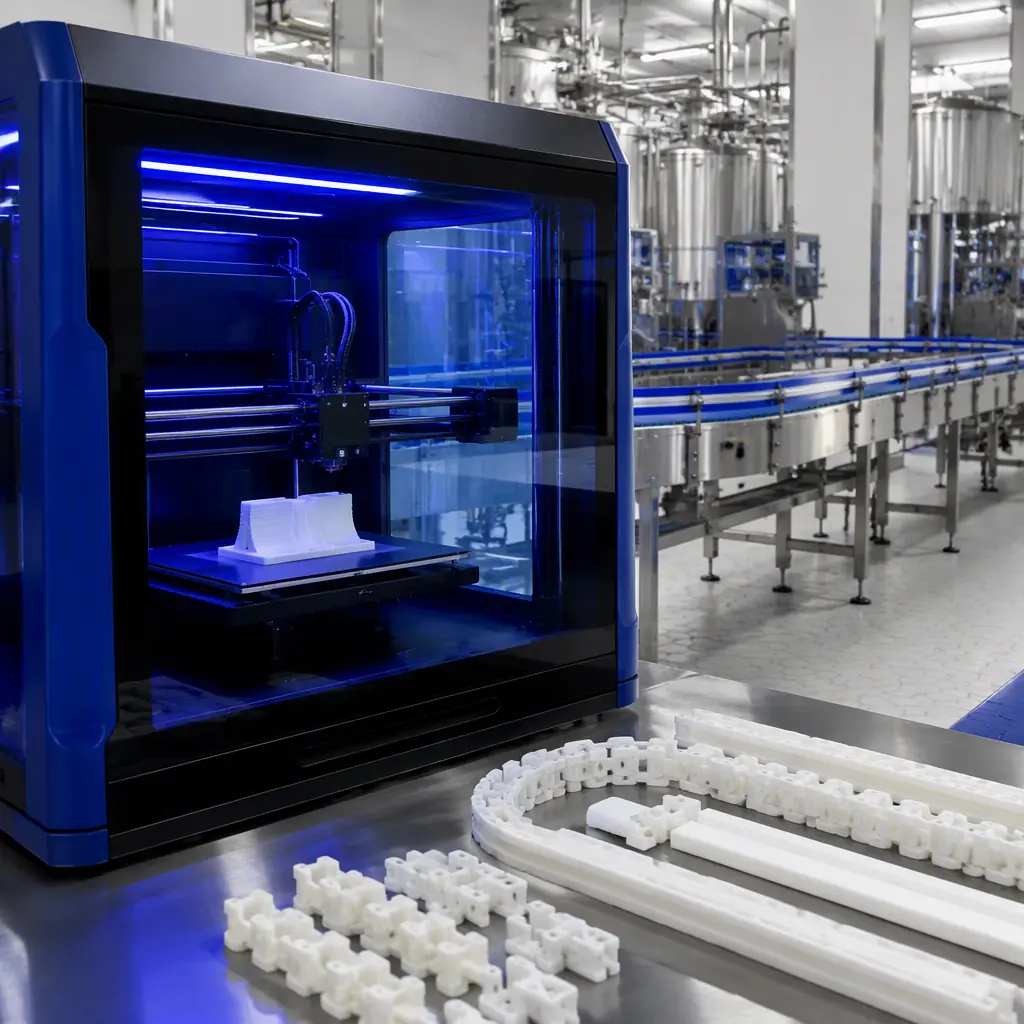
The F&B industry's parts problem is the mirror image of most manufacturing verticals. Where a battery plant needs 40 of one tray variant, an F&B plant needs one set of everything, in dozens of sizes — one star wheel for 330 ml PET, one for 500 ml, one for the 1 L family, one for the seasonal promo bottle with the tapered neck. Every SKU on the line is a changeover kit, every changeover kit is a collection of low-volume, high-precision polymer parts, and every one of them wears out under continuous contact with glass, PET, and washdown chemicals. That combination — high variety, low volume, constant revision — is precisely where 3D printing beats molding on both cost and lead time. The wider story of why engineering teams adopt printed tooling first is in our R&D and rapid prototyping guide.
The Four Part Families F&B Plants Actually Order
F&B plant demand clusters into four families, each with its own volume, material, and tolerance profile. A distributor who can map the four families to specific line positions walks into any plant conversation with a catalog that matches real needs — not a generic "we print parts" pitch.
- Conveyor chain links and wear strips — the highest-volume family. Modular conveyor belts wear at the hinge points, and plants replace chain links and guide wear strips on a 6–18 month schedule. Printed POM (acetal) links with ±0.1–0.2 mm hinge tolerance run quietly and match OEM dimensions when scanned from a worn sample.
- Changeover kits — star wheels, guide rails, gripper fingers, and timing screw segments for bottle and jar lines. Every SKU addition creates a new kit, and kits are stored between runs. Printed kits with ±0.2–0.3 mm pocket tolerance handle glass and PET containers without scratching when the contact faces are polished or vapor-smoothed.
- Hygienic pump and fitting parts — impellers, pipe reducers, valve handles, and sensor housings for the process side. These are smaller, higher-tolerance parts (±0.1–0.2 mm) in contact with the product itself, which raises the compliance bar to food-contact materials.
- Maintenance and line-improvement tooling — sensor brackets, cable guides, washdown shields, and ergonomic handles that keep the line running. This is the fastest-reordering family and the natural entry point for a distributor, because it has no compliance burden and every plant has a backlog of them.
The common thread: none of these parts makes sense as an injection-molded production part at F&B volumes. A plant might need 24 star wheels across six SKUs, then a packaging redesign makes two of them obsolete. That is the volume band where printing wins on cost and lead time — and where a distributor with the right material knowledge becomes a changeover partner, not a box shipper. The general manufacturing tooling economics behind this pattern are detailed in our manufacturing tooling playbook.
Food-Grade Materials: What Qualifies, What Fails, and What Survives Washdown
The compliance landscape for F&B parts has three tiers, and getting them confused is how distributors lose accounts. For contact with dry or non-fatty food, the baseline is FDA 21 CFR 177 compliant polymers — unfilled POM, PETG, and PP all qualify in common formulations. For contact with fatty, wet, or alcoholic food, the bar rises to EU 10/2011 migration limits, which exclude most standard PLA and many pigment-loaded filaments. For parts that never touch food — changeover tooling upstream of the filler, conveyor components in dry zones — no food-contact certification is needed at all, which is why the maintenance family is the easiest entry sale.
The material reality is simpler than the certification paperwork suggests.
The workhorse food-contact materials are POM (acetal) for wear parts like chain links and star wheels, PP for anything touching wet product, and PETG where transparency or easy printing matters. POM is the standout: it has the lowest coefficient of friction of the printable polymers (0.2–0.35 vs 0.4–0.6 for PETG), it resists the caustic washdown chemistry (pH 2–12 at 60–80°C) that destroys PLA in a single cycle, and it prints with ±0.1 mm repeatability on a well-tuned machine. The full engineering filament landscape, including POM's place among wear-resistant options, is covered in our engineering filaments guide.
The washdown problem is where most printed parts fail.
F&B lines are cleaned with caustic soda and peracetic acid at 60–85°C, 2–4 times per day, and parts left on the line must survive it. Standard PLA delaminates and warps in the first cycle; PETG survives caustic but softens above ~70°C; POM and PP handle the full chemistry, with PP the best for continuous hot-wet contact. For parts that see both washdown and mechanical load, PP with a glass-fiber blend (PP-GF30) holds stiffness through 100°C while staying chemically inert — the same material family our polypropylene filament guide covers in depth, including bed adhesion tricks like PP tape and textured plates.
Design Rules for Hygienic Printed Parts
Printed parts fail in F&B environments for predictable reasons, and the fixes are design rules, not heroics. First, design for drainability: every horizontal surface, pocket, and ledge on a food-contact part must drain, or washdown water pools and becomes a bacterial harbor. Radius internal corners to 3–5 mm minimum — the same rule machined stainless follows — and avoid blind holes wherever a through-hole can serve. Second, seal the surface: FDM layer lines are microscopic crevices where product residue collects. For food-contact parts, vapor-smoothing POM or PP with a food-safe smoothing process, or acetone-smoothing a PETG part, closes the layer texture. The surface-finishing options, from sanding to chemical smoothing, are covered in our post-processing and finishing guide.
Third, match the tolerance to the contact surface: a star wheel pocket that touches a glass bottle needs ±0.2 mm and a polished contact face; the mounting bore behind it needs only ±0.3 mm and can be printed with a standard finish. Specifying the contact face separately from the mounting structure is the single biggest cost saver in printed changeover tooling. The dimensional behavior of printed parts across temperature and humidity — why a POM star wheel printed in a humid week can grow 0.2–0.4% — is detailed in our tolerances and dimensional accuracy guide.
Fourth, verify compliance before the demo, not after the order. When a plant asks for food-contact parts, the distributor needs the material's FDA 21 CFR or EU 10/2011 declaration on file — not a "food-safe" label from a filament box. The regulatory detail — what the frameworks actually require, which materials carry compliant formulations, and how post-processing changes the claim — is the subject of our dedicated food-safe 3D printing regulatory guide.
What you're looking for: Caustic washdown at 60–85°C is above the glass transition of standard PETG (~80°C) and far above PLA (~60°C), and caustic chemistry attacks PLA outright. If the part was printed in PLA or standard PETG, the fix is a material change, not a design change: POM handles the full caustic cycle and PP is the choice for hot-wet product contact. If it was already POM, check for stress risers at sharp internal corners — radius them to 3–5 mm. This is the most common printed-part failure we see in F&B, and it is almost always a material spec problem, which is exactly why the distributor who knows the washdown chemistry chart wins the account.
The Distributor Go-to-Market Playbook for F&B Plants
F&B plants buy printers, materials, and parts in a predictable sequence. The entry point is almost always the maintenance department: they have a backlog of sensor brackets, cable guides, and line-improvement parts, they control small budgets, and none of it needs food-contact certification. A distributor who wins the maintenance team gets visibility into the plant's packaging roadmap — and packaging changes are what generate the changeover kit orders that follow. The plant then scales to a dedicated changeover-printing station running POM and PP, which means the consumables and accessories bundling strategy applies: every changeover kit sale carries a material reorder 4–8 weeks later, and the food-contact materials command 2–3× the margin of commodity PLA.
The printer requirements are specific: a heated chamber (POM and PP warp without one), a hardened steel or ruby nozzle (POM is mildly abrasive; glass-filled PP wears brass in 2–3 kg), and a heated bed to 100–120°C for PP adhesion. Distributors should also carry the consumable stack — POM, PP, PP-GF30, and a clear PETG — because the material is where recurring revenue lives. The packaging industry context, including why line changeover is the single biggest printed-parts demand driver, is in our packaging industry guide, and the hygiene-focused maintenance angle connects to the broader 3D printer maintenance guide for the machines themselves.
The bottom line: F&B processing is one of the most reliable verticals for 3D printer distribution because its parts demand is structurally incompatible with traditional manufacturing. High variety, low volume, constant revision, and a brutal washdown environment are the exact conditions where printed polymer parts win — and where a distributor with material and compliance knowledge becomes a changeover partner rather than a one-off parts vendor. The plant does not need to be convinced that 3D printing works; it needs a supplier who shows up with the right POM spec, the right compliance paperwork, and the right changeover catalog on day one.
Reviewed by the Precise3D engineering & OEM team. Compliance files that accompany the catalog are auditable at the certification register.
Start Your Partnership
Ready to Bring food beverage processing equipment to Your Market?
Our OEM program supports food beverage processing equipment programs end to end - the product line, firmware and compliance files that travel with each shipment.