The Pro Audio & Loudspeaker Aftermarket
Pro audio spans studio monitors, PA and line-array loudspeakers, hi-fi and bookshelf designs, car audio, installed commercial audio and portable Bluetooth products. The manufacturing environment is held to a tight deliverable: an acoustic target curve, an enclosure volume, a crossover slope, and a launch date. What separates a winning product from a missed window is how fast the design team can iterate the acoustic geometry, the waveguide, the horn, the baffle, the port. These geometries are genuinely hard to machine: a smooth exponential horn or a contoured waveguide is expensive on a 5-axis mill and slower still to re-run each time the designer tweaks the flare. That constant geometry churn, combined with small order quantities, is precisely where a 3D printing distributor wins.
The buyer is a design engineer or an acoustics product manager, not a plant purchasing agent. For the manufacturing-tooling context that many of these same customers also buy, see our manufacturing tooling distributor guide . Pro audio builders often need printed fixtures for the cabinet and driver assembly line as well.
Waveguide & Horn Parts
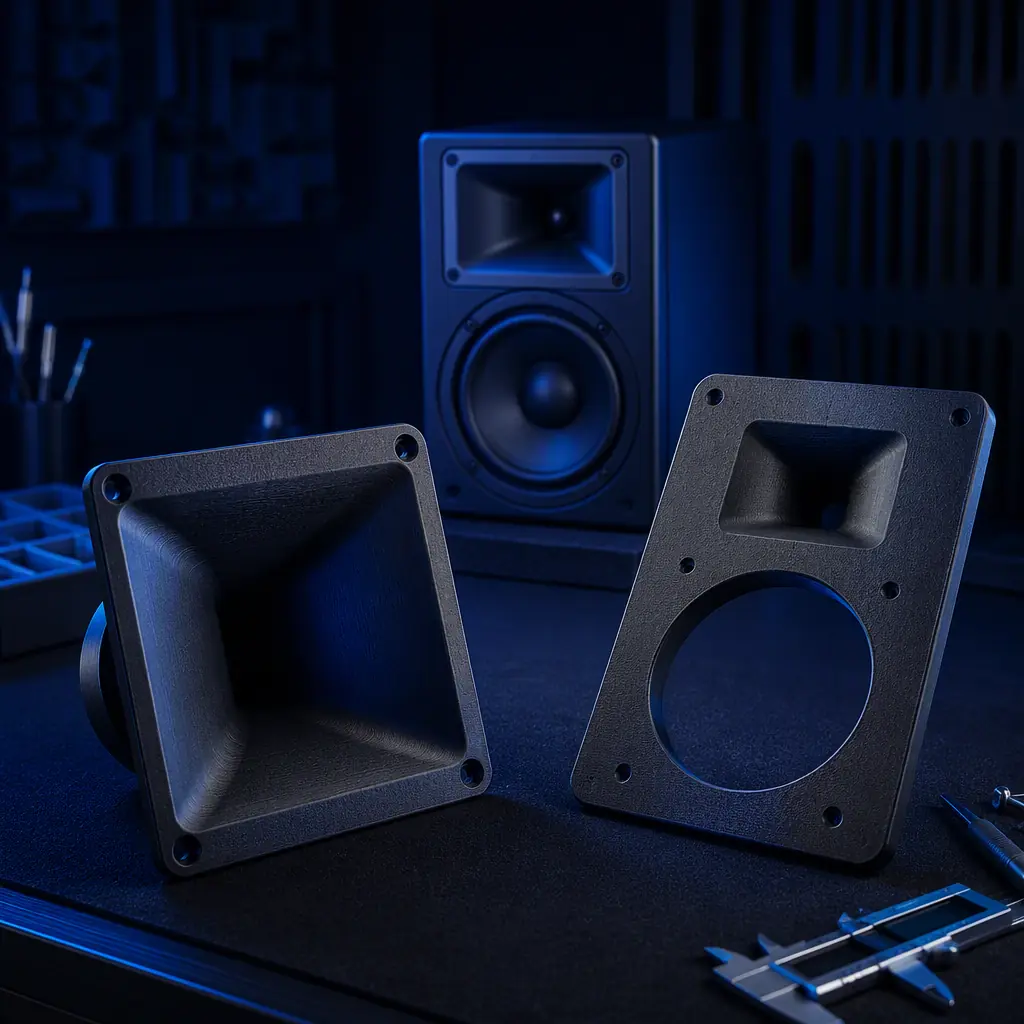
Waveguides, waveguide horns, tweeter faceplates, tweeter waveguides and mid-horn flares are the flagship parts of this vertical. They control off-axis dispersion and are the single most acoustically sensitive printed part. A printed waveguide is drawn as a smooth exponential or bi-radial flare, printed at a fine layer height with a low-resonance material, and it is often the difference between a launch that matches the target response and one that ships with a harsh signature. Because the geometry is unique to each cabinet and tweeter, the order quantity is usually 10-50 units per run and the part can be printed overnight, whereas a CNC or moulded version needs a weeks-long tooling lead. For material and layer-setting guidance that keeps the part stable and acoustically neutral, our FDM design-for-AM rules guide and our engineering-grade printer selection guide cover the setup you need.
Driver Baffle & Mounting Hardware
Behind every driver sits a network of parts that position, seal and trim it: driver baffle plates, driver mounting flanges, recessed mounting rings, driver gasket plates, rear-chamber caps and terminal-plate covers. These hold the driver flush and sealed into the cabinet, and they often need custom cutouts for a specific driver diameter and bolt pattern. A printed flange or baffle is cheap to re-run when the designer switches driver brands or revisits the cutout, and it avoids the weeks-long wait and tooling charge of a face-milled or cast version. Where the flange must resist cabinet vibration, a stiffer filled material is the right call, see our carbon-fibre filled filament guide for the stiffening options.
Assembly, Glue & QC Fixtures
The enclosure assembly line is where printed fixtures turn a fiddly manual process into a repeatable one. The useful targets are driver-press jigs, glue-application masks, panel alignment fixtures, crossover-mounting jigs, crossover boards, cable-clip mounts and QC test stands. A driver-press jig locates the driver in the cutout and applies even pressure while the adhesive cures; a glue mask keeps the bead where it belongs on a panel. These are short-run tooling parts that directly reduce assembly scrap, and they are exactly the kind of part that commands a premium because they save labour on every unit produced. For the broader jig-and-fixture opportunity, our rapid prototyping & R&D guide and our electronics manufacturing tooling guide are the relevant deep-dives.
Materials for Acoustic & Structural Parts
This vertical forces a choice between mass, damping and stiffness. For a waveguide or horn, you want a rigid, low-resonance, low-damping-loss part: PETG is a solid, affordable baseline that prints smooth; PC adds impact strength and better high-temperature stability for outdoor or pro-audio use; PA-CF delivers the stiffness-to-weight needed for a load-bearing baffle or flange without adding resonance. For a port or trim ring, a gloss aesthetic matters, so consider a post-processed surface. Avoid high-fill porous materials on an acoustic surface where surface roughness changes the dispersion signature, and always match the print orientation so the layer lines run along, not across, the flexing axis. See our polycarbonate filament guide, our engineering filaments guide and our post-processing & finishing guide.
What you're looking for: Acoustically critical → rigid low-resonance PETG or PC with fine layers and a smooth surface, orientation matching the acoustically loaded face; structurally loaded → PA-CF or PC for stiffness; high-gloss cosmetic → PETG/PC plus a vapour-smooth or wet-sand finish; always confirm the layer orientation resists the flex axis and gives a clean acoustic surface.
Distributor Economics: High-Mix, Low-Volume, Design-Led
Unlike a recurring consumable, pro audio is a design-led, project-by-project aftermarket. The value is not volume; it is the combination of speed-to-prototype and zero tooling cost on a geometry that keeps changing. A typical loudspeaker brand can generate $8,000–20,000/year in printed waveguide, flange, fixture and prototyping parts once you are the trusted local source. Because each new model and each acoustics iteration needs fresh geometry, and the tooling alternative would be a four-figure mould or a slow 5-axis job. The cadence is project-driven and the margin is excellent: you set the part price, typically at 50–70% under the equivalent CNC or cast part, and your material cost is a small fraction of it. That puts distributor gross margins at roughly 55–75% on printed parts.
The entry plan:
(1) Run a printer with a fine-layer capability and a hardened nozzle for filled materials, plus a low-resonance PETG or PC and a stiff PA-CF option. (2) Print a demo kit of the fastest-moving acoustic parts. A waveguide horn, a baffle plate, a mounting flange, a driver-press jig. (3) Approach local loudspeaker, hi-fi, car-audio and installed-pro-audio brands plus their OEM/ODM houses. (4) Lead with time-to-geometry and the zero-tooling message, because a launch missed by a stalled waveguide is a product cycle lost. For positioning a distributor business, our R&D & rapid prototyping guide and our portfolio & market-segment strategy guide are the relevant reads.
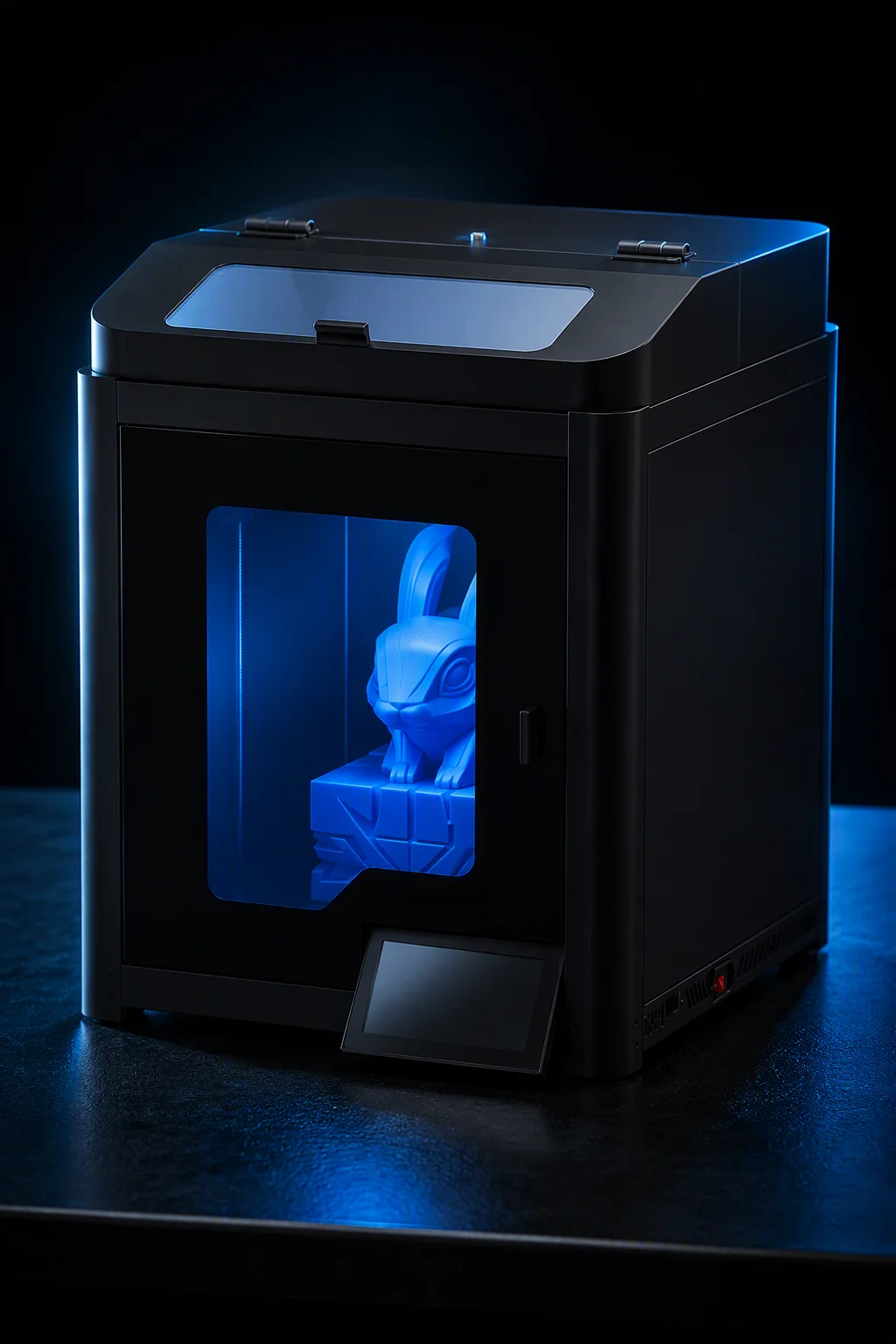
Pro audio is a geometry-driven niche, once a designer sees a printed waveguide hit the target response in 48 hours with no tooling spend, the printed part becomes the default for every new model and every acoustics revision. At Precise3D, our fine-layer, hardened-nozzle FDM platform with low-resonance PETG, PC and stiff PA-CF compatibility is built for exactly this: smooth, dimensionally accurate acoustic parts and fixtures, delivered on a 48-hour turnaround.
Reviewed by the Precise3D engineering & OEM team. Compliance files that accompany the catalog are auditable at the certification register.
Enter This Vertical
Ready to Supply Waveguides & Acoustic Fixtures to Loudspeaker Makers?
Join our network of global distributor network. Fine-layer, hardened-nozzle printers with low-resonance PETG, PC and stiff PA-CF capability, plus a demo kit of the fastest-moving waveguide, baffle and assembly-jig parts, everything you need to open the design-led pro-audio aftermarket.