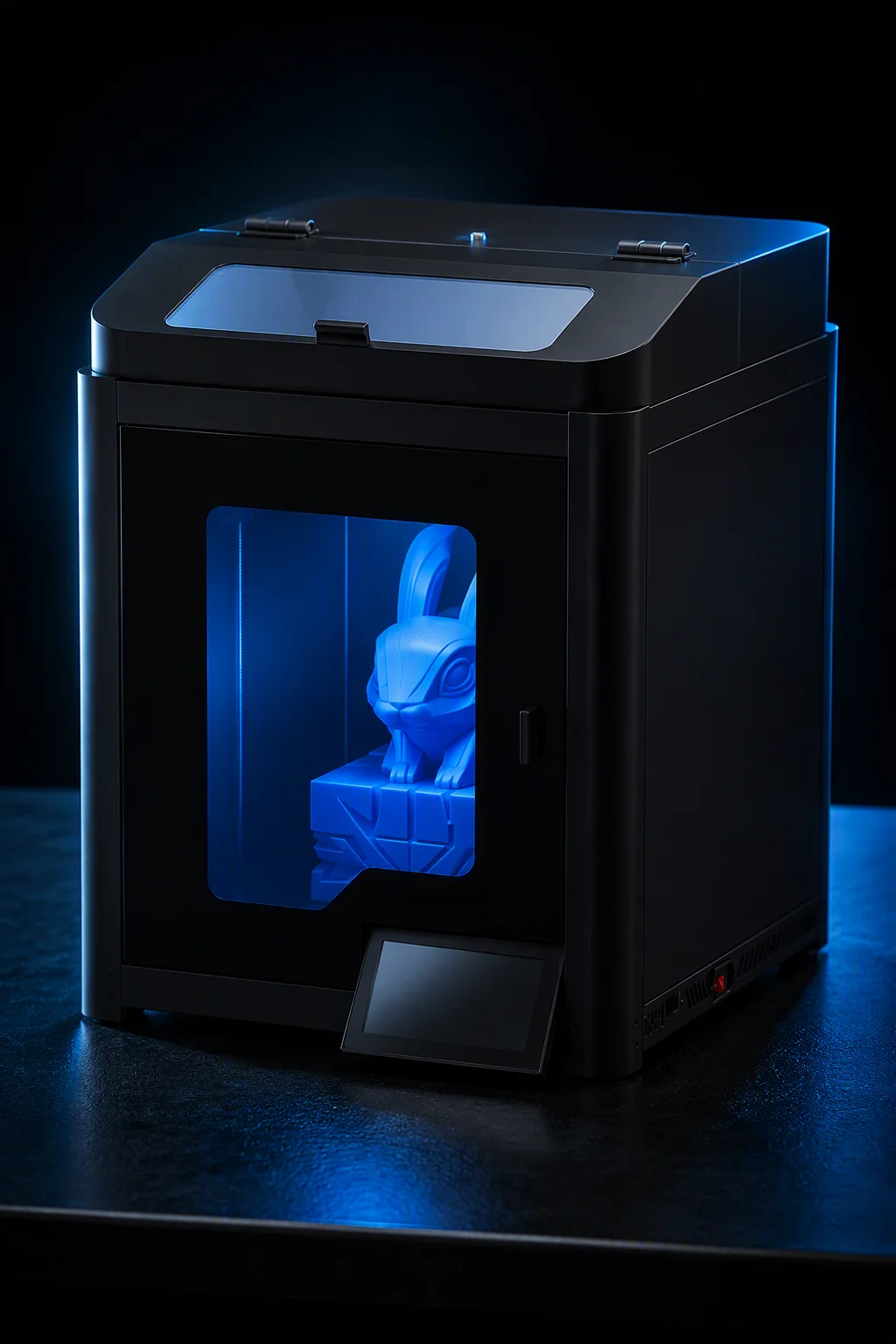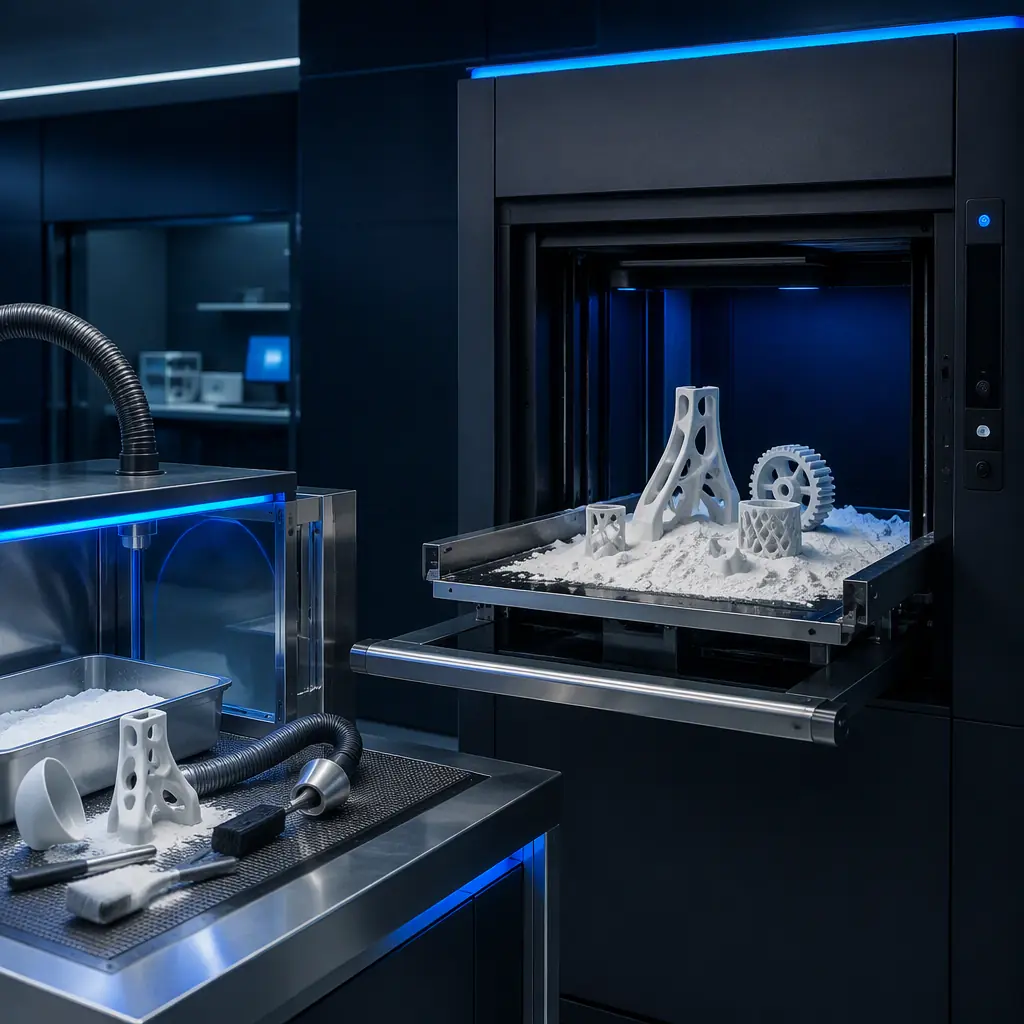
SLS demand follows a predictable pattern: customers who started with FDM and resin hit a wall when a part needs to be strong, durable, and support-free all at once. Hinges that snap, enclosures that warp, clips that fatigue — every one of those failures is a prospect for a nylon powder bed system. The machine fuses 50-80 micron nylon powder particles with a laser in 0.1 mm layers, and because the unsintered powder supports the part, there are no support structures to design, print, and remove. The part comes out of the powder cake ready for bead blasting. For the portfolio logic behind adding a third technology, see our portfolio strategy guide.
How SLS Works: Powder Bed Fusion Without the Metal Price Tag
SLS shares its physics with metal DMLS/SLM — both are powder bed fusion — but the machine cost, material cost, and safety envelope are an order of magnitude friendlier. A CO2 laser traces each cross-section across a heated bed of nylon powder held just below its melting point; the laser adds the final energy to fuse the particles. The bed lowers by one layer height, a roller spreads fresh powder, and the cycle repeats. Because the powder cake surrounds every part, overhangs and internal channels print without supports — a feature no FDM or resin process matches. For the metal-side comparison, see our metal 3D printing guide.
The economics surprise most distributors. Powder costs $60-120 per kilogram — versus $20-40 for engineering filament — but the cost per part is often competitive because SLS packs dozens of parts into one build. A job box filled with nested brackets and housings uses powder efficiently, and unused powder is recycled (typically 50/50 fresh-to-recycled ratio) rather than wasted. The real cost lever is utilization: an SLS machine that runs 24/7 produces parts at a cost per unit that beats resin for functional parts and approaches injection molding for short runs. For the machine economics framework, see our TCO & ROI calculator guide.
The Nylon Powder Lineup: PA12, PA11, and PA-CF
Three powders cover 90% of SLS demand, and stocking them is the whole consumables story. PA12 (nylon 12) is the default: excellent dimensional stability, low moisture absorption, and a proven track record in functional parts — the powder your customers should start with. PA11 is the tough cousin: bio-based, higher elongation at break (up to 45% versus PA12's ~20%), and preferred for living hinges, clips, and parts that flex repeatedly. PA-CF (carbon-fiber-filled nylon) delivers the stiffness: a flexural modulus roughly double that of neat PA12, making it the choice for structural brackets, drone frames, and tooling that carries load. For how these compare to the wider engineering material family, see our engineering materials guide and the PEEK/PEI/PPSU industrial materials guide.
What you're looking for: Failed functional parts are the SLS sales script. A customer who replaced a snapped PLA hinge twice is paying more in rework than a PA12 SLS part costs. The second question is volume: a customer who needs 50-500 identical functional parts per month is a utilization story; a customer who needs 5 is a job-shop story. Both buy, but the pitch is different.
SLS vs FDM vs Resin: Which Jobs Justify the Machine
The three technologies overlap less than distributors fear, and the sales conversation is about matching the technology to the failure mode. FDM wins on cost-per-part for large, non-critical prototypes and anything over about 300 mm — a full-size jig or a visual mockup is still an FDM job. Resin wins on surface finish and fine detail — dental models, jewelry patterns, and miniature components. SLS wins on everything else: functional parts that see load, parts with internal channels or living hinges that FDM cannot print without supports, small-batch production runs of 50-5,000 units, and any part where layer-line weakness is a liability. For the FDM/resin comparison, see our FDM vs resin guide; for the SLA/DLP/MSLA detail, see the resin technology guide.
The decision table below is the one to print and carry into sales conversations. It converts a customer's part description into a technology recommendation in under a minute — and it positions SLS as the upgrade path rather than a competitor to the FDM and resin machines the customer already owns.
What a Powder Room Really Requires
SLS is a powder process, and that changes the installation conversation. The machine needs a nitrogen purge or a sealed chamber, the powder needs dry storage (nylon absorbs moisture, and wet powder prints weak parts), and post-processing needs a bead blaster to remove clinging powder from the part surface. A practical setup is a benchtop SLS system plus a powder-handling station and a bead blasting cabinet in a dedicated room. The consumables story is richer than filament: fresh powder, recycled powder management, and post-processing media create a recurring revenue stream that follows every machine. For the installation and maintenance picture, see our maintenance guide and the fume extraction & filtration guide.
The recurring-revenue math is the strongest in the portfolio. An SLS machine consumes $2,000-6,000 of powder per month at full utilization, plus blasting media and replacement optics over time. A distributor with five SLS accounts is building $10,000-30,000 in monthly consumable revenue from a technology that most competitors are not yet stocking. For the consumables bundling approach, see our consumables bundling guide.
Real Applications: Where SLS Parts Earn Their Keep
SLS applications cluster in four groups, each with a different buyer. Functional prototypes are the entry application: design teams print working prototypes that survive bench testing, which FDM and resin parts often do not. End-use production parts are the volume application: brackets, housings, ducts, and enclosures in small batches that do not justify injection molding — the classic 50-5,000 unit band where SLS beats molded minimum order quantities. Manufacturing tooling is the factory application: jigs, fixtures, vacuum-forming tools, and conformal-cooling-adjacent tooling that rides the production line. Spare parts are the service application: discontinued components printed on demand instead of stocked. For the tooling angle, see our manufacturing tooling guide; for the end-use parts angle, see the end-use functional parts guide.
The Distributor Playbook: Entering SLS Without Overstocking
The SLS market is still young enough that distributors can enter with one machine line, one powder vendor, and a demo unit — no need to build a powder inventory before the first sale. (1) Start with a demo machine in your own facility: print customer parts in PA12 and PA-CF, and let the part quality sell the technology. (2) Sell the upgrade story, not the machine: the customer already owns FDM and resin; SLS is the fix for the parts that failed. (3) Pair the machine with a powder subscription: fresh powder, recycling service, and blasting media on a monthly schedule lock in the consumable revenue from day one. (4) Build the application library: a catalog of proven SLS parts (hinges, clips, brackets, ducts) with cost-per-part data converts prospects faster than any spec sheet. Sales cycles run 3-6 months, longer than FDM, because the customer is buying a new process — but the margins are higher and the competition is thinner. For the go-to-market sequence, see our dealership scaling roadmap.
Bottom Line
SLS is the technology that completes a 3D printer portfolio. FDM and resin cover the parts customers can already make; SLS covers the parts that fail — the hinges, clips, brackets, and functional components that FDM and resin simply cannot produce reliably. The machine economics are friendly (no supports, dense nesting, recycled powder), the material story is simple (PA12, PA11, PA-CF), and the consumable revenue is the richest in the industry at $2,000-6,000 per machine per month. Distributors who add an SLS line now are selling into a gap: most of their competitors are still quoting FDM for parts that need powder bed fusion. The distributor who puts a benchtop SLS system on the demo bench and a PA12 powder subscription behind it will win the functional-parts business that FDM and resin cannot touch.
Reviewed by the Precise3D engineering & OEM team. Compliance files that accompany the catalog are auditable at the certification register.
Start Your Partnership
Ready to Add SLS to Your Portfolio?
Join our network of global distributor network. SLS machines, nylon powders, and dedicated support.