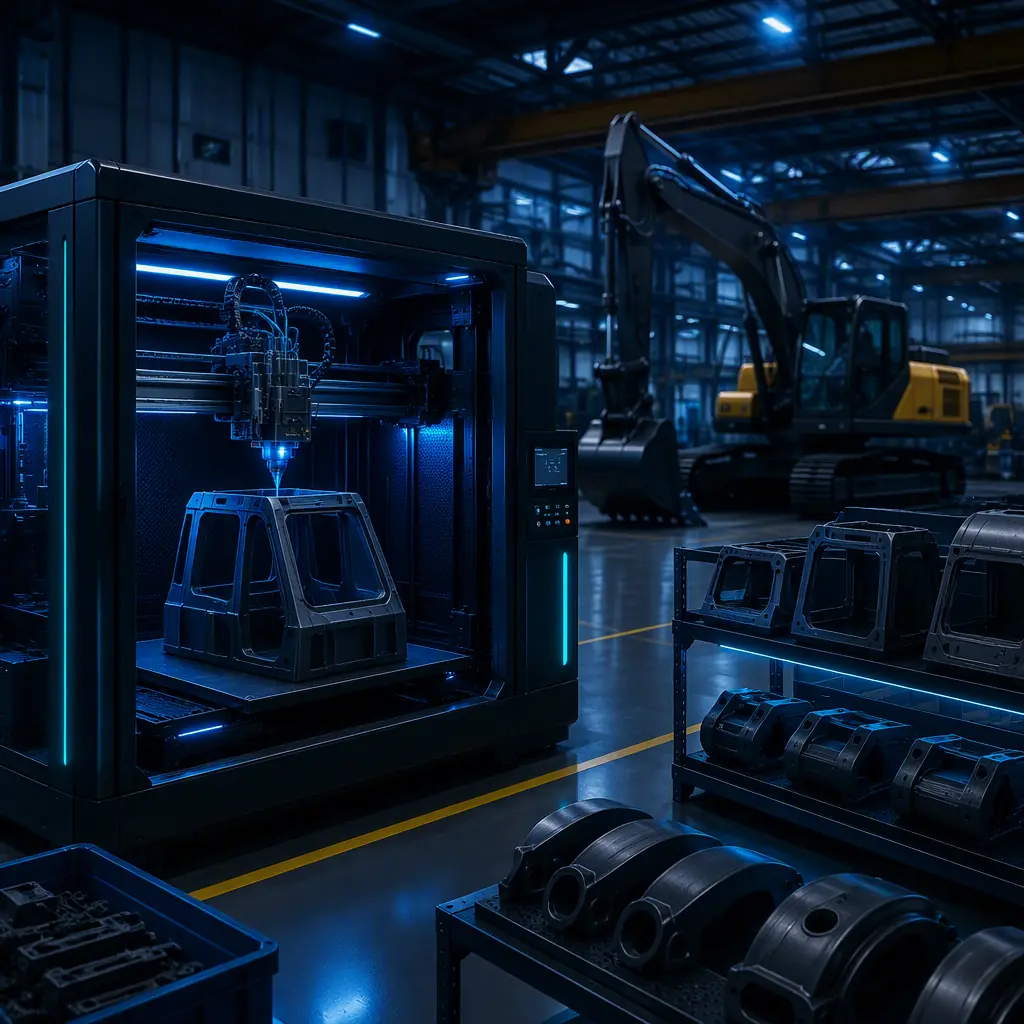
An equipment dealer in Texas serving a fleet of 300 excavators and wheel loaders was losing $800-2,500 per machine per month in downtime while waiting on OEM spare parts, small plastic components like switch bezels, air-vent grilles, and cable clips took 2-6 weeks to arrive. After installing an FDM printer in the service bay, the dealer now prints those same components in 1-3 days for $5-40 in material: service turnaround dropped from weeks to same-week, and the shop recovered 70% of the parts spend that previously went to OEM rush orders. Construction machinery is one of the most parts-hungry verticals in 3D printing. A single excavator has hundreds of non-structural plastic components, machines stay in service for 15-25 years, and OEMs discontinue spare parts long before the equipment is retired. For distributors, it is a service-parts market where uptime math, not part price, closes the sale.
Why Construction Machinery Is a Structural 3D Printing Buyer
Three facts make heavy equipment customers exceptional. First, the long tail of discontinued parts: machines operate for 15-25 years, and OEMs stop supporting plastic components after 7-10 years, printed replacements keep fleets running without scrapping otherwise healthy machines. Second, downtime economics: a rented excavator bills $800-2,500 per day, so a $30 printed switch bezel that saves a week of waiting is worth a thousand times its material cost. Third, fleet-scale repeatability: a dealer with 300 machines needs the same bracket, clip, or cover for dozens of units, printed parts make that repeatability immediate. The wear-and-tear material discipline is covered in our engineering filaments guide.
The Applications That Actually Buy
Five clusters generate repeat orders. The buyers are equipment dealers, rental fleets, heavy machinery OEMs, aftermarket parts distributors, and fleet maintenance shops.
1. Cab and interior components. The flagship application. Switch bezels, vent grilles, grab-handle brackets, cup holders, and trim clips printed for fleet replacement. These parts must match OEM mounting geometry precisely, and printed tolerances of ±0.2-0.3 mm are sufficient for most cab interfaces. The dimensional control discipline is covered in our tolerances & dimensional accuracy guide.
2. Hydraulic and engine-compartment parts. Reservoir caps, breather covers, hose guides, cable clips, and access-panel latches. These parts sit near heat and vibration, so material selection is critical, glass-filled nylon and PC-ABS are the workhorses. Threaded interfaces for metal inserts are covered in our heat-set inserts guide.
3. Service tooling and shop fixtures. Seal-installation tools, bearing puller guards, filter-wrench adapters, and alignment fixtures for the service bay. Custom tooling is one-off by nature, exactly what additive manufacturing does best. The tooling discipline is detailed in our manufacturing tooling guide.
4. Exterior guards and covers. Mirror brackets, light housings, mud-flap mounts, and sensor covers for GPS and camera systems. These parts face UV, mud, and impact, so ASA and UV-stabilized materials are required for outdoor survival. The weather-resistant material map is covered in our outdoor weather-resistant printing guide.
5. Legacy and orphaned-machine parts. Components for machines whose OEM spares are no longer available. A dealer with a parts library of printed replacements can keep orphaned machines in service and win service contracts that competitors cannot touch.
Materials and Finish for Heavy Equipment
Construction parts must survive vibration, heat, UV, and occasional impact. The map distributors should stock:
Two traps: (1) heat and vibration are the killers, engine-compartment parts need glass-filled nylon or PC-ABS with data sheets, not PETG for every application; (2) fleet consistency is part of the product, a dealer replacing parts across 50 machines needs repeatable print settings, so distributors must provide validated print profiles and orientation notes, not just filament. The finishing and surface treatments that extend part life are covered in our post-processing & finishing guide.
Economics: OEM Rush Order vs Printed
The comparison that closes heavy equipment accounts:
The distributor math is attractive because the purchase is systemic: once a dealer validates a printed service-parts workflow, every machine in the fleet and every future project flows through the same printer, filament, and design support. A mid-size dealer can consume $8,000-20,000/year in filament and printed production parts, before counting the printer itself. For building this ROI case, use our TCO/ROI calculator guide.
The Distributor Playbook: Entering Construction Machinery
The winning playbook has five moves:
1. Anchor on uptime, not part price. The pitch is "same-day replacement parts that keep your fleet billing". Cost savings are the confirmation, uptime is the decision. Bring the daily-billing math to every presentation.
2. Offer service-parts-on-demand. Dealers do not want to run a print farm in their service bay. A distributor offering parts-on-demand service (dealer sends a worn part or part number, distributor prints and ships a production-grade replacement in 1-3 days) turns a printer sale into a recurring service line. The service economics are developed in our after-sales support strategy.
3. Build the parts library. The moat is the catalog: a dealer with 300 machines needs a searchable library of print-tested replacement parts with validated profiles. Build it with the dealer's permission, and the library itself becomes the reason they stay.
4. Stock the heavy-equipment material set. Glass-filled nylon, PC-ABS, ASA, nylon, PETG, and TPU are the true margin engine, plus validated print profiles for each. A dealer replacing 30-60 parts per month consumes 20-40 kg of filament monthly; a filament-plus-parts subscription locks the account.
5. Win the orphaned-machine niche. Machines whose OEM spares are discontinued are the highest-value opportunity. No competition, urgent need, and the dealer will pay a premium for a working part today. One solved orphaned machine recruits the next, equipment dealers talk constantly at CONEXPO, bauma, and regional heavy-equipment auctions.
Common Pitfalls in Heavy Equipment Accounts
Five mistakes account for most failed initiatives: (1) selling the wrong material for engine-compartment parts, PETG near a diesel engine fails within months, while glass-filled nylon survives for years; (2) ignoring fleet consistency, a dealer replacing parts across 50 machines needs repeatable print profiles, not one-off prints; (3) underselling the parts library, the catalog is the moat, so in-house design and documentation capability is the differentiator; (4) underselling the consumable model, the printer is the foot in the door, but filament contracts and parts-on-demand retainers are where margin compounds; and (5) neglecting the rental channel, rental fleets have the highest downtime cost per hour and the most urgent parts needs, so a distributor must serve them with same-day response, not standard lead times. The discipline of documenting measurable outcomes mirrors what we teach for end-use parts in our end-use functional parts guide.
Getting Started: The First 90 Days
A 90-day entry plan: Month 1 . Stock glass-filled nylon, PC-ABS, ASA, nylon, PETG, and TPU with validated print profiles, plus a small demo kit of common cab and engine-compartment parts, and identify 10-15 target accounts (equipment dealers, rental fleets, heavy machinery OEMs, aftermarket parts distributors, fleet maintenance shops) within a 3-hour drive. Month 2 . Run two pilot parts-on-demand projects at cost-plus-10% to build documentation evidence and a parts library; document uptime impact and parts-spend recovery. Month 3 . Convert pilots to full accounts with filament-and-parts subscriptions and parts-on-demand retainers, publish your first co-branded case study with measured numbers ("excavator switch bezel: $180 OEM rush → $18 printed, 1-day delivery, machine back on rent in 2 days"), and exhibit at a regional heavy-equipment or construction-technology event. If you already serve mining, oil & gas, or agricultural accounts, our mining & heavy industry guide and oil & gas guide show how the same service-parts logic transfers directly to construction machinery.
Reviewed by the Precise3D engineering & OEM team. Compliance files that accompany the catalog are auditable at the certification register.
Enter the Heavy Equipment Market
Ready to Supply Construction Machinery Dealers?
Get wholesale pricing on large-format FDM printers, glass-filled nylon and PC-ABS engineering filament lines, and the parts-on-demand service playbook that wins construction machinery accounts.