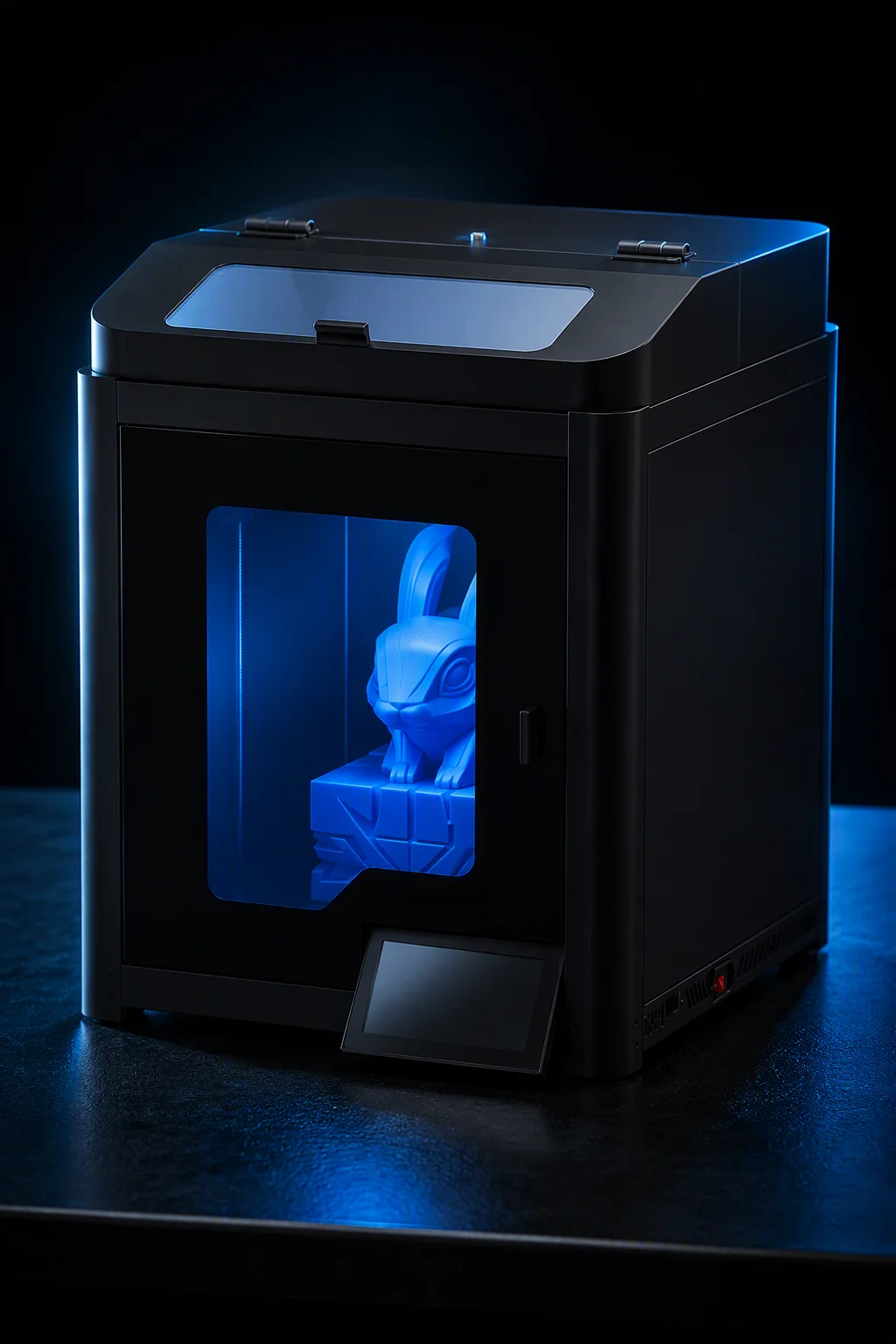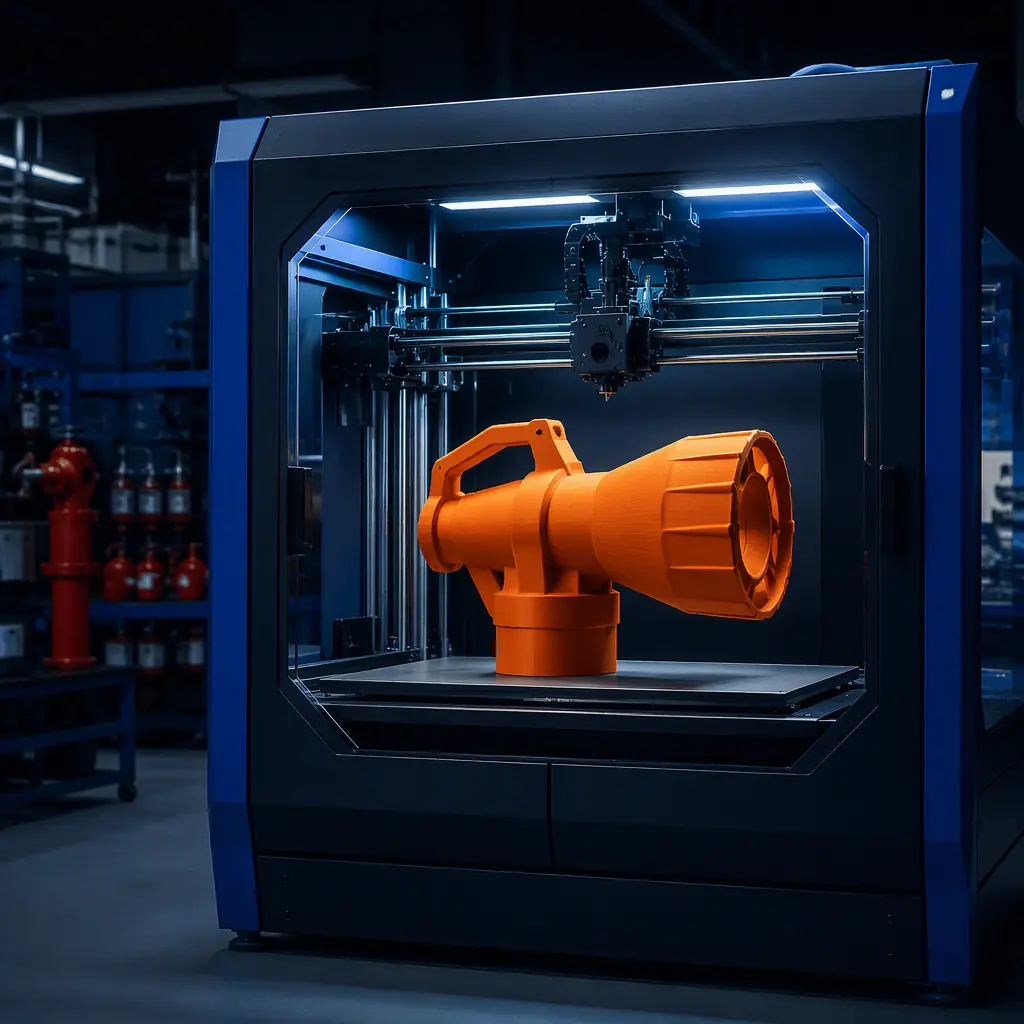
A fire equipment manufacturer in Ohio needed a new smooth-bore nozzle tip for a municipal contract. Machining the first article took three weeks and $4,800; a printed PETG-CF prototype was on a flow bench within 48 hours at a material cost of $60. The design team iterated the throat geometry four times in one week, a cycle that used to consume a quarter, then sent the final geometry to CNC for the production run. Fire and safety equipment is a certification-heavy, low-volume, high-stakes industry: parts must meet UL, NFPA, and EN standards, orders come in small batches, and every department or station has a unique retrofit problem. Those are exactly the conditions where 3D printing earns its keep, from the factory floor to the service bench.
Why Fire & Safety Is Buying 3D Printers
Four structural facts make this a durable buyer. First, certification-driven iteration: getting a nozzle, valve, or housing through UL or NFPA testing means physical revisions, and printing collapses each revision cycle from weeks to days. Second, legacy equipment support: fire departments run gear for decades, and manufacturers face a constant stream of "you stopped making this part in 2009" requests, the same reproduction logic that drives our railway & transit guide, where 20-year-old rolling stock needs parts nobody tools anymore. Third, customization at the station level: every department rigs its apparatus differently, so mounts, brackets, and adapters are inherently low-volume and custom. Fourth, training demand: fire academies need realistic training aids, simulators, and prop replicas that are expensive to buy and cheap to print. The industrial safety markets that buy the same way are covered in our oil & gas guide and mining & heavy industry guide.
The Applications That Actually Buy
Six clusters generate the orders. The buyers are fire equipment manufacturers, SCBA and PPE service centers, nozzle and hydrant makers, safety product companies, fire academies, and municipal workshop crews.
1. Nozzle and hydrant components. The flagship application: smooth-bore tips, fog nozzle bodies, playpipe adapters, and hydrant fittings. Printed prototypes go straight to flow testing, and printed jigs align the machining of production runs. A nozzle tip that cost $800-2,500 and three weeks to machine now costs $40-120 and prints overnight.
2. SCBA and regulator parts. Housings, covers, gauge bezels, and valve knobs for self-contained breathing apparatus. Service centers use printing to replace discontinued parts and to produce the test fixtures required by NFPA 1852 compliance checks. The strength and material logic is in our frame rigidity & materials guide.
3. Helmet and PPE accessories. The volume driver: helmet brackets, radio mounts, face-shield adapters, flashlight holders, and strap keepers. Every department standardizes differently, so this category never stops reordering. And it is the natural entry point for a distributor.
4. Apparatus and station tooling. Custom wrenches for valve stems, hose-rack fixtures, compartment organizers, and station key boxes. Firehouses are small workshops that fabricate constantly; FDM printers run nearly non-stop here.
5. Hazmat and industrial safety gear. Secondary containment fittings, decontamination line parts, gas-detector mounts, and confined-space rescue hardware. The high-performance material needs of hazmat work mirror those of our energy & renewables guide.
6. Training aids and simulators. Fire academies buy printed props: nozzle-flow trainers, door-forcing simulators, SCBA obstacle course fixtures, and scale model apparatus for officer training. Budgets here are stable and repeat annually.
Materials for Safety-Critical Parts
Safety buyers are more material-disciplined than any other vertical because lives depend on the parts:
One fact dominates material conversations: flame retardancy. Any part that sits near heat or in a fireground environment must meet UL 94 or local flammability ratings, which pushes serious shops toward PEEK, PEI, and PA lines, the high-temperature material selection is detailed in our PEEK/PEI/PPSU industrial materials guide. Certification requirements across the account are covered in our certification & compliance guide.
From Spec to Station: The Safety Equipment Workflow
The workflow that wins safety accounts has five stages. Spec review . Confirm the standard the part must meet (UL, NFPA, EN) and which properties are non-negotiable. Design or scan . Legacy parts are digitized with a 3D scanner; the scanning selection logic is in our scanner & printer bundle strategy. Print. FDM for structural and prototype parts, with high-temperature materials for heat-adjacent applications; the printer selection logic is in our buyer's guide by price tier. Finish and verify . Clean, dimension-check, and test (flow bench for nozzles, leak test for housings). Document . Safety buyers need material datasheets, print settings, and test records filed with the part; a distributor who provides the paperwork sells the next order. Shops that master this flow quote jobs their competitors refuse, and the machine settings that get them there are in our slicer software guide.
Budget Reality: Printed vs Traditional
The comparison that closes safety accounts:
The distributor math compounds because safety shops are consumable-hungry: a busy service center printing PPE accessories and replacement parts can consume 15-40 kg of filament per month, plus nozzles, build plates, and spare hotends, the recurring-revenue model is developed in our consumables & accessories bundling guide.
The Distributor Playbook: Entering Fire & Safety
Five moves win safety accounts:
1. Target the service centers first. SCBA and PPE service centers, nozzle rebuild shops, and municipal workshop crews are the repeat buyers; manufacturers prototype in bursts. Build a target list of 20-30 service centers and workshops in your region.
2. Sell the compliance workflow, not the printer. The pitch is "NFPA inspection fixture in a day, legacy regulator part in two." Bring a finished demo part with its material datasheet and test record, a safety buyer's first question is always documentation.
3. Stock the safety material set. PETG, PA12, ASA, TPU, and one high-temperature line (PEEK or PEI) plus spare nozzles and build plates. The high-temp capability of the printers you sell matters here more than speed, see our heated chamber guide for why.
4. Offer the print-to-test service. Many small service centers and academies will not own a printer. A distributor offering print-to-test service (customer sends a spec or legacy part, distributor delivers a tested part) captures the work before they buy, the service economics mirror our after-sales support strategy.
5. Work the academy pipeline. Fire academies buy training props every budget cycle and teach the next generation of mechanics and officers, the education procurement channels are covered in our education & university guide. An academy account seeds the departments of tomorrow.
Common Pitfalls in Fire & Safety Accounts
Five mistakes cost distributors safety business: (1) selling non-rated parts for rated applications . A printed part replacing a UL-rated component without documentation creates liability, so always confirm whether the application is cosmetic, non-rated, or rated, and sell accordingly; (2) ignoring the documentation requirement . Safety buyers file material datasheets and test records; a distributor who cannot produce them loses the account; (3) underestimating heat exposure . A part near an engine bay or exhaust needs PEEK or PEI, not PETG, and selling the wrong material once ends the relationship (the high-temp material logic is in our industrial materials guide); (4) treating departments as one customer . Every department is its own buyer with its own budget cycle, so build a territory list, not a single account; and (5) skipping the printer's own safety story . When you sell a printer into a safety culture, the machine's own thermal-runaway protection and power-loss recovery matter, the safety feature set is detailed in our printer safety features guide.
Getting Started: The First 90 Days
A 90-day entry plan: Month 1 . Identify 20-30 target accounts (SCBA service centers, nozzle rebuild shops, municipal workshops, safety product companies, fire academies) and stock the safety material set: PETG, PETG-CF, PA12, ASA, TPU, plus a PEEK/PEI line and spare nozzles. Month 2 . Produce a finished demo part with full documentation, run two pilot jobs at cost-plus-10% (a legacy SCBA part and a helmet accessory batch) to build documented evidence, and offer print-to-test service to two service centers. Month 3 . Convert pilots to full accounts with filament subscriptions and a 48-hour reprint SLA, publish your first measured case study ("legacy regulator housing: unavailable → 2 days, $140"), and open one academy account. The printer investment model that justifies the distributor's own machines is in our TCO & ROI calculator guide.
Reviewed by the Precise3D engineering & OEM team. Compliance files that accompany the catalog are auditable at the certification register.
Enter the Safety Market
Ready to Supply Fire & Safety Accounts?
Get wholesale pricing on FDM and high-temperature printers, PETG/PA/ASA/TPU and PEEK/PEI filament lines, spare parts, and the fire-and-safety playbook that wins compliance-driven accounts.