The fitness equipment market splits into four buyer groups: commercial gym operators (big-box chains, boutique studios, hotel and corporate fitness rooms) who maintain 50-500 machines per location, fitness equipment manufacturers (treadmills, ellipticals, strength machines, accessories) who prototype and produce low-volume parts, home-fitness brands that ship direct to consumers, and service and repair companies that keep gyms running. Every group shares one structural trait: fitness machines take brutal, high-cycle abuse, a commercial treadmill runs 8-16 hours a day at speeds up to 20 km/h, and their plastic parts (pulleys, guards, brackets, grips, console housings) wear out on a predictable schedule. When a part fails on a $8,000 treadmill, the OEM part is $120-400 and takes two weeks; the printed equivalent is $2-15 and takes a day. That recurring economics makes fitness one of the most dependable verticals for 3D printing, and a perfect fit for distributors who already sell consumables and aftermarket parts.
Why Fitness Is Buying 3D Printers
Four structural facts make fitness a durable buyer. First, wear-part churn: grips, pulley wheels, rollers, guards, and housing clips fail on commercial machines within 2-5 years, and a 100-machine gym replaces hundreds of parts annually; the recurring-replacement logic is the same one we map in our spare parts & aftermarket revenue guide. Second, discontinued support: equipment manufacturers refresh product lines every 3-5 years and drop parts support for older models, stranding gyms with machines that still work but cannot be repaired, a printed-bracket market with zero competition. Third, customization demand: gyms want branded grips, custom attachments, and color-matched accessories; members pay premium for specialty gear like fractional plates, grip enhancers, and mobility tools. Fourth, prototyping velocity: equipment manufacturers iterate on new machines and accessories constantly, and 3D printing compresses their development cycle from months to days, the same speed logic covered in our rapid prototyping & R&D guide.
The Applications That Actually Buy
Six clusters generate the orders. The buyers are commercial gym operators, equipment manufacturers, home-fitness brands, repair companies, accessory brands, and physical-therapy studios.
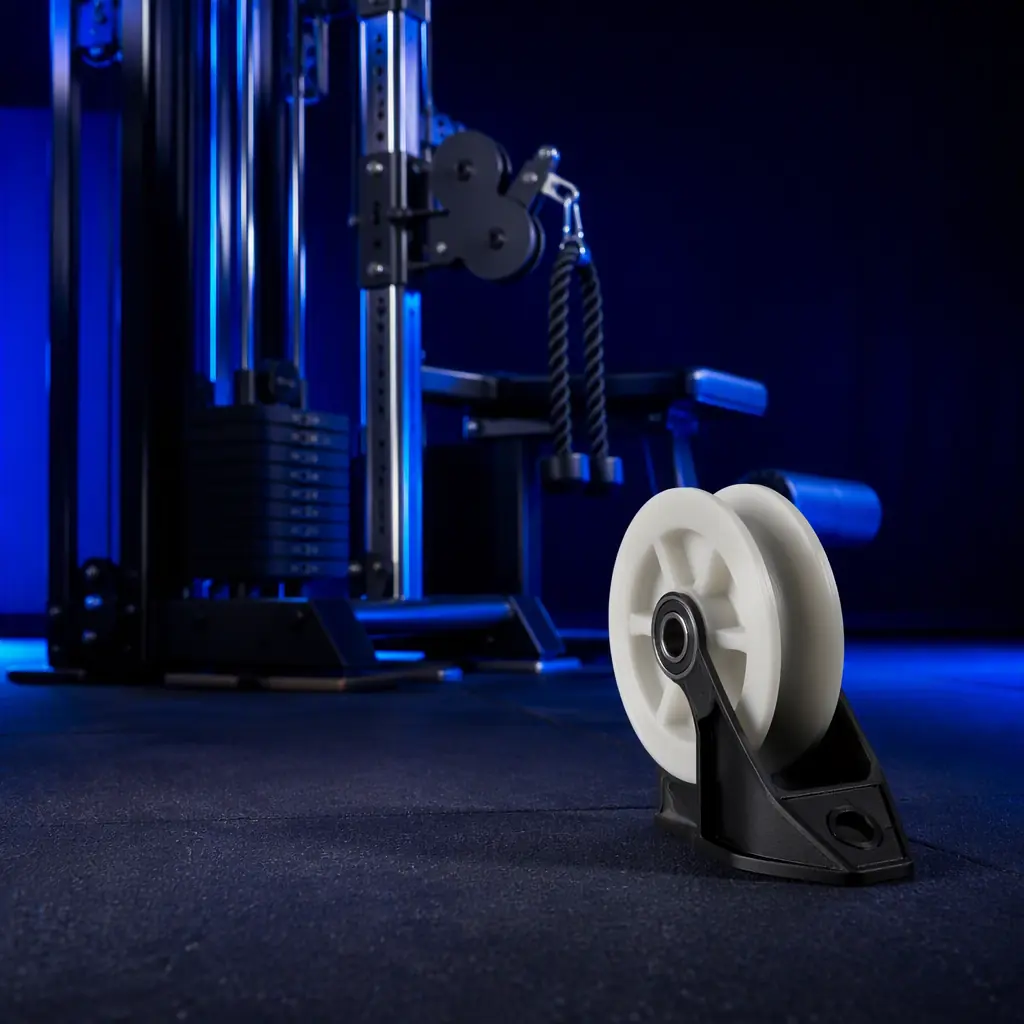
1. Replacement wear parts. The flagship application: pulley wheels, roller bearings housings, belt guards, console brackets, foot-plate bushings, and housing clips for treadmills, ellipticals, and cable machines. A printed pulley wheel costs $3-12 and ships in a day; the OEM part costs $80-400 and takes 1-3 weeks. The part-versus-purchase decision framework is developed in our TCO & ROI calculator guide.
2. Grips and touch surfaces. Knurled kettlebell grips, dumbbell handle sleeves, pull-up bar grips, and rowing-handle covers. These are TPU parts that must feel right in the hand. Gyms replace them constantly, and the flexible-filament selection logic is covered in our flexible filaments guide.
3. Custom accessories. Fractional plates, plate holders, cable attachments (rope handles, tricep straps, ankle cuffs), landmine handles, and mobility tools. This is the premium accessory market where boutique brands sell printed gear at 5-10x material cost, the small-batch production economics are in our print farm operations guide.
4. Manufacturing jigs and fixtures. Assembly fixtures, alignment jigs, and test fixtures for treadmill and strength-machine production lines. Equipment manufacturers use printed tooling to cut assembly time and error rates, the tooling economics mirror our manufacturing tooling guide.
5. Prototyping new equipment. Full-scale mockups of console housings, frame brackets, and accessory mounts before sheet-metal and injection tooling is committed. The prototype-to-production path is detailed in our injection molding vs 3D printing guide.
6. Accessibility and rehab gear. Adaptive grips, handle extenders, and therapy aids for physical-therapy studios and inclusive gyms, steady, high-loyalty, low-volume demand that compounds across accounts.
Materials for Fitness Equipment
Fitness buyers work in three material worlds, structural, touch, and cosmetic:
Two realities dominate material conversations. First, load and fatigue: pulley wheels and brackets carry repeated dynamic load, so nylon or PC-ABS is the honest recommendation over PLA or PETG for anything structural, the engineering-material selection framework is in our engineering filaments guide. Second, touch and sweat: grips and handles face sweat, chalk, and cleaning chemicals daily, so TPU with documented chemical resistance wins over materials that degrade. The durability and certification logic is covered in our certification & compliance guide.
From Failed Part to Back in Service: The Fitness Workflow
The workflow that wins fitness accounts has five stages. Identify the failure . Gym maintenance teams catalog failures by machine type; teach them that pulleys, guards, grips, and brackets are all printable. Model or scan . Most legacy parts are reverse-engineered from the failed sample or the OEM drawing; pair printer sales with a 3D scanner bundle using the playbook in our scanner + printer bundle guide. Match the material . Structural parts get nylon or PC-ABS, touch parts get TPU, cosmetic parts get ASA or ABS. Print, test, and install . Verify fit and load on the actual machine, then document the part in the gym's maintenance system; the qualification workflow is in our incoming QC guide. Build the parts library . The winning distributors maintain a digital catalog of common fitness parts per machine brand, turning a one-off bracket into a 50-part-per-month relationship.
Budget Reality: OEM vs Printed
The comparison that closes fitness accounts:
The distributor math compounds because fitness is consumables-rich: every commercial machine consumes grips, rollers, cleaning supplies, and lubrication on a schedule, and a 100-machine gym is a $5,000-15,000 per year consumables account, the recurring-revenue model is developed in our consumables & accessories bundling guide.
The Distributor Playbook: Entering Fitness
Five moves win fitness accounts:
1. Target the gym chains and service companies. Commercial gym operators and independent equipment service companies face wear-part churn weekly. Build a target list of 20-30 gym chains, boutique studios, and repair companies in your territory.
2. Lead with the downtime pitch. The pitch is "any failed part, printed in structural material, back on the machine in 48 hours." Bring a demo kit of three real parts: a pulley wheel, a grip sleeve, and a console bracket, gym buyers approve what they can install.
3. Bundle the material ecosystem. Nylon, TPU, and PC-ABS are the anchors; the margin is in filament subscriptions, nozzles, build plates, and finishing supplies. The bundling mechanics are in our consumables bundling guide.
4. Offer the parts-library service. Most gyms do not have CAD skills or part catalogs. A distributor that maintains a digital library of common fitness parts and prints on demand captures the account before anyone else, the services-stickiness logic is in our after-sales support strategy.
5. Work the refresh cycle. Gyms refresh equipment and accessories every 3-5 years, and January (new-year resolutions) is the biggest sales window. Time outreach to pre-resolution buying and pair hardware with the seasonal inventory planning playbook from our seasonal inventory guide.
Common Pitfalls in Fitness Accounts
Five mistakes cost distributors fitness business: (1) selling PLA for structural parts. PLA is brittle and creeps under load, and a snapped pulley wheel on a loaded cable machine is a liability incident; nylon or PC-ABS is the honest recommendation for anything load-bearing; (2) ignoring load testing . A part that fits can still fail under 200 kg of dynamic load; test pulleys and brackets to failure before promising them (the QC framework is in our factory audit & QC checklist guide); (3) skipping UV and chemical resistance . Gym parts face sunlight, sweat, and harsh cleaning chemicals; ASA and TPU outlast ABS and PLA in real gyms; (4) treating gyms like consumers . A 30-location chain is an enterprise account with service contracts and volume pricing; and (5) ignoring safety certification . Structural parts on commercial equipment can fall under liability scrutiny, so document material and load data from day one using the framework in our certification & compliance guide.
Getting Started: The First 90 Days
A 90-day entry plan: Month 1 . Identify 20-30 target accounts (gym chains, boutique studios, equipment service companies, home-fitness brands) and stock the fitness material set: nylon PA12, PA-CF, TPU, PC-ABS, ASA, plus nozzles, build plates, and finishing consumables. Month 2 . Produce a finished demo kit (pulley wheel, grip sleeve, console bracket) with load-test data, run two pilot jobs at cost-plus-10% (a wear-parts batch for one gym and a custom accessory run for one studio), and offer the parts-library service to one gym chain. Month 3 . Convert pilots to full accounts with filament subscriptions and a 48-hour parts SLA, publish your first measured case study ("discontinued console bracket: 2 weeks → 1 day, $2.10/part"), and open one equipment-manufacturer account. The printer investment model that justifies the distributor's own machines is in our TCO & ROI calculator guide. The sustainability angle also lands with modern fitness brands. The recycled and low-waste filament playbook is in our sustainable & recycled filament guide.
Reviewed by the Precise3D engineering & OEM team. Compliance files that accompany the catalog are auditable at the certification register.
Enter the Fitness Equipment Market
Ready to Supply Gyms & Fitness Equipment Companies?
Get wholesale pricing on engineering printers, nylon and TPU filament lines, 3D scanners, nozzles, build plates, finishing supplies, and the fitness-market playbook that wins gym chains and equipment manufacturers.