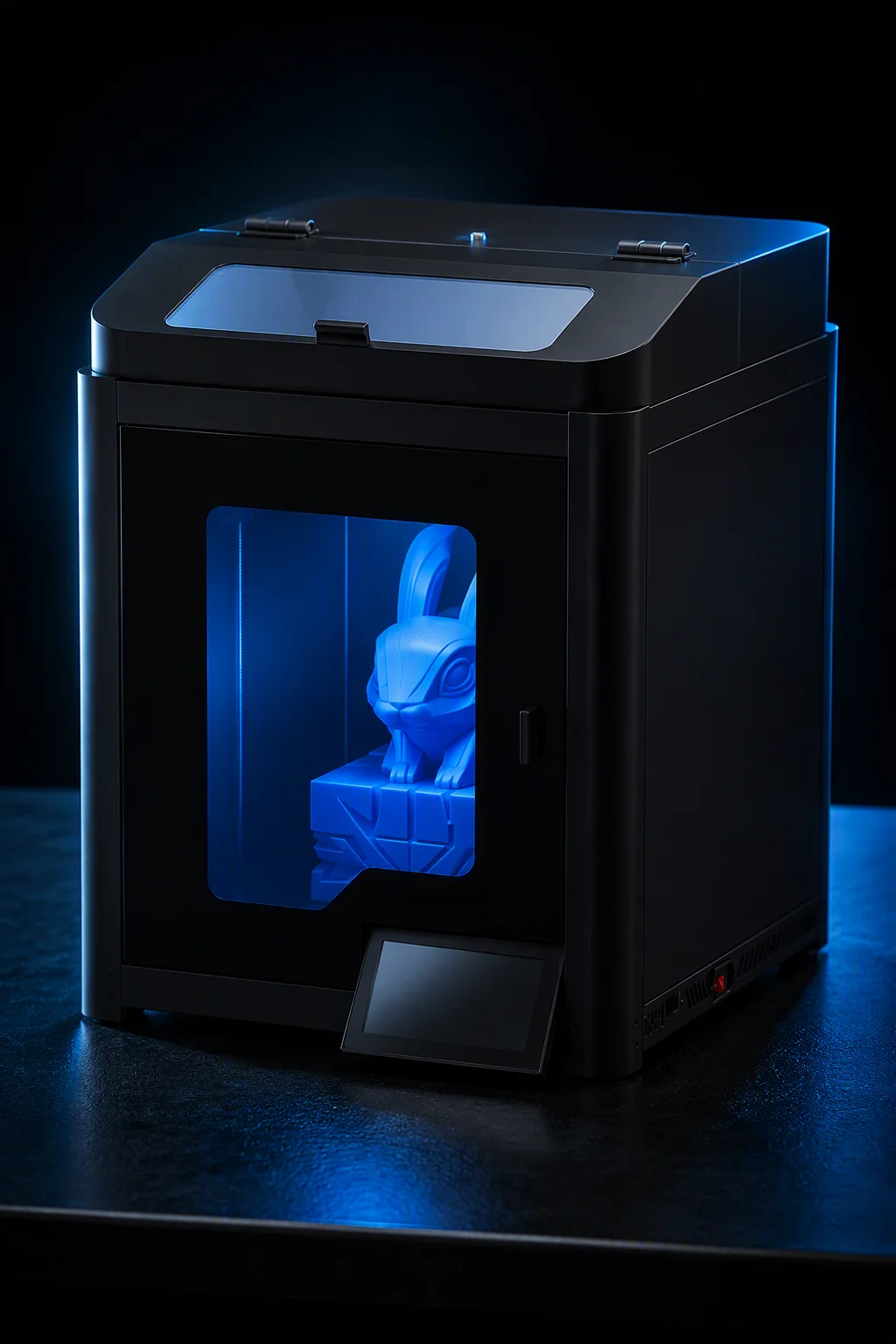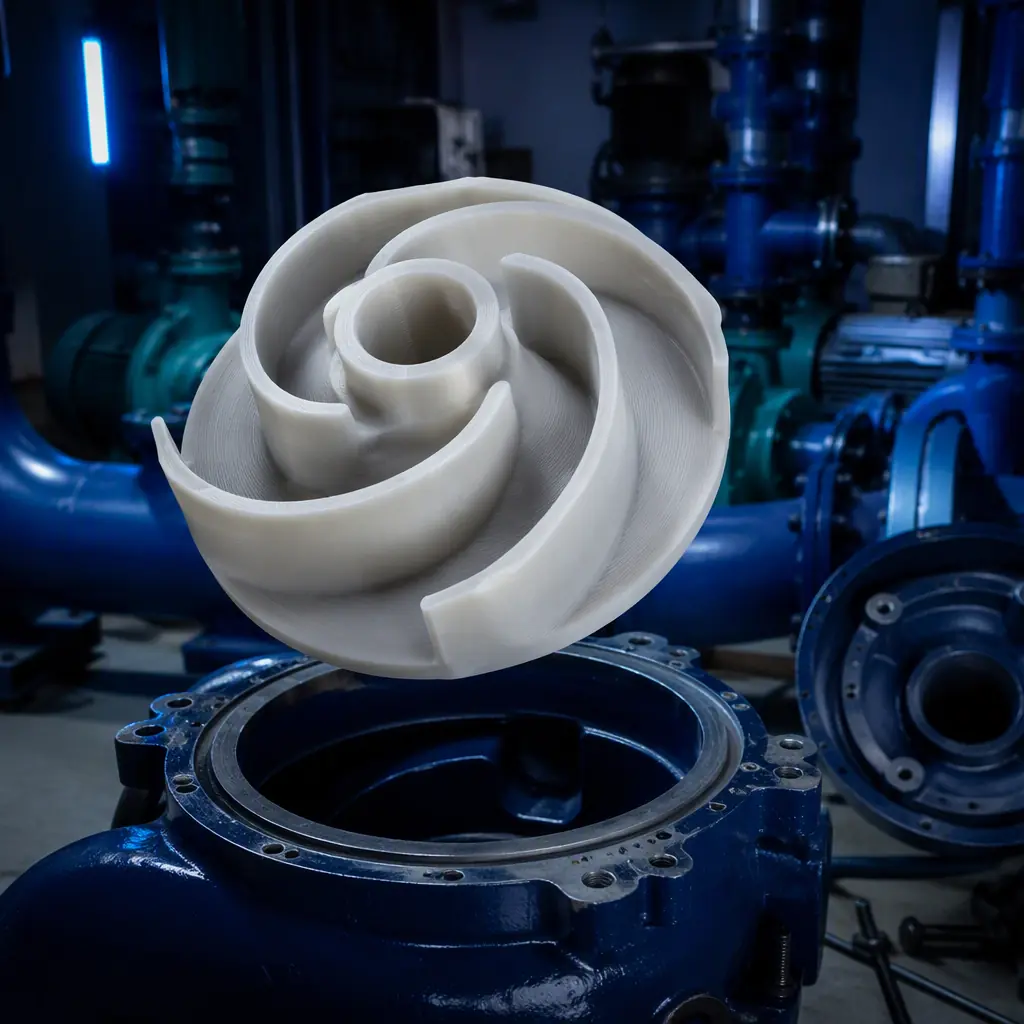
A municipal water utility in Ohio kept a 1998 vertical turbine pump online by replacing its bronze impeller with a printed polypropylene version: the original casting had an 11-week OEM lead time and a $4,200 price tag, while the printed impeller was produced in 4 days for $180, balanced, and installed in the same wet well. The utility's maintenance superintendent now keeps a large-format FDM printer and a shelf of engineering filaments in the pump shop, and every one of the district's 47 pumps has a scan-to-print replacement file on file. Pumps and valves are the most physically demanding maintenance market in industrial 3D printing. Rotating equipment runs continuously, wear parts erode on a predictable calendar, and castings for legacy equipment become scarce or unobtainable. For distributors, it is a specification-driven market where chemical compatibility and dimensional accuracy, not price, close the sale.
Why Pumps & Valves Are Structural 3D Printing Buyers
Three facts make fluid-handling customers exceptional. First, continuous operation: process pumps and control valves run 24/7 in water, wastewater, chemical, oil & gas, and food plants, and a failed impeller or valve seat shuts down a line. Downtime at a mid-size chemical plant runs $5,000-30,000 per hour. Second, predictable wear: impellers, wear rings, and valve seats erode on a documented schedule (typically 12-36 months depending on media), which means repeat orders are calendar-driven, not crisis-driven. Third, obsolete castings: pump OEMs change designs every 5-10 years, and castings for installed base equipment are frequently discontinued. Printed replacements are often the only documented path to keep legacy pumps running. The documentation and traceability expectations mirror what we cover in our certification & compliance guide.
The Applications That Actually Buy
Five clusters generate repeat orders. The buyers are pump maintenance managers, MRO shop supervisors, valve distributors, and plant reliability engineers.
1. Impellers and rotating wear parts. The flagship application. Pump impellers, wear rings, diffusers, and shaft sleeves for pumps 10-40 years old. Materials range from PP and nylon for water service to glass-filled nylon and PPS for abrasive slurries. The scan-to-print pipeline for reverse-engineering worn castings is documented in our 3D scanner selection guide.
2. Valve components and seats. Valve seats, discs, stems, bushings, and gaskets for gate, globe, butterfly, and check valves. PTFE-compatible and chemical-resistant materials dominate; a distributor that stocks a chemical-compatibility chart with every material it sells wins the specification battle. Material selection guidance for demanding service is in our engineering filaments guide.
3. Casting replacements for obsolete equipment. The emergency-repair application. When a 1980s pump's discharge head casting cracks, the OEM is gone and the pattern is scrapped, a printed replacement in glass-filled nylon or carbon-fiber nylon restores service in days. The strength engineering for load-bearing replacements is covered in our support structures & strength guide.
4. Fixtures, gauges, and assembly tooling. Impeller-balancing fixtures, seal-assembly press tools, dial-gauge holders, and pump-alignment jigs. Plants verify rotating equipment on a documented schedule, and custom tooling is one-off by nature, exactly what additive manufacturing does best. The tooling discipline is detailed in our manufacturing tooling guide.
5. Chemical dosing and lab hardware. Dosing pump manifolds, sensor mounting cages, tube fittings, and lab stands for water treatment and chemical plants. Lower volume per part but steady, specification-locked repeat business.
Materials and Chemical Compatibility
Fluid-handling parts must survive the media they carry. The map distributors should stock:
Two traps: (1) chemical compatibility is the sale, a PP impeller that swells in a solvent the customer did not disclose becomes a liability, so every quote must carry a material-chemical compatibility chart and a media questionnaire; (2) surface finish affects efficiency, impeller surface roughness changes pump efficiency by 1-3%, so printed impellers need vapor smoothing or sanding before balancing. The finishing side of producing service-ready parts is covered in our post-processing & finishing guide.
Economics: OEM Casting vs Printed Replacement
The comparison that closes pump and valve accounts:
The distributor math is attractive because the purchase is systemic: once a plant validates a printed-replacement workflow for one pump, every pump in the facility flows through the same printer, filament, and service supply. A water utility with 50 pumps can consume $15,000-40,000/year in replacement parts, filament, and balancing services, before counting the printer itself. For building this ROI case, use our TCO/ROI calculator guide.
The Distributor Playbook: Entering Pumps & Valves
The winning playbook has five moves:
1. Anchor on uptime, not part price. The pitch is "restore the pump in days, not months". Cost savings are the confirmation, uptime is the decision. Lead with the hourly downtime math in every presentation.
2. Offer scan-to-print with a media questionnaire. Plants do not want to reverse-engineer castings in-house. A distributor offering replacement-part service (plant ships a worn part plus media details, distributor returns a documented replacement with material data and balancing report in 72 hours) turns a printer sale into a recurring service line. The service economics are developed in our after-sales support strategy.
3. Speak specification language. Every printed part must satisfy the plant's reliability engineers and the pump OEM's warranty terms (where applicable). Provide material data sheets, chemical-compatibility charts, and dimensional inspection reports, the plant's own specification culture becomes your sales collateral.
4. Stock the fluid-handling filament set. PP, nylon, glass-filled nylon, carbon-fiber nylon, and PPS are the true margin engine. A plant replacing 10-20 wear parts per month consumes 15-30 kg of engineering filament monthly; a filament subscription locks the account.
5. Build the parts-library flywheel. Every scanned casting becomes an asset: build a catalog of reverse-engineered pump and valve components (with the customer's permission) and offer print-on-demand across the entire plant network. One validated plant recruits the next, reliability engineers talk constantly at H2O, WEFTEC, and regional pump maintenance conferences.
Common Pitfalls in Pump & Valve Accounts
Five mistakes account for most failed initiatives: (1) skipping the media questionnaire, a PP part exposed to an undisclosed solvent fails fast and destroys trust, so chemical compatibility must be confirmed before every quote; (2) ignoring balancing, an unbalanced printed impeller vibrates and shortens bearing life, so balancing service must be part of the offering; (3) selling desktop printers into a 30-kg-per-month workload, plants need large-format machines and industrial duty cycles, so match the machine class to the parts library; (4) underselling the consumable model, the printer is the foot in the door, but filament contracts and scan-to-print retainers are where margin compounds; and (5) neglecting the specification review, plants will not buy a replacement part that has not been reviewed by their reliability engineer, so build spec-review into the sales cycle instead of fighting it. The discipline of documenting measurable outcomes mirrors what we teach for end-use parts in our end-use functional parts guide.
Getting Started: The First 90 Days
A 90-day entry plan: Month 1 . Stock PP, nylon, glass-filled nylon, carbon-fiber nylon, and PPS with full data sheets and chemical-compatibility charts, and identify 10-15 target accounts (municipal utilities, chemical plants, valve distributors, MRO shops) within a 3-hour drive. Month 2 . Run two pilot replacement projects at cost-plus-10% with a balancing partner to build documentation evidence and a photo library; document part lifetime and dimensional inspection acceptance. Month 3 . Convert pilots to full accounts with filament subscriptions and scan-to-print retainers, publish your first co-branded case study with measured numbers ("impeller: $4,200 OEM casting → $180 printed, 4-day turnaround, 0.5% efficiency delta"), and exhibit at a regional water or process industry event. If you already serve water treatment or oil & gas accounts, our water & wastewater treatment guide and oil & gas guide show how the same replacement-part logic transfers directly to pump and valve maintenance.
Reviewed by the Precise3D engineering & OEM team. Compliance files that accompany the catalog are auditable at the certification register.
Enter the Fluid-Handling Market
Ready to Supply Pumps & Valves?
Get wholesale pricing on large-format FDM printers, chemical-resistant PP/nylon/PPS filament lines, and the scan-to-print replacement service playbook that wins pump and valve maintenance accounts.