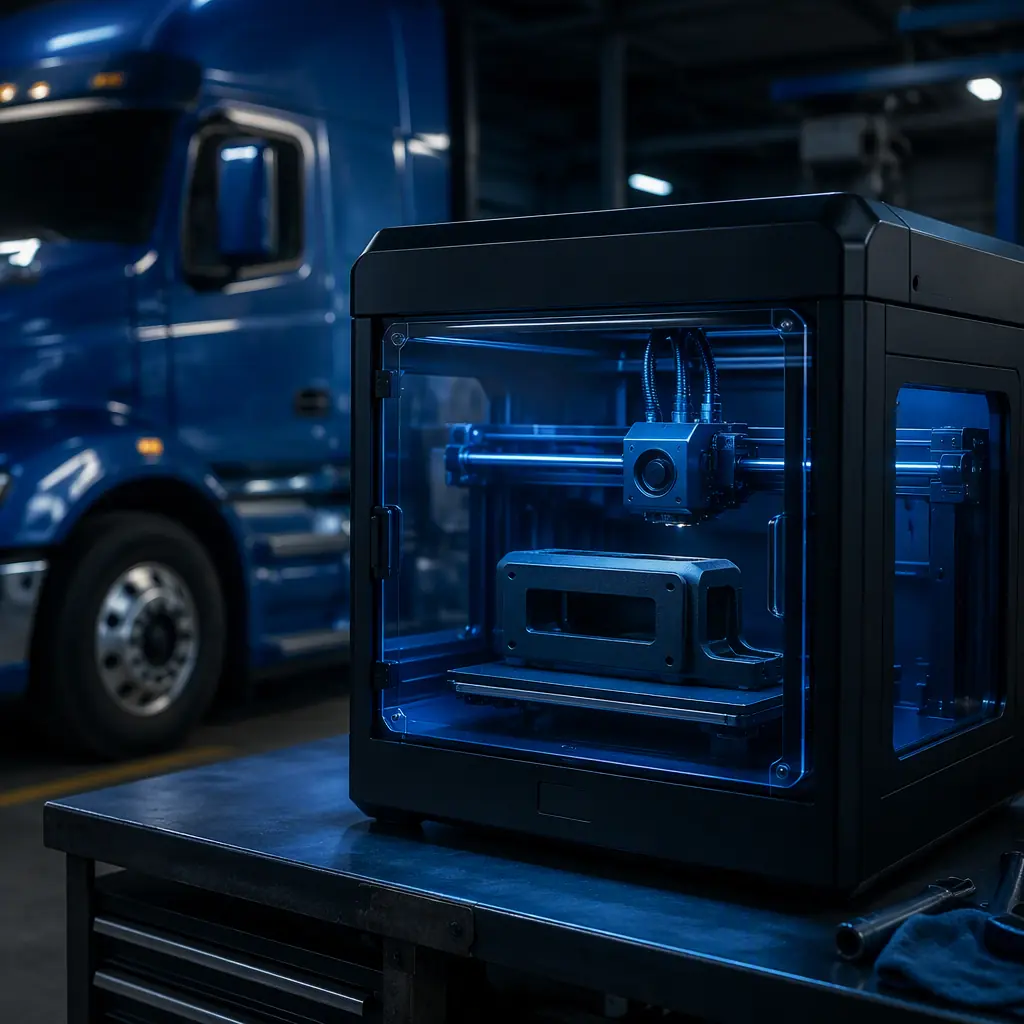
The trucking and commercial-vehicle vertical spans Class 8 and medium-duty fleets, trailer manufacturers, truck body and equipment upfitters (dumps, service bodies, reefers, tankers), commercial-vehicle OEMs, and the parts distributors and body shops that serve them. One structural fact drives the opportunity: commercial vehicles are revenue machines, a down truck costs $600-1,400 per day in lost revenue, yet OEM parts availability for vehicles older than 8-10 years collapses. Interior trim, exterior trim, brackets, bezels, and small plastic components simply go out of production, and the aftermarket substitutes are often worse than the original. Traditional sourcing means dealer back-order at 4-12 weeks, or a machined one-off at $500-3,000. Printing collapses the cost to $2-80 in materials and the lead time to overnight. The same economics apply to custom tooling and low-volume production, and the make-versus-buy logic is mapped in our injection molding vs 3D printing guide.
Why Trucking Is Buying 3D Printers
Four structural facts make trucking buyers durable. First, downtime cost: fleets measure everything in days-down, and a $30 printed part that returns a truck to service today is worth more than a $5 OEM part that arrives in two months, the ROI framing is in our TCO & ROI calculator guide. Second, parts obsolescence: commercial-vehicle OEMs support models for 10-15 years, then stop; the vehicle keeps earning for 20+ years, and every discontinued part is a print job. Third, upfit customization: every truck body and equipment upfitter builds custom configurations, and printing custom brackets, mounts and trim beats sourcing one-offs, the customization economics mirror our consumables & accessories bundling guide. Fourth, interior and exterior trim volume: cabs are full of plastic parts that crack, fade and break, cup holders, vent bezels, door handles, dash panels, mud flaps, and trim clips, a continuous, high-frequency demand stream.
The Applications That Actually Buy
Six clusters generate the orders. The buyers are fleet maintenance teams, trailer builders, upfitters, body shops, and commercial-vehicle OEM service departments.
1. Interior and exterior trim. The highest-frequency application: dash bezels, vent louvers, cup holders, door handles, trim clips, mud flaps, and mirror covers. These crack and fade on every fleet, print in ASA or PETG in hours, and cost $2-40. The material and finish choices are covered in our filament stocking guide.
2. Brackets, mounts and hardware. Sensor brackets, camera mounts, hose clips, cable organizers, and accessory mounts for telematics, dash cams and safety systems. Nylon or ASA prints replace $100-500 machined or dealer parts at $5-30, the nylon options are in our nylon filament guide.
3. Custom tooling for repair and build. Pinion-depth gauges, wiring-harness fixtures, panel alignment jigs, and specialized sockets for the shop. Unit-of-one tools that shops print on demand, the tooling playbook is in our manufacturing tooling guide.
4. Short-run aftermarket production. Parts that no longer justify a mold but have steady demand across a fleet, printed in ASA, PETG or nylon at 20-500 units per quarter. The low-volume production path is developed in our MOQ & OEM negotiation guide.
5. Reverse-engineered legacy parts. Scan, model and print components for trucks 10-25 years old whose drawings no longer exist. This is the wedge that opens fleet accounts, the scanning workflow is in our 3D scanner & printer bundle guide.
6. Custom storage and organization. Toolbox organizers, cab storage bins, clipboards mounts, and paperwork holders for the cab and service body. A strong print-farm product line for the truck accessory channel, the accessory revenue model is in our accessories revenue multiplier guide.
Materials for Trucking Applications
Trucking buyers work in three material worlds, outdoor durability, impact resistance, and flexibility:
Two realities dominate material conversations. First, UV and weather exposure: exterior truck parts sit in sun, salt and road grime, so ASA and PC replace PLA in almost every exterior application; the outdoor-durability guidance is in our outdoor & weather-resistant printing guide. Second, vibration and impact: truck parts live on a vibrating, shock-loaded platform, so nylon and TPU earn their place where PLA would crack, the material-selection framework is in our engineering filaments guide.
From Broken Part to Installed Part: The Workflow
The workflow that wins fleet accounts has five stages. Identify the failure . Classify the part (interior, exterior, structural, cosmetic) and confirm the material it replaces; the diagnosis framework is in our troubleshooting & diagnosis guide. Scan or model the part. 3D-scan the broken component or model it from caliper measurements; the reverse-engineering path is in our scanner & printer bundle guide. Select the material . Match UV, heat and impact exposure to ASA, PETG, nylon or TPU; the stocking framework is in our filament stocking guide. Print and fit . Print, verify fit, and install; the dimensional discipline for these fits is in our tolerances & dimensional accuracy guide. Track and reorder . Log the part in the fleet's parts system; recurring trim and bracket demand is developed in our consumables & accessories bundling guide.
Budget Reality: Printed vs Dealer Part
The comparison that closes fleet accounts:
The distributor math compounds because fleets maintain hundreds of vehicles and every successful print creates demand for the next. The printer investment model that justifies the fleet's own machines, and your demo fleet, is in our TCO & ROI calculator guide.
The Distributor Playbook: Entering Trucking
Five moves win trucking accounts:
1. Target fleets and upfitters with aging fleets. Mid-size fleets (50-1,000 trucks), trailer builders, and truck body upfitters are the highest-intent buyers, they live on parts availability. Build a target list of 30-50 accounts across your territory.
2. Lead with the down-truck pitch. The pitch is "a discontinued $14 part is costing you $1,400 per day of downtime, print it overnight." Bring a printed dash bezel and a bracket to every meeting, maintenance managers approve what they can hold and install on the spot.
3. Bundle the fleet material set. An enclosed printer for ASA plus a second unit for nylon/TPU is the anchor combination, and the margin is in ASA, PETG, nylon and TPU lines, build plates, and a drying system. The bundling mechanics are in our consumables bundling guide.
4. Offer a scan-to-part service. Many fleets have broken parts and no CAD. A distributor that offers scanning, modeling, printing and installation for a fixed per-part fee captures the account before hardware discussion starts, the service-revenue logic is in our repair service center guide.
5. Work the seasonal inspection cycle. DOT inspections and winterization drive parts demand twice a year; sell printers, materials and print-on-demand services ahead of each cycle, using the framework in our trade show strategy guide.
Common Pitfalls in Trucking Accounts
Five mistakes cost distributors trucking business: (1) selling PLA for exterior parts. PLA deforms in a hot cab and degrades in UV; the exterior-material guidance is in our weather-resistant printing guide; (2) ignoring heat . Cabs and engine bays exceed 60-80°C, and standard PLA parts sag; recommend ASA or PC where heat is a factor; (3) treating cosmetic parts like structural ones . A bracket holding a sensor is safety-relevant; qualify material and infill for load, using the framework in our end-use functional parts guide; (4) skipping the fit check . Trim parts need precise fit against OEM panels; the measurement discipline is in our incoming QC guide; and (5) forgetting flame-retardant requirements . Some interior applications need flame-retardant materials and documented compliance, and the certification framework is in our certification & compliance guide.
Getting Started: The First 90 Days
A 90-day entry plan: Month 1 . Identify 30-50 target accounts (fleets, trailer builders, upfitters) and stock the fleet material set: ASA, PETG, nylon, TPU, PC, plus build plates, hardened nozzles and a drying system. Month 2 . Produce a finished demo kit (a printed dash bezel, a sensor bracket, and a TPU grommet), run two pilot jobs at cost-plus-10% (a discontinued interior trim set and a short run of a common bracket), and offer scan-to-part service to one fleet. Month 3 . Convert pilots to full accounts with inspection-season supply agreements, publish your first measured case study ("Ohio fleet: 7 trucks back in service in 4 days, $14 bezel printed for $5"), and open one upfitter account. The printer investment model that justifies the distributor's own machines is in our TCO & ROI calculator guide.
Reviewed by the Precise3D engineering & OEM team. Compliance files that accompany the catalog are auditable at the certification register.
Enter the Trucking Market
Ready to Supply Fleets & Upfitters?
Get wholesale pricing on enclosed printers, ASA/PETG/nylon/TPU/PC material lines, build plates, drying systems, and the trucking playbook that wins fleet maintenance and upfitter accounts.