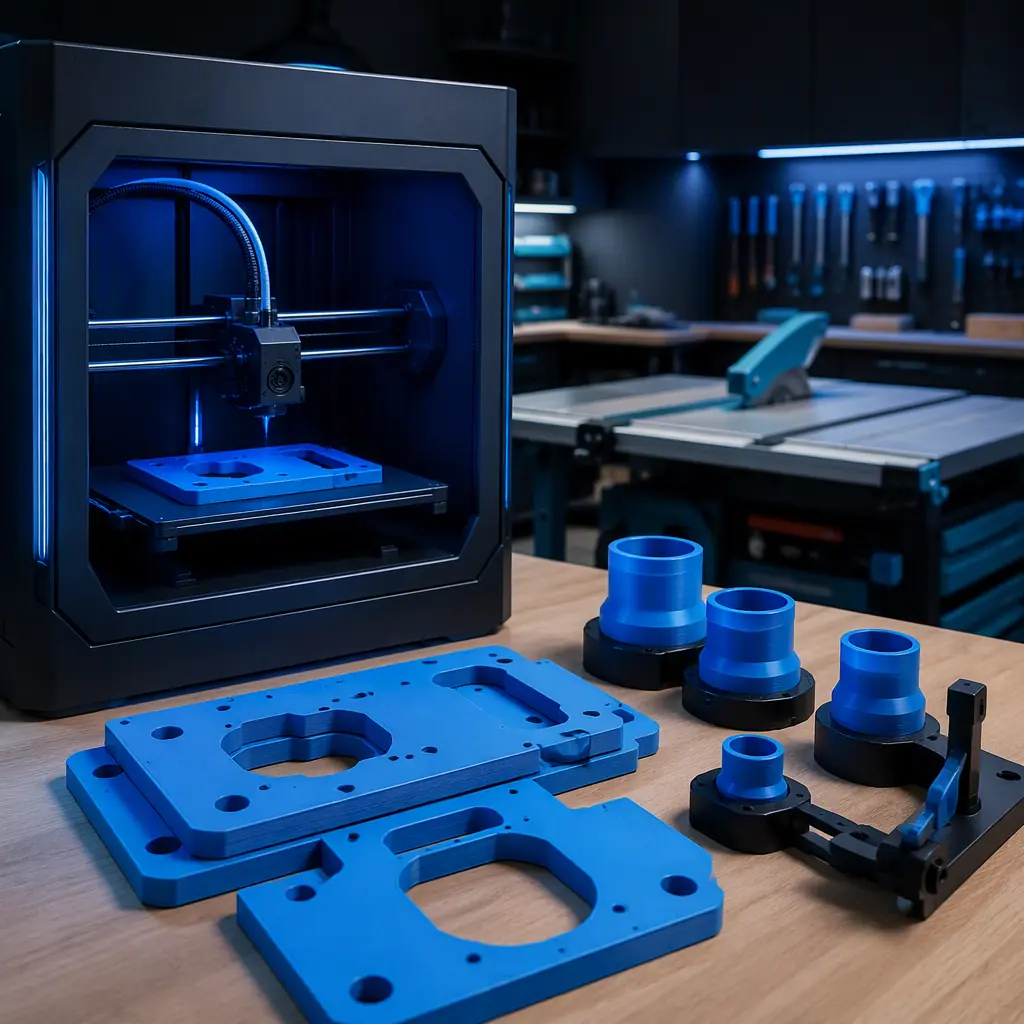
A custom cabinetry shop in Dongguan producing fitted kitchens and wardrobes was buying generic jigs and router templates from overseas at $40-120 each, with 3-5 week lead times — and fabricating one-off drilling templates on the bench every time a client specified a non-standard hinge or handle spacing. After adding a 3D printer to the workshop, the shop now prints custom drilling templates, hinge-jig inserts, and dust-collection adapters overnight for $2-15 in material, and its setup time per cabinet door dropped from 45 minutes to 12. Woodworking and cabinetry is a workshop-productivity market: every job is custom, every run is small, and the tools that reduce setup time pay for themselves in a single project.
Why Woodworking & Cabinetry Are Structural 3D Printing Buyers
Three structural facts make this vertical exceptional. First, infinite job variety: no two kitchens, wardrobes, or staircases are identical, so every project generates new drilling patterns, hinge positions, and router templates. Second, small-shop density: the vertical is dominated by shops of 3-30 people that cannot justify $5,000-20,000 custom tooling but will happily buy a $400-1,500 printer that replaces a wall of specialized jigs. Third, existing CNC fluency: most modern cabinet shops already run CNC routers and understand digital fabrication, which makes them the fastest-adopting audience in woodworking. The manufacturing-tooling mindset that applies to shop fixtures is covered in our manufacturing tooling guide.
The Applications That Actually Buy
Five clusters generate repeat orders. The buyers are cabinet shops, joinery and millwork workshops, furniture makers, woodworking retailers, and hobbyist-turned-pro workshops.
1. Drilling templates and jigs. The flagship application. Hinge-boring templates, shelf-pin templates, dowel jigs, and pocket-hole guides printed to match exact hardware spacing. A template that a shop would buy for $40-120 or build by hand in half a day now prints in 2-4 hours for $3-10. The tolerance control that makes templates accurate is covered in our tolerances & dimensional accuracy guide.
2. Router templates and guides. Template guides for hinge mortises, inlay work, and decorative edge profiles. Printed templates clamp or stick to the workpiece and guide the router bearing, replacing expensive brass and acrylic templates. A full hinge-mortise template set that costs $150-400 retail prints for $10-25 in PETG or nylon.
3. Dust-collection adapters. The quiet killer: hose adapters, blast-gate reducers, and tool-specific dust ports that connect shop vacuums to routers, sanders, and track saws. Every workshop has a drawer of mismatched fittings — printed adapters make every tool dust-tight for $2-8 each. The flexible-seal versions use TPU and are covered in our flexible filaments guide.
4. Custom hardware and fittings. Knobs, pulls, corner brackets, shelf supports, cam-lock covers, and spacer blocks for custom cabinets. Shops use these for prototypes, for matching discontinued hardware on renovation jobs, and for short-run custom designs where metal equivalents are expensive or unavailable. Threaded metal inserts for hardware that must take a screw are covered in our heat-set inserts guide.
5. Workshop organization and one-offs. Clamp pads, bench dogs, featherboards, dowel-centering pins, and fixture blocks that every workshop needs in odd sizes. Low visibility, but they build daily printer usage and open the door to the template conversation. The economics of replacing bought tooling are detailed in our TCO/ROI calculator guide.
Materials and Finish for Shop Tooling
Shop tooling faces abrasion from wood dust, occasional solvent exposure, and physical knocks. The map distributors should stock:
Two traps: (1) router templates take bearing wear — the guide surface should be printed in PETG or PA12 with 3-4 perimeters, not single-wall PLA, or the edge will wear after a few dozen passes; (2) dust adapters need a smooth inner bore — print with the bore vertical and use a light sand or ream pass so hoses slide on and seal. The finishing that makes printed shop tooling last is covered in our post-processing & finishing guide.
Economics: Bought Tooling vs Printed
The comparison that closes workshop accounts:
The distributor math is attractive because the purchase compounds: once a shop prints its first template, it discovers ten more applications, and every application consumes filament and accessories. A mid-size cabinet shop can consume $3,000-9,000/year in filament, build plates, and printed tooling — before counting the printer itself. The material-margin side of this recurring spend is covered in our consumables & accessories bundling guide.
The Distributor Playbook: Entering Woodworking & Cabinetry
The winning playbook has five moves:
1. Lead with the template problem, not the printer. The pitch is "custom drilling template overnight, no minimum order" — the printer is the tool behind the template. Start with a demo kit of five high-value templates (hinge-boring, shelf-pin, dowel jig, dust adapter, bench dog) printed in PETG and show them at cabinet shops.
2. Offer template-printing service. Many shops will not run a printer themselves at first. A distributor offering template-printing service (customer sends a sketch or hardware spec, distributor designs, prints, and ships in 3-5 days) turns a printer sale into a recurring service line. The service economics are developed in our after-sales support strategy.
3. Speak the shop-productivity language. Cabinet shops quote against setup time and error rates, not filament. Show minutes saved per door, per drawer, per installation — "hinge boring: 45 min → 12 min per door" — and the sale makes itself. The productivity case mirrors what we teach in our demo lab setup guide.
4. Stock the workshop material set. PETG, PLA+, PA12, TPU, ASA, and PA6-CF are the true margin engine, plus build plates and finishing consumables. A shop printing 20-40 templates and adapters per month consumes 5-12 kg of filament monthly; a filament subscription with a quarterly template-library update locks the account.
5. Build the template library flywheel. Every custom template becomes an asset: catalogue each one by hardware brand and spacing, and offer the library as a subscription that grows monthly. One validated shop recruits the next — cabinet makers talk constantly at IWF, AWFS, and regional woodworking events.
Common Pitfalls in Woodworking Accounts
Five mistakes account for most failed initiatives: (1) selling single-wall PLA templates that wear out — router template edges need PETG or PA12 with 3-4 perimeters; (2) ignoring router-bearing clearance — a template that binds the bearing burns the wood, so print and test the guide surface before selling; (3) underselling the dust problem — adapters must seal, so TPU collars or a ream pass on PETG bores are part of the product, not an afterthought; (4) underselling the consumable model — the printer is the foot in the door, but filament subscriptions and template-library retainers are where margin compounds; and (5) neglecting the service channel — standalone workshops that will never buy a printer still pay for template-printing service, so a distributor must serve both buyers and users. The discipline of documenting measurable outcomes mirrors what we teach for end-use parts in our end-use functional parts guide.
Getting Started: The First 90 Days
A 90-day entry plan: Month 1 — stock PETG, PLA+, PA12, TPU, ASA, and PA6-CF with full data sheets, and identify 10-15 target accounts (cabinet shops, joinery workshops, furniture makers, woodworking retailers, pro hobbyists) within a 3-hour drive. Month 2 — print a demo kit of five high-value templates and adapters; run two pilot template jobs at cost-plus-10% to build documentation evidence and a template-sample library. Month 3 — convert pilots to full accounts with filament subscriptions and template-library retainers, publish your first co-branded case study with measured numbers ("hinge-boring template: $95 bought → $8 printed, setup time 45 min → 12 min per door"), and exhibit at a regional woodworking or furniture trade event. If you already serve furniture or construction accounts, our furniture industry guide and architecture & construction models guide show how the same template-and-fixture logic transfers directly to cabinetry.
Reviewed by the Precise3D engineering & OEM team. Compliance files that accompany the catalog are auditable at the certification register.
Enter the Woodworking Market
Ready to Supply Cabinet Shops & Woodworkers?
Get wholesale pricing on FDM printers, PETG and nylon filament lines, and the template-printing playbook that wins workshop accounts.