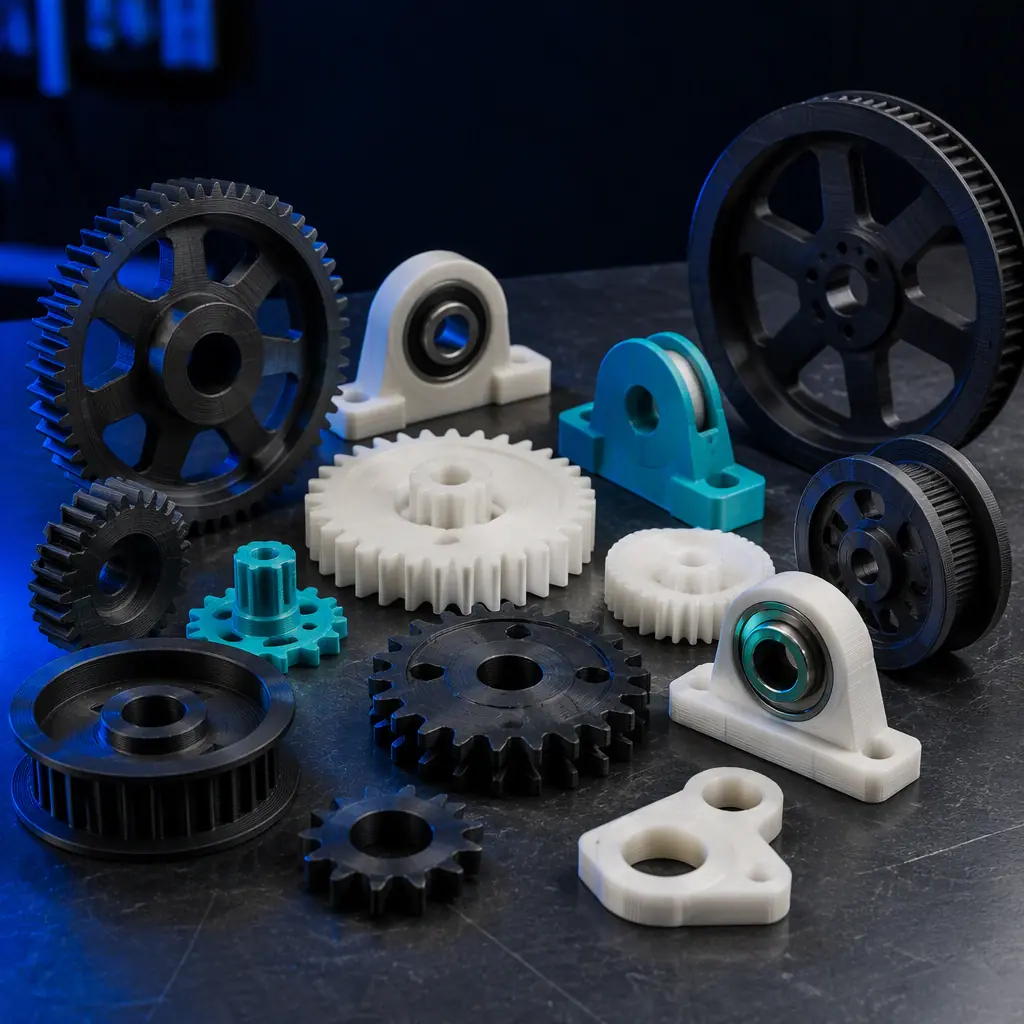
Power transmission parts, gears, pulleys, sprockets, bearings, bushings, couplings, and shafts, are the mechanical backbone of industrial equipment. The replacement market is enormous: OEMs discontinue drive components for machines that run for decades, and aftermarket suppliers charge premium prices for legacy parts. The engineering question distributors must answer honestly is when a printed part is strong enough. The short answer: printed polymer gears and housings work reliably for low to moderate loads, low to moderate speeds, and where lubrication or self-lubricating materials are acceptable, and they fail badly when pushed into high-torque, high-RPM, or high-temperature territory that demands metal. Knowing exactly where that line sits is the difference between a hero repair and a failed part that destroys a customer relationship.
Where Printed Power Transmission Parts Work
Five application zones are proven for 3D printed power transmission parts. First, legacy replacement gears: nylon idler gears, timing gears, and change gears for machines whose OEM parts are discontinued. Printed PA12 replacements routinely outlast the original acetal parts in low-load service, and the aftermarket economics are mapped in our spare parts & aftermarket revenue guide. Second, bearing housings and pillow blocks: printed housings with pressed-in metal ball bearings work well because the printed part carries static load while the bearing carries the rotation, the hybrid design logic is developed in our end-use functional parts guide. Third, pulleys and belt components: v-belt pulleys, timing pulleys, and belt tensioners for light drives; printed parts are quiet and grippy, and the motion-system design principles are covered in our linear rails vs v-wheels guide. Fourth, couplings and shaft adapters: spider couplings, jaw-coupling spiders, and keyed shaft adapters for fractional-horsepower drives. Fifth, low-torque mechanisms: gear trains in vending machines, dispensers, actuators, and HVAC damper drives, the exact application family we cover in our vending & kiosk vertical guide.
The Load and Speed Limits That Matter
The honest engineering answer to "can you print a gear?" is: it depends on three numbers, torque, speed, and temperature. As a practical rule for distributor conversations:
The three limits interact: a gear can handle more speed if torque is low, and more torque if speed is low. The material temperature limits are the same ones we map in our heated chamber guide, and the tolerance math for gear meshing is covered in our tolerances & dimensional accuracy guide.
Materials for Power Transmission
Gear buyers work in four material tiers:
Two facts matter most in gear material conversations. First, self-lubrication: nylon and PETG run dry acceptably in light service, which is why printed gears work in mechanisms where lubricated metal gears would be messy, the material comparison is developed in our PEEK/PEI/PPSU industrial materials guide. Second, fillers change everything: carbon-fiber nylon (PA-CF) roughly doubles stiffness over neat nylon and is the default recommendation for any load-bearing gear, the filled-filament playbook is in our carbon-fiber filament guide.
Design Rules That Make or Break a Printed Gear
Six design rules separate printed gears that last from printed gears that fail: 1. Orientation . Print gears with the tooth face on the side (axis horizontal) so layer lines run perpendicular to tooth bending loads, not parallel; a gear printed flat delaminates under load. 2. Tooth count and profile . Use standard involute profiles (module 0.5-2.0 for most printed applications) and avoid thin pointed teeth; the profile math is in our tolerances guide. 3. Bore reinforcement . Press a metal insert, bearing, or shaft pin into printed bores; printed bores alone wear out fast, and the heat-set insert workflow is covered in our heat-set inserts guide. 4. Wall thickness . Keep minimum walls above 2-3 mm; thin gear webs crack at the hub. 5. Backlash . Add 0.2-0.4 mm backlash per mesh and test the fit before batch printing; print-to-print consistency is the tool we cover in our incoming QC guide. 6. Annealing . Annealed nylon gears gain measurable strength and dimensional stability; the annealing workflow is in our annealing & heat treatment guide.
Bearing Housings, Bushings & Couplings
Beyond gears, three part families drive steady demand. Bearing housings and pillow blocks are the easiest win: print the housing, press in a standard metal bearing, and the assembly handles real loads, this is the hybrid approach detailed in our end-use functional parts guide. Bushings and wear liners in nylon or PETG replace worn acetal bushings in low-speed pivots, linkages, and actuators. Couplings and shaft adapters . Jaw-coupling spiders, pin couplings, and keyed adapters, are high-frequency replacement parts in fractional-horsepower drives. For distributors, these parts share one trait with gears: they fail on a predictable cycle, which makes them perfect recurring-revenue items, the model is developed in our consumables & accessories bundling guide.
The Distributor Playbook: Selling Power Transmission
Five moves win power transmission accounts:
1. Target maintenance departments, not purchasing. Plant maintenance engineers and reliability teams are the buyers who care about downtime, not part cost. Build a target list of 20-30 plants in food, beverage, packaging, textile, and material-handling, the vertical playbooks are in our food & beverage processing guide and packaging industry guide.
2. Lead with the rescue story. The pitch is "down line back up in hours, not weeks." Bring a scanned-and-printed idler gear and a bearing housing with a pressed-in bearing to every meeting. Maintenance teams approve what they can install and run.
3. Bundle a scan-to-print service. Most legacy gears have no CAD. A distributor that scans, models, prints, and validates replacement gears for a fixed fee captures the account before hardware discussion starts, the service-revenue logic is in our repair service center guide.
4. Sell the material upgrade story. PA-CF and annealed nylon outlast the original acetal parts in many applications, that message turns a cheap replacement into a reliability improvement. The filled-material playbook is in our carbon-fiber filament guide.
5. Anchor with a fleet contract. Plants with 50+ drives will burn through replacement parts on a predictable calendar; sell annual parts contracts alongside printers using the framework in our annual service contracts guide.
Common Pitfalls in Power Transmission Accounts
Five mistakes cost distributors power transmission business: (1) overpromising strength . Quoting printed parts for high-torque, high-RPM, or shock-load applications guarantees a field failure; be the distributor who says "this one needs metal" and you win trust; (2) printing gears flat . A gear printed with layers parallel to the tooth face delaminates under load; orientation is the single biggest failure cause; (3) ignoring bore wear . A printed bore on a steel shaft wears out in days; always press in a bushing, bearing, or insert (the workflow is in our heat-set inserts guide); (4) skipping annealing . Un-annealed nylon gears creep and lose mesh; the annealing process is in our annealing guide; and (5) treating every gear the same . A vending-machine gear and a conveyor-drive gear live in different load worlds; match material and design to the application using the framework in our tolerances guide.
Getting Started: The First 90 Days
A 90-day entry plan: Month 1 . Identify 20-30 target accounts (food, beverage, packaging, textile, and material-handling plants) and stock the gear material set: PA12, PA-CF, PETG, ABS, plus build plates and a gear-design starter kit. Month 2 . Produce a finished demo piece (a scanned idler gear and a bearing housing with pressed-in bearing) with load-test photos, run two pilot jobs at cost-plus-10% (a legacy gear batch and a coupling run), and offer scan-to-print services to one plant. Month 3 . Convert pilots to full accounts with annual parts contracts and a 24-hour gear SLA, publish your first measured case study ("conveyor idler gear: 6 weeks → 4 hours, $40 → $6"), and open one material-handling account. The printer investment model that justifies the distributor's own machines is in our TCO & ROI calculator guide.
Reviewed by the Precise3D engineering & OEM team. Compliance files that accompany the catalog are auditable at the certification register.
Enter the Power Transmission Market
Ready to Supply Gears, Bearings & Drive Parts?
Get wholesale pricing on enclosed FDM printers, PA12 and PA-CF filament lines, build plates, gear-design toolkits, and the reliability playbook that wins plant maintenance teams.