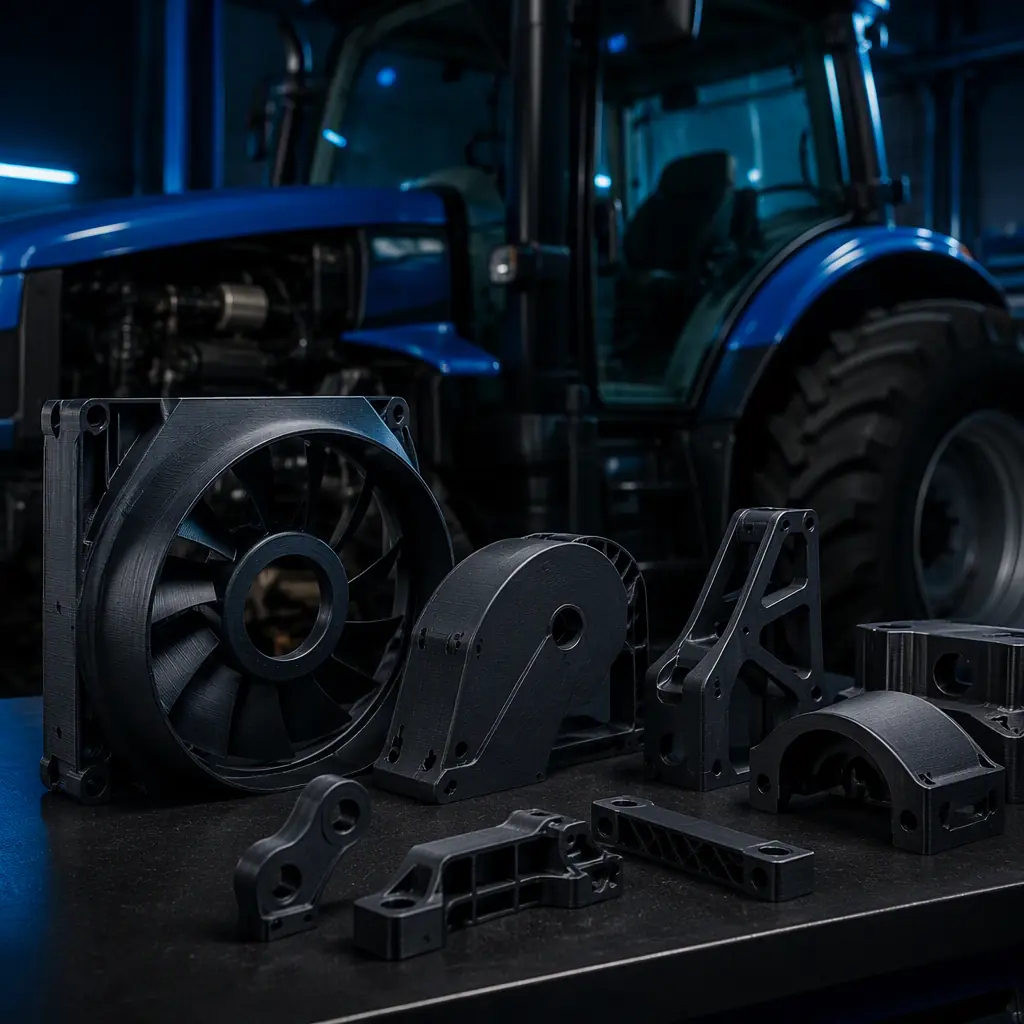
The agricultural equipment vertical spans tractor and combine dealers, aftermarket parts suppliers, independent farm repair shops, sprayer and application equipment dealers, and agronomy and precision-agriculture service providers. One structural fact drives the opportunity: farm machinery is built to run for decades, and OEMs stop stocking parts long before the machines stop running. A discontinued plastic knob, fan shroud, gear guard or sensor bracket can sideline a $300,000 combine for days during the two-week harvest window when it makes or loses the season. A printed replacement costs cents to a few dollars and prints overnight. Every dealer has a shelf of obsolete part numbers nobody can source. And every one of them is a print job. The same make-versus-buy economics are mapped in our CNC machining vs 3D printing guide.
Why Farm Machinery Buyers Are Buying 3D Printers
Four structural facts make agricultural equipment buyers durable. First, obsolete-part reality: OEMs support machines for 10-15 years, but many tractors and implements run for 30-40 years, leaving a permanent tail of unavailable parts; the recurring-demand model is developed in our consumables & accessories bundling guide. Second, harvest-season urgency: a machine down in the field loses thousands of dollars a day, and overnight prints beat any freight option; the tooling logic is in our manufacturing tooling guide. Third, dirt, chemical and impact reality: everything on a farm faces dust, fertilizer, diesel, UV and vibration, which drives the material conversation toward PA-CF and PETG; the material-selection framework is in our engineering filaments guide. Fourth, unit-of-one geometry: every model year has its own brackets, guards and covers, and low-volume runs make printing cheaper than minimum-order injection molding; the prototyping economics are in our buyer's guide & price tiers.
The Applications That Actually Buy
Six clusters generate the orders. The buyers are farm equipment dealers, aftermarket parts suppliers, independent repair shops and agronomy service providers.
1. Obsolete and discontinued parts. The highest-frequency application: fan shrouds, knobs, levers, brackets, sensor covers, switch housings and interior trim for machines whose OEM parts are discontinued. Printed in PA-CF or PETG for shop-floor abuse, the material rules are in our filament stocking guide.
2. Wear items and sacrificial parts. Bushings, spacers, wear pads, belt guards, roller covers and dust seals that wear out seasonally and are cheap to print in bulk. Printed in PA-CF or TPU depending on load, the durable and flexible families are in our TPU/TPE filament guide.
3. Sprayer and application components. Nozzle holders, nozzle caps, tank fittings, gauge mounts, hose routing clips and boom end caps for sprayers and applicators. Printed in PETG or PP for chemical resistance, the chemical-resistant material options are in our engineering filaments guide.
4. Planter and seeder components. Seed tube guards, row unit brackets, depth gauge covers, marker arms and seed cup parts for planters and seeders. Printed in PA-CF for impact and abrasion, the QC framework is in our incoming QC & inspection guide.
5. Custom tooling and repair fixtures. Bearing puller aids, seal installation tools, alignment jigs, hydraulic line guards and service fixtures that make field repairs faster. Printed in PETG or PA-CF, the tooling logic is in our manufacturing tooling guide.
6. Shop and cab organizers. Tool holders, parts-bin labels, cab mounts for tablets and radios, cup holders and seed-sample scoops that keep dealers and operators organized. Unit-of-one prints that adapt to any cab or shop, the accessory logic is in our accessories revenue guide.
Materials & Farm Reality
Farm machinery buyers select materials by dust, chemical, UV and load exposure. Four families dominate:
Two realities dominate material conversations. First, chemical and dust exposure is a spec, not a suggestion: anything that touches fertilizer, diesel or herbicide gets PETG or PP; anything that takes impact gets PA-CF, the engineering material options are in our engineering filaments guide. Second, load and vibration drive selection: structural brackets and wear items get PA-CF; anything flexible gets TPU; anything outdoors gets ASA, the durable and flexible families are in our TPU/TPE filament guide.
From Discontinued Part to Printed Part: The Workflow
The workflow that wins farm machinery accounts has five stages. Identify the unavailable part . The discontinued shroud, the worn bushing, the bracket nobody stocks; the failure-analysis framework is in our print troubleshooting guide. Model or scan it . Model the part from OEM drawings or scan the worn original geometry; the scanning path is in our scanner & printer bundle guide. Select the material by exposure and load . Impact parts get PA-CF; chemical-contact parts get PETG or PP; flexible parts get TPU, using the framework in our filament stocking guide. Print, test and verify fit . Print, test on the actual machine, and iterate; the verification checklist is in our incoming QC guide. Build the model library . Every qualified part becomes a digital asset the dealer can reprint for the next identical machine; the recurring-demand model is developed in our consumables subscription guide.
Budget Reality: Printed vs OEM vs Salvage
The comparison that closes farm equipment accounts:
The distributor math compounds because every dealer has hundreds of obsolete part numbers, and every successful print builds the library that sells the next. The printer investment model that justifies the dealer's own machines, and your demo fleet, is in our TCO & ROI calculator guide.
The Distributor Playbook: Entering Agricultural Equipment
Five moves win farm machinery accounts:
1. Target dealers and suppliers with obsolete-part pain. Tractor and combine dealers, aftermarket parts suppliers and independent repair shops (5-200 employees) are the highest-intent buyers. Build a target list of 40-80 accounts in your territory.
2. Lead with a discontinued-part rescue pilot. Offer to print one unavailable part for free. The dealer sees a part that would sideline a machine for days delivered overnight at $2-12, the demo playbook is in our B2B sales demo guide.
3. Bundle the farm-duty material set. An enclosed printer plus PA-CF, PETG, PP, TPU and ASA lines is the anchor combination, and the margin is in materials, build plates and hardened nozzles. The bundling mechanics are in our consumables bundling guide.
4. Offer a parts-on-demand service. Dealers need obsolete and wear parts on demand. A distributor that prints and ships parts for a per-job fee captures the account before hardware discussion starts; the service-revenue logic is in our repair service center guide.
5. Work the seasonality cycle. Pre-planting and pre-harvest are the peak windows; sell printers, materials and print-on-demand services ahead of each season, using the framework in our trade show strategy guide.
Common Pitfalls in Farm Machinery Accounts
Five mistakes cost distributors agricultural equipment business: (1) selling hobby-grade materials for farm parts . A PLA knob cracks in a dusty, sun-baked cab within weeks; qualify PA-CF or PETG for anything structural; (2) ignoring chemical exposure . Parts near fertilizer, diesel or herbicide need PETG or PP, not ABS; the material rules are in our filament stocking guide; (3) treating farm accounts like general manufacturing . The buyer is a dealer or shop owner, and the pitch is harvest-season uptime and cost per part, not throughput; (4) skipping the field test . A part that fails in the field burns the account; test through a real duty cycle before handover; and (5) forgetting adjacent agricultural verticals . Greenhouse and hydroponics buyers use the same printers, covered in our agriculture & hydroponics guide, and heavy-equipment wear parts follow the same pattern as mining, covered in our mining & heavy industry guide.
Getting Started: The First 90 Days
A 90-day entry plan: Month 1 . Identify 40-80 target accounts, and stock the farm-duty material set: PA-CF, PETG, PP, TPU, ASA, plus build plates, hardened nozzles and a drying system. Month 2 . Run two discontinued-part rescue pilots (one dealer, one aftermarket supplier), produce a parts-on-demand service template, and add a dealer to your advisory loop. Month 3 . Convert pilots to paid accounts with parts-service agreements, publish your first measured case study ("Farm equipment dealer: discontinued combine shroud, OEM gone, overnight PA-CF print, machine back in the field same week"), and open one aftermarket parts supplier account. The printer investment model that justifies the distributor's own machines is in our TCO & ROI calculator guide.
Reviewed by the Precise3D engineering & OEM team. Compliance files that accompany the catalog are auditable at the certification register.
Enter the Agricultural Equipment Market
Ready to Supply Farm Machinery Buyers?
Get wholesale pricing on enclosed printers, PA-CF/PETG/PP/TPU/ASA material lines, build plates, hardened nozzles, dryers, and the parts-on-demand playbook that wins dealer and aftermarket accounts.