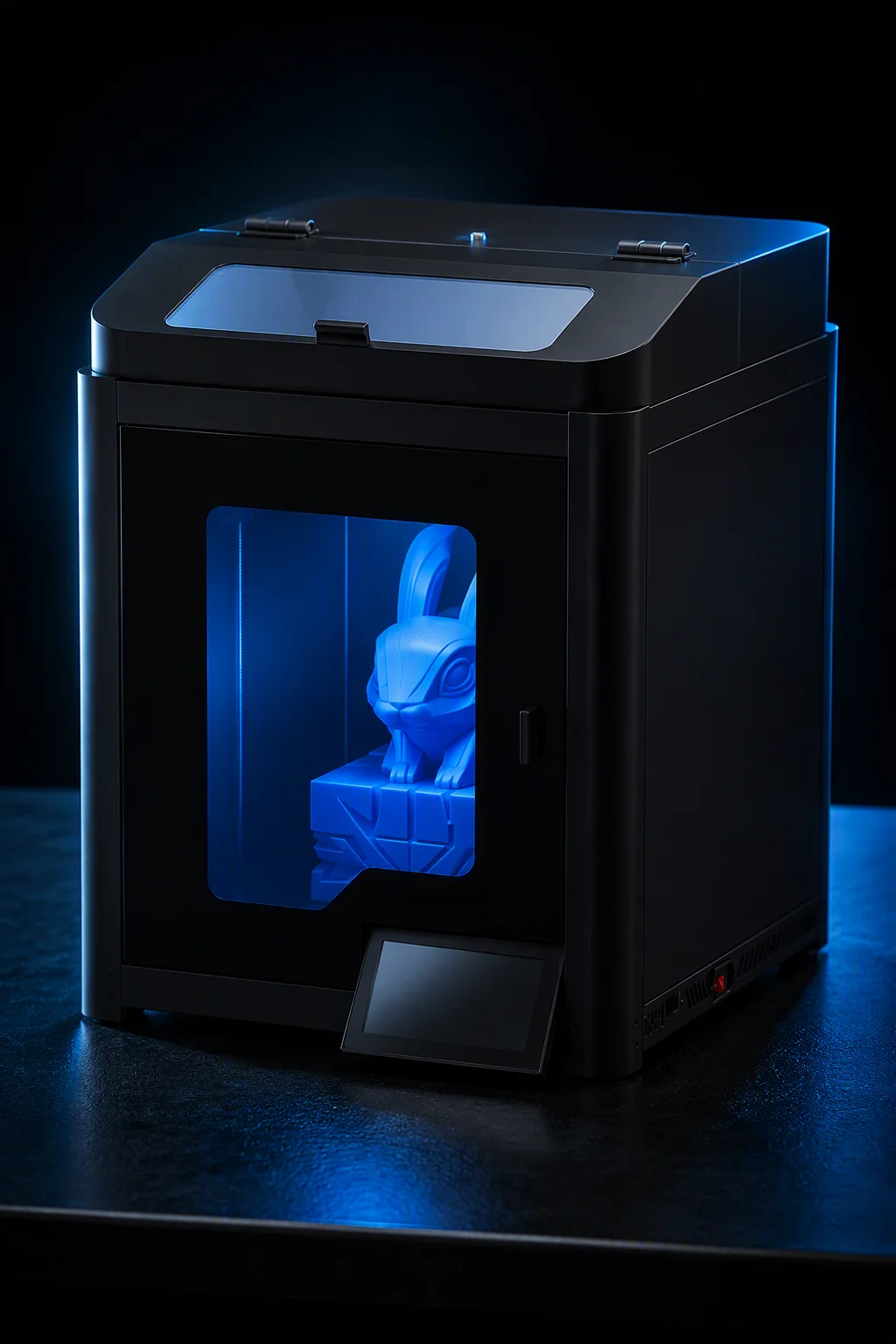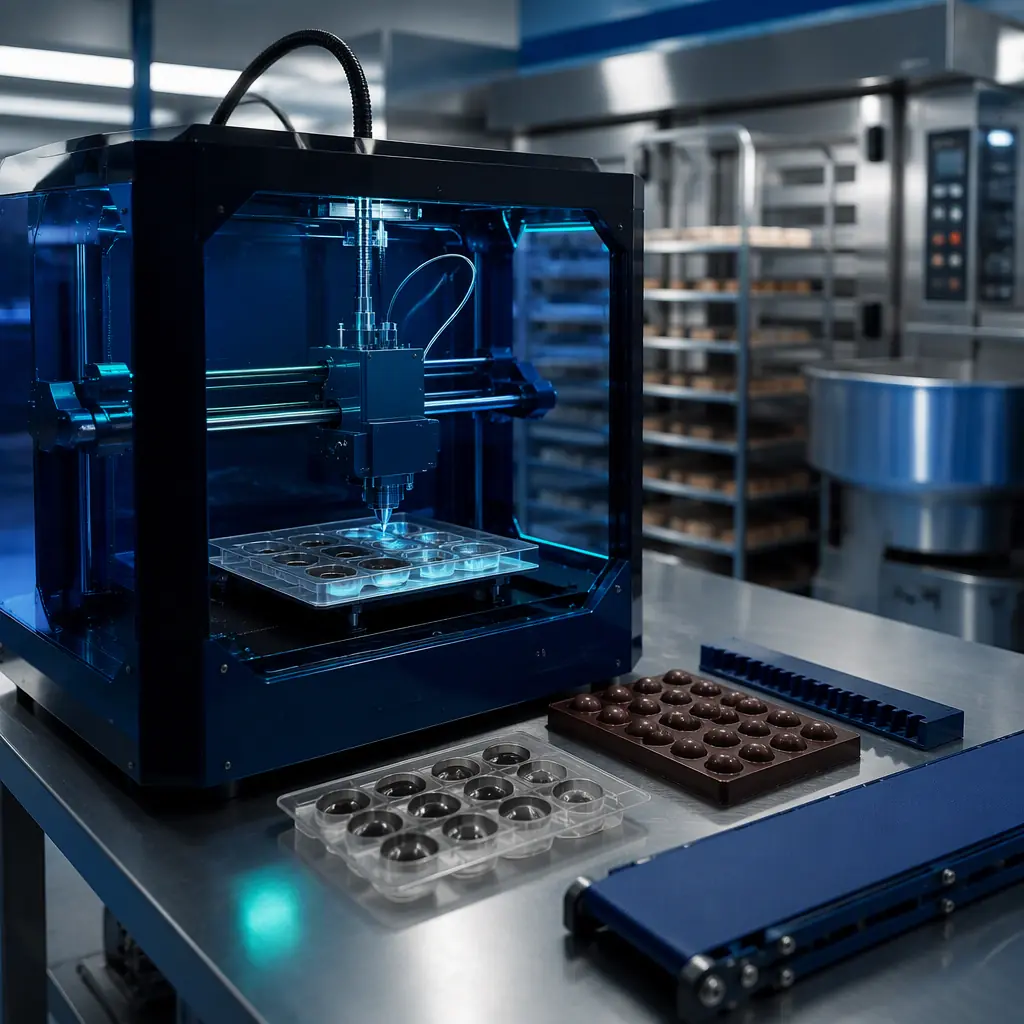
The bakery and confectionery equipment vertical spans industrial bakeries and biscuit plants, chocolate and candy manufacturers, bakery equipment OEMs, food equipment distributors and dealers, packaging machine operators, artisan bakeries and patisseries at scale, and plant maintenance and engineering teams. Three structural facts drive the opportunity. First, food lines run around the clock: a 24/7 bakery or confectionery line cannot wait five weeks for an OEM spare. Downtime costs $500-5,000 per hour depending on line size, so same-day parts win. Second, changeover is the hidden cost: modern bakeries run dozens of SKUs (breads, rolls, pastries, biscuits, chocolate bars) and change over forming, cutting, enrobing and packaging tooling constantly, including every changeover part is a candidate for printing. Third, the parts are small, food-safe and expensive: guide rails, scrapers, forming rollers, depositor nozzles, mold carriers and conveyor components that cost $100-3,000 OEM print at $10-80 in food-safe materials. The economics that justify the customer's own printer are laid out in our TCO & ROI calculator guide, and the aftermarket logic in our spare parts & aftermarket revenue guide.
Why Bakery & Confectionery Is Buying 3D Printing
Five forces convert food plants into printer buyers. First, downtime intolerance: food lines run 24/7 with margin tied to throughput, and a snapped guide rail or worn scraper stops production immediately, the same urgency that drives our repair service center guide, applied at line speed. Second, custom mold demand: chocolate and candy manufacturers launch new shapes constantly, and a steel mold costs $2,000-15,000 with 4-8 week lead times; printed molds get a new product to market in days for validation, the rapid-iteration logic is in our food & beverage processing guide. Third, SKU proliferation: more products means more changeover parts, and plants that print their own changeover tooling cut setup time and inventory simultaneously. Fourth, aging equipment base: bakery and confectionery machinery routinely runs 15-30 years, and OEM spare support for a 20-year-old depositor or wrapper ended a decade ago, the legacy-spares pattern is in our aftermarket guide. Fifth, sanitation pressure: food safety audits (BRCGS, FSSC 22000, IFS) demand documented, cleanable parts; printed parts with food-safe material data sheets fit audit culture better than unlabeled salvaged parts. A mid-size bakery plant replaces dozens of plastic and rubber components per year; a food equipment distributor serving 200 plants can sell 400-1,200 printed parts a month at $10-80 each.
The Applications That Actually Buy
Six clusters generate the orders. The buyers are plant maintenance engineers, production managers, chocolate and candy R&D teams, packaging line operators, and food equipment OEM procurement teams.
1. Changeover parts for forming & cutting lines. The highest-frequency application: guide rails, scrapers, wiper blades, forming inserts, cutter guides, depositor nozzles, valve handles and star wheels for bread, biscuit, pastry and chocolate lines. Printed in food-safe PETG or PP, these cut changeover time and inventory, the material rules are in our filament stocking guide. A guide rail that costs $200-800 OEM prints at $12-45 with a same-day turnaround.
2. Chocolate & candy molds. The highest-value application: custom chocolate molds, candy shell molds, truffle forms, lollipop molds and validation samples for new product launches. Printed in food-safe resin or PETG and used for prototyping, pilot runs and low-volume seasonal lines, these compress a $2,000-15,000 steel mold investment into a $20-200 printed validation. The finishing workflow that gives molds their release surface is in our post-processing & finishing guide. A seasonal line that sells for 6 weeks never needs the steel tool.
3. Conveyor & handling components. Custom conveyor guides, side rails, roller end caps, belt wipers, transfer plates and product diverters for bakery and confectionery handling lines. Printed in food-safe PETG or PA, these replace $100-600 OEM parts at $10-50, the same handling-line logic as our warehouse automation guide, applied to food-safe duty. A plant running 8-15 conveyors consumes dozens of these parts per year.
4. Packaging machine parts. Changeover parts for flow wrappers, cartoners, baggers and tray sealers: forming shoulders (low-volume), guide fingers, pusher paddles, sealing jaw guards, film path rollers and star wheels. Printed in food-safe materials with wear-resistant fill, these keep packaging lines running, the maintenance discipline is in our printer maintenance guide applied to the customer's machines. A packaging changeover set that costs $300-1,500 OEM prints at $30-120.
5. Oven & proofing room tooling. Heat-tolerant parts near ovens: rack positioners, tray stops, proofing rack guides, oven door handles and airflow baffles. Printed in PA or heat-resistant materials (never in direct flame or radiant-heat zones), the high-temperature material behavior is in our engineering filaments guide. A rack guide that costs $80-250 OEM prints at $8-25.
6. Artisan & craft production tooling. Custom cookie cutters, stencils, piping guides, tart rings and decorating tools for artisan bakeries and patisseries producing at craft scale. Printed in food-safe PETG, these are a fast entry point and a reorder engine, the consumables pull-through model is in our accessories revenue guide. An artisan bakery orders 20-60 printed tools per month.
Food-Safe Materials & Compliance Reality
Food-line parts live under one rule: the material must be food-contact documented. Five material families dominate:
Three compliance realities dominate. First, food contact is a documented claim: use filaments and resins with explicit food-contact declarations (FDA 21 CFR or EU 1935/2004 compliant grades), and keep the data sheets, the documentation discipline is in our engineering filaments guide. Second, hygienic design is geometry, not just material: smooth surfaces, no crevices, rounded corners and drainable shapes are what make a part cleanable; printed parts must be finished smooth to pass audit scrutiny, using the workflow in our post-processing guide. Third, know the contact boundary: direct food-contact parts (molds, scrapers touching product) need food-grade documented materials; non-contact parts (guards, guides behind shields) can use standard engineering materials, the boundary must be stated in every proposal. The broader food equipment context is in our food & beverage processing guide, and the adjacent craft-beverage angle in our craft brewery & beverage guide.
From Snapped Part to Line-Ready Replacement: The Workflow
The workflow that wins food plant accounts has five stages. Assess . Confirm the part is non-critical to food safety (never replace a part that contacts product without food-grade material), identify the failure mode, and check whether a certified OEM path exists; quote both and let the plant choose. Model . Scan the intact sibling part with a handheld scanner in 15-30 minutes or model from calipers; keep a revision history for audit purposes, the scanner workflow is in our scanner & printer bundle guide. Print . Select food-contact-grade material for product-touching parts, print with verified settings, and log the parameters. Verify . Check dimensions against the original, test fit and function on the line during a planned changeover, and confirm cleanability (no crevices trapping product); the verification checklist is in our incoming QC & inspection guide. Document and deliver . Hand over the part with its food-contact data sheet, print log and verification record; that paperwork is what makes the part acceptable to a BRCGS or FSSC auditor. The full cycle runs 1-2 days versus 2-8 weeks for OEM paths, and one qualified print service sustains 8-20 food plant part jobs per week.
Budget Reality: Printed vs OEM vs Machined
The comparison that opens food plant accounts:
The distributor math compounds because food plants buy on urgency: every downtime event is a sale, every changeover is a sale, and plants standardize on parts that work. The recurring stream is the same margin engine as our accessories revenue guide, and the printer investment model that justifies the customer's own machines, and your demo fleet, is in our TCO & ROI calculator guide.
The Distributor Playbook: Entering Food Plant Accounts
Five moves win bakery and confectionery accounts:
1. Target the right segments. Artisan bakeries are the fastest entry, they buy custom tools weekly and already understand craft production. Industrial bakeries and confectionery plants are the second tier (highest-value, slower cycle), and food equipment OEMs are the third, sell to them as a changeover-parts supplier, not a competitor. Build a list of 40-80 accounts in your territory.
2. Lead with the food-safety story, not the price. Walk in with food-contact data sheets, a printed chocolate mold with a release-surface finish, and a finished guide rail, the documentation is the differentiator. The consultative selling framework is in our B2B sales demo playbook.
3. Sell the downtime-rescue service. Position printed parts as the answer to line-down emergencies: "if it snapped, we can print a documented food-safe replacement overnight." The service-revenue model is in our repair service center guide.
4. Demo with a real line part. Ask a plant for their most-replaced plastic part (guide rail, scraper, star wheel), print it during the demo and deliver it documented. The pilot structure is in our B2B sales demo playbook.
5. Bundle the food-safe material set. Food-grade PETG, PP, PA, TPU and food-safe resin lines, plus a filament dryer, a washable build plate system and a scanner bundle, with margin in materials and consumables. The build-surface options are in our print surfaces & build plate guide, and the bundling mechanics in our accessories revenue guide. The unifying rule: food plants purchase certainty, documented materials, cleanable geometry, reproducible results, and the distributor who delivers paperwork with every part owns the account.
Common Pitfalls in Food Plant Accounts
Five mistakes cost distributors bakery and confectionery business: (1) printing direct food-contact parts without food-grade documentation . A "food-safe-looking" PETG with no declaration is a failed audit waiting to happen; product-touching parts need documented food-contact grades, with the data-sheet discipline in our engineering filaments guide; (2) ignoring hygienic design . A part with crevices that trap dough or chocolate fails sanitation review no matter the material; design smooth, drainable geometry and finish it, using our post-processing guide; (3) skipping heat exposure checks . A PETG part near an oven or in a washdown zone can soften or creep; verify temperature and chemical exposure before quoting, using the engineering material rules in our PEEK/PEI/PPSU materials guide; (4) underestimating wear . Food lines run continuously, and a printed star wheel that wears out in weeks instead of months loses the account; use wear-resistant PA for moving parts; and (5) treating audited plants like craft shops. BRCGS/FSSC plants need supplier qualification, documentation formats and revision control; the procurement discipline is in our B2B RFQ & proposal playbook. Two quieter mistakes compound these: under-pricing documented parts (the paperwork is half the value) and skipping the artisan segment because it feels small (it is your fastest recurring-revenue entry point).
Getting Started: The First 90 Days
A 90-day entry plan: Month 1 . Identify 40-80 target accounts across artisan bakeries, industrial plants and food equipment OEMs; stock the food-safe material set (food-grade PETG, PP, PA, TPU, food-safe resin) plus a filament dryer, washable build plates and finishing consumables; and print a sample board of the 15 most-requested food plant parts (guide rails, scrapers, molds, star wheels) with their data sheets attached. Stock one enclosed demo printer. Food-safe PETG and PA parts print more reliably enclosed, and the case for enclosure is in our enclosed vs open-frame guide. Month 2 . Run two pilots: one artisan bakery (print 20-30 custom tools and molds across two weeks with documentation) and one industrial plant (replace three line parts with verified, documented spares); document both in a service template. Month 3 . Convert the pilots into a documented-spares supply agreement, publish your first measured case study ("Confectionery plant: $2,400 enrobing line guide rail replaced by a $14 documented food-safe PETG print, verified and installed overnight"), and open one food equipment OEM account as a changeover-parts supplier. Throughout the quarter, log every part with line/machine model, material, data-sheet reference, cost and verification result, that log becomes your food plant parts library, your changeover catalog, and your proof for the next 40 accounts. The printer economics that justify the distributor's own fleet are in our TCO & ROI calculator guide.
Reviewed by the Precise3D engineering & OEM team. Compliance files that accompany the catalog are auditable at the certification register.
Enter the Food Equipment Market
Ready to Supply Bakery & Confectionery Plants?
Get wholesale pricing on enclosed printers, food-grade PETG, PP, PA, TPU and food-safe resin lines, filament dryers, washable build plates, 3D scanners, and the documented-parts playbook that wins food plant accounts.