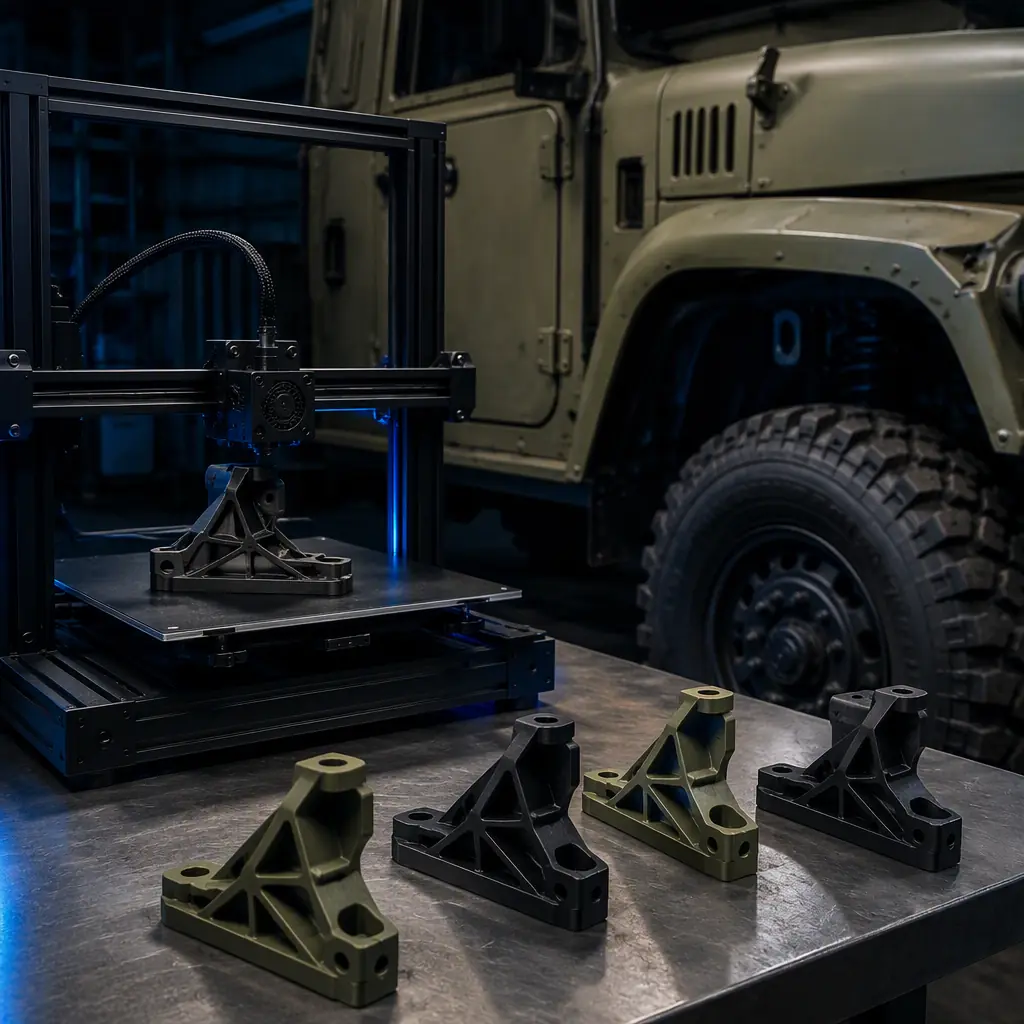
The military land vehicle vertical spans defense contractors and primes, tier-2/3 subcontractors, military vehicle MRO shops, tactical vehicle parts suppliers and defense distributors. One structural fact drives the opportunity: legacy fleets outlive their OEM supply chains, and the parts that keep them running are low-volume, one-off or discontinued. A replacement bracket, radio mount, vent cap or inspection gauge costs $8-45 to print versus $80-400 to machine or buy, and printing delivers the part in hours instead of the 4-8 week lead times that idle vehicles. Every MRO shop has a shelf of parts marked "NLA" (no longer available). And every one of them is a print job. The same make-versus-buy economics are mapped in our CNC machining vs 3D printing guide.
Why Defense & Military Vehicle Programs Are Buying 3D Printing
The maintenance-side economics are equally blunt. A legacy vehicle awaiting a single bracket or cap sits in the depot, and every day of downtime is a day the unit does not have the vehicle. MRO shops routinely see machined quotes for simple legacy parts land at $80-400 with 4-8 week lead times, against $8-45 printed parts delivered overnight. And when a program needs 5-10 copies of a part for a fielded fleet, printing wins on cost and schedule at every quantity below roughly 50 units. The quantity-break analysis that proves this to a procurement officer is in our CNC machining vs 3D printing guide.
Four structural facts make defense land vehicle programs durable buyers. First, fleet age: MRAPs, HMMWVs, tactical trucks, armored support vehicles and engineer equipment from the 1980s-2000s remain in service decades past their design life, and OEMs have discontinued spares for most of them; the tooling and fixture logic for keeping aging hardware running is in our manufacturing tooling guide. Second, small quantities and brutal lead times: most legacy parts are needed in runs of 1-50 units, below machining minimums and far below OEM MOQs, while machined quotes run 4-8 weeks against vehicles that need to move this week; the quantity-break economics are developed in our CNC vs 3D printing guide. Third, IP-controlled domestic fabrication: programs increasingly require that replacement parts be fabricated in-country under controlled documentation, which printing satisfies locally without waiting on an offshore OEM shipment. Fourth, qualification precedent: defense additive programs have already validated polymer spare parts for ground vehicles, so MRO shops know the route exists. The remaining barrier is a supplier who can execute it, which is exactly the distributor's opening.
The Applications That Actually Buy
Six clusters generate the orders. The buyers are maintenance leads, MRO shop managers, program supply-chain staff and vehicle parts suppliers.
1. Obsolete and legacy spare parts. The highest-frequency application: brackets, housings, caps, vents, interior trim, cable clips, bezels and switch plates for vehicles whose OEM spares are discontinued. Printed in PETG, ASA or PA-CF. The tooling logic for low-volume replacement parts is in our manufacturing tooling guide.
2. Drone and UAS components. Ground-station mounts, gimbal parts, antenna mounts, launch and recovery accessories and payload adapters for the small UAS platforms that increasingly ride on land vehicles. Printed in PA-CF for stiffness and impact resistance, the accessory revenue logic is in our accessories revenue guide.
3. Vehicle electronics and comms retrofits. Radio mounts, display housings, switch panels, cable guides and antenna brackets for the comms, sensor and electronics retrofits that every legacy platform goes through. Printed in PA-CF or ASA, the durable material options are in our engineering filaments guide.
4. Tooling, jigs and fixtures. Assembly fixtures, drill guides, inspection gauges, torque-check fixtures and shipping protectors for vehicle production and overhaul lines. Printed in PA-CF or PETG, the fixture design framework is in our manufacturing tooling guide.
5. Training aids and simulators. Replacement parts for training hardware, mock-ups, cutaway models and maintenance trainers that take constant abuse. Printed in PETG or PLA, the material cost logic is in our filament stocking guide.
6. Field-expedient repairs. Temporary clamps, covers, adapters and caps printed on-site to keep a vehicle operational while OEM or machined parts are procured. Printed in PA-CF, the MRO workflow parallels are in our aviation MRO guide.
The buyers inside each cluster share one profile: they maintain vehicles, they hate NLA (no longer available) status more than they hate cost, and they already know 3D printing works because their aviation and electronics colleagues use it. The fastest conversations start with a specific vehicle, a specific part and a specific failed quote, not with a technology pitch. That is why the applications above, rather than printer specs, are the sales language that closes.
Materials & Processing Reality
Defense vehicle parts are selected by impact exposure, heat, UV, flammability and chemical resistance. Four families dominate:
Two realities dominate material conversations. First, environment beats appearance: anything underhood or near exhaust needs PEEK/PEI-class or flame-retardant grades; anything exterior needs ASA; anything load-bearing needs PA-CF, the full selection framework is in our engineering filaments guide. Second, the high-temp materials change the printer conversation: PEEK and PEI need a hotend rated to 400 °C and a chamber that holds 120-150 °C, which means an enclosed high-temperature printer rather than an entry-level machine; the chamber logic is in our heated chamber guide. Matte olive drab and tan filaments are available in PA-CF and ASA lines, which matters for vehicle programs that require color-matched parts on inspection.
Processing matters as much as material choice. Carbon-fiber nylons are hygroscopic. An undried PA-CF spool prints stringy, weak parts, so a filament dryer is non-negotiable on the demo bench. Carbon-filled filaments wear brass nozzles in a few hundred grams of extrusion; hardened steel nozzles are the standard upsell on every defense material sale. And printed parts benefit from a consistent stress-relief or annealing step to lock dimensions and reduce warpage over time. Which is part of why the documentation package (print settings, drying log, annealing record) is the real product in this vertical.
From CAD to Approved Part: The Qualification Workflow
The workflow that wins defense accounts has five stages. Identify the part and its failure mode . Confirm the part is NLA, capture the original part number and note why it failed or is needed; the failure-analysis framework is in our print troubleshooting guide. Reverse-engineer or scan the geometry . Model from the original spec or 3D-scan the mating surfaces so critical interfaces match; the scanning path is in our scanner & printer bundle guide. Select the material by environment . Underhood gets PEEK/PEI-class, exterior gets ASA, load-bearing gets PA-CF, interior gets flame-retardant grades, using the framework in our engineering filaments guide. Print and test . Print, verify fit on the actual vehicle, and test through the duty cycle (torque, impact, heat soak) the part will see; the verification checklist is in our incoming QC & inspection guide. Document and get approval . Assemble the material certificate, lot traceability, dimensional report and test photos into a documentation package, then route it through the customer's engineering or maintenance approval; the documentation discipline is covered in our aviation MRO guide.
Two documentation items separate defense parts from commercial parts. First, material certification: the filament manufacturer's data sheet for the exact lot used, showing the mechanical properties the design assumed. Second, a first-article inspection report: dimensional measurements against the critical features, test photos, and the print profile used. For a $9 bracket this sounds like overkill. But it is exactly what lets a maintenance engineer approve the part, and it is what lets the same part reprint identically next year. Shops that adopt this package find approval cycles drop from weeks to days; the inspection framework is in our incoming QC & inspection guide.
Budget Reality: Printed vs Machined vs OEM
The comparison that closes defense accounts:
The distributor math compounds because every vehicle program needs dozens of discontinued parts, and every qualified part builds the documentation library that sells the next. The printer investment model that justifies the customer's own machines, and your demo fleet, is in our TCO & ROI calculator guide.
Add vehicle downtime to the comparison and the printed option stops being "cheaper" and becomes the only option that makes schedule sense. Nine weeks at the depot for a $240 machined bracket is not a $240 problem, it is a nine-week mission-availability problem. Defense buyers price schedule differently from commercial buyers, which is why the overnight print wins even when the part cost is a rounding error next to the vehicle's operating budget; the full cost model is in our TCO & ROI calculator guide.
The Distributor Playbook: Entering Defense Accounts
Five moves win defense accounts:
1. Map the three buying layers. Prime contractors buy program-driven, qualification-heavy volumes; tier-2/3 subcontractors buy production and repair quantities; MRO shops and tactical vehicle parts suppliers buy fastest and are the natural entry point. Build a target list of 40-80 accounts in your territory.
2. Learn the procurement basics. Defense buying runs on RFQ/RFP cycles, NSN (NATO Stock Number) aftermarket channels and set-aside programs that favor small suppliers; distributors who speak that language get invited to quote. NSN-listed aftermarket parts are a particular sweet spot: if a part number already has an NSN, the procurement route exists, and the distributor who can actually deliver the part, printed, documented and certified, walks into an existing demand stream; the procurement mechanics are in our government & public sector procurement guide.
3. Know the ITAR and export basics. ITAR in the US (and equivalent export regimes elsewhere) control defense articles and technical data. A distributor does not need to be an export lawyer, but must know classification basics, work only with compliant customers, and never broker controlled items. In practice that means: know whether the parts and technical data you touch are ITAR-controlled, use only customers who are registered and compliant, and keep the files and material traceability a compliance audit would expect. A compliance-aware channel is what primes and MRO shops actually want.
4. Demo with a parts rescue. Offer to print one actual legacy bracket or mount for an MRO shop's real vehicle. The shop sees a $240 six-week machined quote replaced by a $9 overnight print, the demo structure is in our B2B sales demo playbook.
5. Bundle the defense material set. An enclosed high-temperature printer plus PA-CF, ASA and flame-retardant lines, hardened nozzles, dryers and a documentation package is the anchor combination. And the margin is in materials, nozzles, build plates and the parts-on-demand service that follows; the bundling mechanics are in our accessories revenue guide.
Common Pitfalls in Defense Accounts
Five mistakes cost distributors defense business: (1) treating defense like commercial . Defense buyers expect material certs, lot traceability and test reports with every qualified part, not just a good price; ship the documentation package before they ask; (2) ignoring material certs and traceability . Use manufacturer-certified filament lots and keep spool labels and data sheets for every part you qualify; the inventory discipline is in our filament stocking guide; (3) selling hobby materials for outdoor or underhood parts, PLA warps and fails on a vehicle; qualify ASA for exterior, PA-CF for brackets and PEEK/PEI-class for underhood; (4) neglecting flame-retardant requirements . Interior and electrical parts often need UL 94 V-0 grades; ask for the vehicle's flammability spec before quoting, not after a failed inspection; and (5) bypassing ITAR-aware partners . Export rules apply to printed parts and files, so work only with compliant customers and distributors. The same spare-parts economics repeat in adjacent heavy verticals: railway fleets, mining equipment and oil & gas field hardware buy the same brackets, caps and fixtures, see our railway & transit guide, mining & heavy industry guide and oil & gas guide.
Getting Started: The First 90 Days
A 90-day entry plan: Month 1 . Identify 40-80 target accounts (MRO shops, tier-3 subcontractors, tactical vehicle parts suppliers), and stock the defense material set: PA-CF, ASA, flame-retardant PETG/ABS, plus hardened nozzles, a drying system and spare build plates; if you run a demo or service fleet, put it on remote monitoring so print status and material usage are visible without a site visit, the fleet-management setup is in our remote monitoring guide. Month 2 . Run two demo pilots: one legacy-spare rescue and one drone/UAS mount retrofit, prepare your documentation package template, and add a maintenance lead or procurement officer to your advisory loop. Month 3 . Convert pilots to paid accounts with documentation packages and parts-on-demand agreements, publish your first measured case study ("Legacy door latch bracket: $240 machined quote, 6-week lead → $9 PA-CF print, overnight"), and open one vehicle parts supplier account; the parts-on-demand service model is in our repair service center guide, and the printer investment model that justifies your own machines is in our TCO & ROI calculator guide.
Reviewed by the Precise3D engineering & OEM team. Compliance files that accompany the catalog are auditable at the certification register.
Enter the Defense & MRO Market
Ready to Supply Defense & MRO Accounts?
Get wholesale pricing on enclosed high-temperature printers, PA-CF/ASA/flame-retardant material lines, hardened nozzles, dryers, remote monitoring and the documentation package that wins defense accounts.