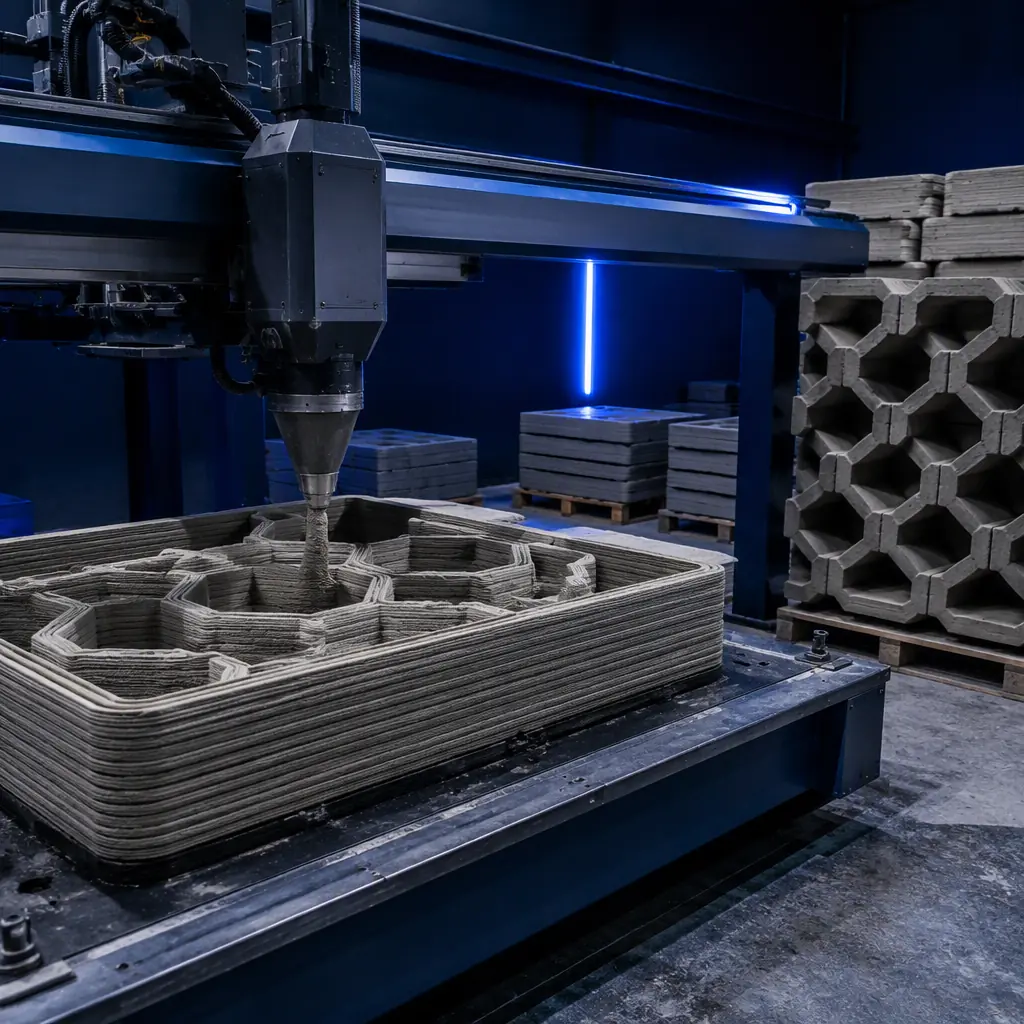
The precast concrete vertical spans architectural precast plants (facade panels, columns, decorative elements), hardscape and landscape producers (pavers, steps, edging, retaining-wall blocks), concrete furniture makers (tables, benches, sinks, planters, countertops), GFRC and cast-stone shops, and general contractors casting site-specific elements. One structural fact drives the opportunity: every unique concrete element needs a mold, and molds are the bottleneck. Traditional pattern making means CNC routing at $2,000-15,000 per pattern with 3-8 week lead times, or hand-built timber and fiberglass formwork that takes skilled labor and days to assemble. 3D printing collapses pattern and formwork cost to $150-1,500 and lead time to 1-3 days, and the same make-versus-buy economics are mapped in our CNC machining vs 3D printing guide.
Why Precast & Concrete Product Makers Are Buying 3D Printers
Four structural facts make concrete buyers durable. First, customization demand: architects and landscape designers increasingly specify unique textures, reliefs and geometries that standard molds can't produce, and each unique element needs new tooling. Second, pattern economics: CNC-routed patterns cost $2,000-15,000 and take 3-8 weeks, while printed formwork runs $150-1,500 in 1-3 days, so small-batch and one-off elements become profitable. Third, repair and legacy molds: worn or damaged molds for existing product lines can be recreated by scanning the surviving part and printing a new one, the scanning workflow is in our 3D scanner & printer bundle guide. Fourth, the architectural model connection: the same geometry that wins a project as a 3D printed architectural model becomes the formwork for the real element, the workflow is in our architecture & construction models guide.
The Applications That Actually Buy
Six clusters generate the orders. The buyers are precast plant managers, hardscape shop owners, concrete furniture makers, GFRC shops, and contractors with casting operations.
1. Architectural precast formwork. The highest-value application: formwork for facade panels, columns, cornices and decorative elements with custom reliefs, textures and logos. Printed PETG or ABS formwork replaces CNC-routed patterns at 5-15% of the cost, and the tooling logic is in our manufacturing tooling guide.
2. Hardscape and landscape molds. Pavers, steps, edging, retaining-wall blocks, garden ornaments and site furniture with unique shapes and textures. One printed master mold can cast dozens of units, the durability and cycle-life guidance is in our filament stocking guide.
3. Concrete furniture and countertop molds. Molds for tables, benches, sinks, planters and concrete countertops, including the silicone mold workflow where a printed pattern is used to cast a flexible production mold for undercuts and complex shapes.
4. Void formers and embedment templates. Disposable void formers for slab openings, duct chases and recesses, plus templates that position rebar, anchors, sleeves and embedments accurately in the form. Unit-of-one parts printed on demand, the dimensional discipline is in our tolerances & dimensional accuracy guide.
5. GFRC and cast-stone patterns. Masters for glass-fiber-reinforced concrete and cast-stone production: a printed master is used to build the production mold, capturing texture and detail that hand-building can't match, the surface-finish workflow is in our post-processing & finishing guide.
6. Repair and legacy mold recreation. Scan a surviving element from a discontinued product line, model the mold, and print it to restart production: every precast yard has a drawer of dead SKUs that become print jobs.
Materials for Concrete Formwork
Concrete buyers select formwork materials by cycle count and release behavior, not by cost. Four families dominate:
Two realities dominate material conversations. First, release behavior is the spec: a formwork that grips the concrete destroys the cast part and the mold; PP prints release naturally, while PETG and ABS need a release agent, the PP material details are in our PP filament guide. Second, cycle life determines the material tier: a 10-pour prototype can use PETG, but a 100-pour production mold needs PA-CF or a coated ABS master; the durability trade-offs are in our engineering filaments guide.
From Digital Model to Cast Element: The Workflow
The workflow that wins concrete accounts has five stages. Design the element and the mold . Model the concrete element with draft angles and shrinkage, then design the formwork as its negative; the design rules are in our tolerances guide. Print the formwork . Print in PETG, ABS or PP depending on the cycle count, orienting to minimize layer lines on the cast face; the large-format sizing logic is in our large-format industrial printer guide. Finish and seal . Sand, coat and seal the cast face for a smooth concrete surface; the smoothing workflow is in our post-processing guide. Cast and strip . Apply release agent (or use PP for natural release), pour, cure and strip; the formwork is reusable or disposable depending on material. Build the mold library . Every validated mold stays as a digital file the shop can reprint for reorders and variations; the recurring-demand model is developed in our consumables & accessories bundling guide.
Budget Reality: Printed Formwork vs CNC Patterns
The comparison that closes concrete accounts:
The distributor math compounds because every project produces unique geometry, and every printed mold creates demand for the next variation. The printer investment model that justifies the shop's own machines, and your demo fleet, is in our TCO & ROI calculator guide.
The Distributor Playbook: Entering Precast & Concrete Products
Five moves win concrete accounts:
1. Target shops with active custom work. Architectural precast plants, hardscape producers and concrete furniture makers that bid on custom projects are the highest-intent buyers. Build a target list of 20-40 shops and contractors in your territory.
2. Lead with a pattern pilot. Offer to print one master pattern for an upcoming project free of charge. The shop sees a $2,000-7,500 pattern problem solved for $200 and a weekend, the demo playbook is in our B2B sales demo guide.
3. Bundle the formwork material set. A large-format enclosed printer plus PETG, ABS, PP, PA-CF and TPU lines is the anchor combination, and the margin is in materials, build plates and nozzles. The bundling mechanics are in our consumables bundling guide.
4. Offer a mold-design service. Many shops can pour concrete but can't model mold geometry. A distributor that offers modeling, printing and finishing of formwork for a fixed fee captures the account before hardware discussion starts, the service-revenue logic is in our repair service center guide.
5. Work the project and bid cycle. Contractors and precast plants need formwork fast when a project lands; sell printers, materials and print-on-demand services ahead of bidding seasons, using the framework in our trade show strategy guide.
Common Pitfalls in Concrete Accounts
Five mistakes cost distributors concrete business: (1) ignoring release behavior . A formwork that grips concrete destroys the cast part and the mold; test release agents or sell PP for natural release before promising anything; (2) undersizing wall thickness . Formwork flexes under concrete pressure; thin printed walls bow and ruin the cast face, so sell the stiffening and wall-thickness engineering, not just the machine; (3) treating concrete like plastic parts . Concrete abrasion wears printed surfaces fast; the buyer is a shop owner who thinks in pours per mold, and the pitch is cycle life, not layer resolution; (4) skipping the finish step . Layer lines transfer to the concrete face; the coating workflow in our post-processing guide is part of the sale; and (5) forgetting the construction-market context . Precast buyers also need the site and machinery side of the story, covered in our construction machinery industry guide.
Getting Started: The First 90 Days
A 90-day entry plan: Month 1 . Identify 20-40 target precast shops, hardscape producers and contractors, and stock the formwork material set: PETG, ABS, PP, PA-CF, TPU, plus build plates, hardened nozzles and a drying system. Month 2 . Run two free pattern pilots (one paver pattern, one furniture mold master), produce a mold-cycle report template, and add a precast plant manager to your advisory loop. Month 3 . Convert pilots to paid accounts with mold-design service agreements, publish your first measured case study ("hardscape manufacturer: $7,500 CNC pattern → $340 printed formwork, 6 weeks → 48 hours, 40 pavers cast"), and open one architectural precast account. The printer investment model that justifies the distributor's own machines is in our TCO & ROI calculator guide.
Reviewed by the Precise3D engineering & OEM team. Compliance files that accompany the catalog are auditable at the certification register.
Enter the Precast Concrete Market
Ready to Supply Mold Shops & Precast Plants?
Get wholesale pricing on large-format enclosed printers, PETG/ABS/PP/PA-CF/TPU material lines, build plates, hardened nozzles, dryers, and the concrete-formwork playbook that wins precast and hardscape accounts.