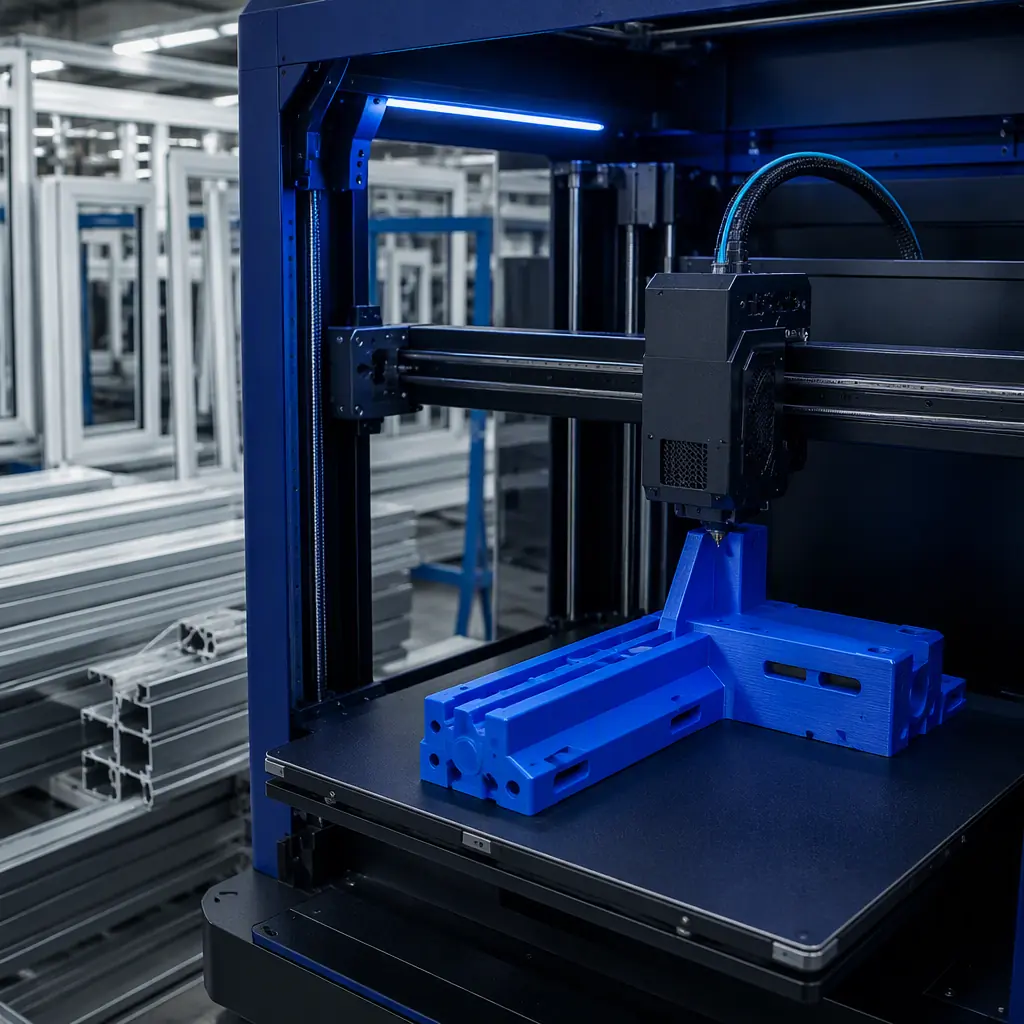
The door and window manufacturing vertical spans PVC window fabricators, aluminum door and window plants, steel and composite door makers, hardware suppliers, and glazing and glass processing shops. One structural fact drives the opportunity: every profile family and hardware change creates a tooling gap. Corner welding jigs, router templates, drill guides, gasket profile tools and hardware mounting fixtures are either bought from machinery vendors with 4-8 week lead times or improvised on the shop floor. A printed alignment jig costs a few dollars and prints overnight; a router template for a new profile prints in an afternoon. Every fabrication shop has a stack of worn jigs and a drawer of improvised fixtures. And every one of them is a print job. The same make-versus-buy economics are mapped in our CNC machining vs 3D printing guide.
Why Door & Window Fabricators Are Buying 3D Printers
Four structural facts make door and window buyers durable. First, profile-change tooling demand: every time a fabricator adds a profile family or a hardware line changes, they need new jigs, templates and fixtures, the recurring-demand model is developed in our consumables & accessories bundling guide. Second, precision tooling: welded corners, routed gaskets and drilled hardware mounting holes are tolerance-critical, and printed gauges and templates standardize quality, the tooling logic is in our manufacturing tooling guide. Third, hardware prototyping: door and window hardware goes through many design iterations, and printed prototypes compress the cycle from weeks to days, the prototyping economics are in our buyer's guide & price tiers. Fourth, legacy machine support: plants running 10-20 year old fabrication lines can't source worn fixtures, and unit-of-one prints keep them running, the spare-parts economics are in our spare parts revenue guide.
The Applications That Actually Buy
Six clusters generate the orders. The buyers are fabrication shop managers, production engineers, tooling supervisors and hardware R&D teams.
1. Corner welding jigs and alignment tools. The highest-frequency application: corner clamps, alignment blocks, weld seam gauges and sash squareness fixtures for PVC welding lines. Printed in PA-CF for precision and durability, the material-selection framework is in our engineering filaments guide.
2. Router templates and drill guides. Routing templates for drainage slots, glazing bead profiles, hardware recesses, and drill guides for hinge and lock mounting holes. Printed in PETG or PA-CF for dimensional accuracy, the tooling logic is in our manufacturing tooling guide.
3. Gasket and glazing profile tooling. Setting blocks, glazing spacers, gasket insertion rollers, and profile pull fixtures for weatherstripping and glazing. Printed in PETG, PP or TPU depending on contact, the material rules are in our filament stocking guide.
4. Hardware prototypes and fit-check parts. Hinges, handles, locks, rollers and multi-point locking components printed for fit and function testing before tooling investment. Printed in PA-CF or ABS, the prototyping logic is in our rapid prototyping & R&D guide.
5. Line fixtures and machine guards. Sensor mounts, conveyor guides, stacker fingers, cable trays and guard brackets for fabrication lines. Unit-of-one prints that adapt to any machine, the accessory logic is in our accessories revenue guide.
6. Packaging and handling tooling. Spacer bars, pallet guides, banding fixtures and glazing protection caps for finished windows and doors. Printed in PETG or PP for durability, the bundling mechanics are in our consumables bundling guide.
Materials & Precision Rules
Door and window buyers select materials by precision requirement, contact surface and UV exposure. Four families dominate:
Two realities dominate material conversations. First, precision is a spec, not a suggestion: a corner jig that drifts 0.3 mm produces rejected welds, so PA-CF or annealed PETG beats cheaper plastics for anything tolerance-critical; the engineering material options are in our engineering filaments guide. Second, contact surface drives selection: anything touching finished profiles or glass gets non-marring materials like TPU or PP; anything outdoors gets UV-stable ASA, the flexible and durable families are in our TPU/TPE filament guide.
From Profile Change to Printed Template: The Workflow
The workflow that wins fabrication-shop accounts has five stages. Identify the tooling gap . The worn jig, the missing template, the hardware that needs a fit check; the failure-analysis framework is in our print troubleshooting guide. Model or scan it . Model the template from the profile cross-section or scan the worn original; the scanning path is in our scanner & printer bundle guide. Select the material by precision and contact . Corner jigs get PA-CF; drill guides get PETG; glass-contact parts get TPU, using the framework in our filament stocking guide. Print and validate . Print, test on the actual profile, and iterate; the verification checklist is in our incoming QC guide. Build the template library . Every qualified template becomes a digital asset the shop can reprint for the next profile run; the recurring-demand model is developed in our consumables subscription guide.
Budget Reality: Printed vs Vendor vs Machined Tooling
The comparison that closes fabrication-shop accounts:
The distributor math compounds because every profile change and hardware line creates a new wave of tooling demand, and every successful print creates demand for the next. The printer investment model that justifies the shop's own machines, and your demo fleet, is in our TCO & ROI calculator guide.
The Distributor Playbook: Entering Door & Window Manufacturing
Five moves win fabrication-shop accounts:
1. Target fabricators with active profile and hardware cycles. PVC window fabricators, aluminum door and window plants and hardware R&D teams (20-300 employees) are the highest-intent buyers. Build a target list of 30-60 shops in your territory.
2. Lead with a precision tool pilot. Offer to print one corner welding jig or profile router template for free. The shop sees a $180-500 vendor part delivered overnight at $8-30, the demo playbook is in our B2B sales demo guide.
3. Bundle the fabrication material set. An enclosed printer plus PA-CF, PETG, ABS, ASA, TPU and PP lines is the anchor combination, and the margin is in materials, build plates and hardened nozzles. The bundling mechanics are in our consumables bundling guide.
4. Offer a template-service program. Shops need new templates for every profile and hardware change. A distributor that prints and validates templates for a per-part fee captures the account before hardware discussion starts, the service-revenue logic is in our repair service center guide.
5. Work the hardware R&D cycle. Door and window hardware goes through constant iteration, and each round needs printed prototypes and fit checks. Sell printers, materials and print-on-demand services ahead of each product cycle, using the framework in our trade show strategy guide.
Common Pitfalls in Fabrication-Shop Accounts
Five mistakes cost distributors door and window business: (1) selling cheap materials for tolerance-critical tooling . A corner jig that drifts produces rejected welds; qualify PA-CF or annealed PETG for anything precision-critical; (2) ignoring marring . Anything touching finished profiles or glass needs non-marring TPU or PP, not PLA; the material rules are in our filament stocking guide; (3) treating fabricators like general manufacturing . The buyer is a shop manager or production engineer, and the pitch is reject reduction and changeover speed, not throughput; (4) skipping the fit-check step . A template that doesn't match the profile is scrap; test on the actual profile before handover; and (5) forgetting adjacent glazing verticals . The same shops process glass and make curtain wall and sunroom products, covered in our glass industry guide and signage & display fabrication guide.
Getting Started: The First 90 Days
A 90-day entry plan: Month 1 . Identify 30-60 target fabricators, and stock the fabrication material set: PA-CF, PETG, ABS, ASA, TPU, PP, plus build plates, hardened nozzles and a drying system. Month 2 . Run two precision-tool pilots (one PVC window shop, one aluminum door plant), produce a template-service template, and add a shop manager to your advisory loop. Month 3 . Convert pilots to paid accounts with template-service agreements, publish your first measured case study ("PVC shop: 3% corner rejects → 0% with printed PA-CF alignment jigs"), and open one hardware supplier account. The printer investment model that justifies the distributor's own machines is in our TCO & ROI calculator guide.
Reviewed by the Precise3D engineering & OEM team. Compliance files that accompany the catalog are auditable at the certification register.
Enter the Door & Window Market
Ready to Supply Door & Window Fabricators?
Get wholesale pricing on enclosed printers, PA-CF/PETG/ABS/ASA/TPU/PP material lines, build plates, hardened nozzles, dryers, and the fabrication-shop playbook that wins jig and template accounts.