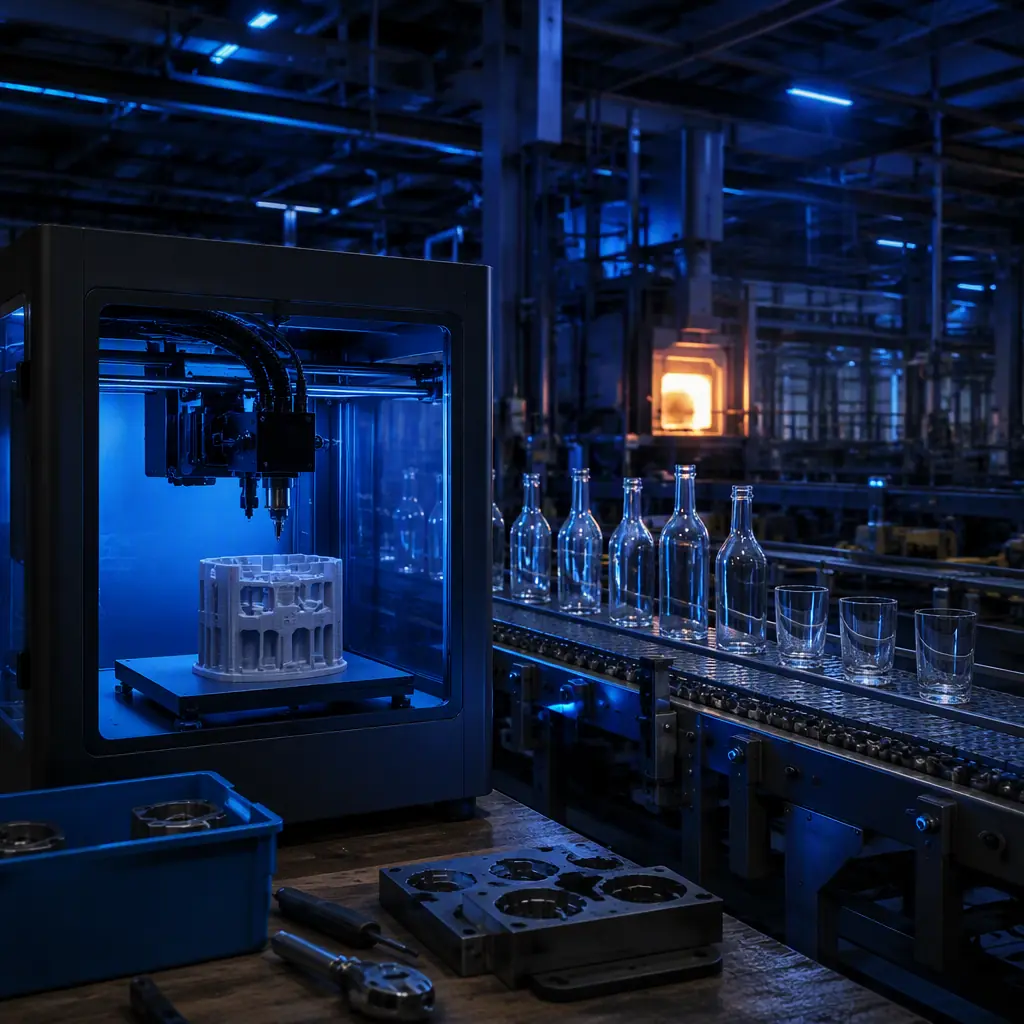
The glass manufacturing vertical spans container glass (bottles, jars, vials), flat glass (architectural, automotive), specialty glass (borosilicate laboratory ware, cookware, lighting glass), fiberglass, and tableware and decor producers. Three structural facts drive the opportunity. First, mold tooling is slow and expensive: production molds are machined from cast iron or bronze at $8,000-40,000 per set with 6-12 week lead times, so every product redesign starts with a costly bet. Second, kiln furniture is consumable: setters, posts, plates and supports for glass firing crack and sag in normal use and are reordered constantly. Third, legacy equipment never dies: glass lines run 30-50 years, and spare parts for lehrs, feeders, gob distributors and cold-end machines vanish from catalogs. Printing collapses the prototype mold cost to $100-800 and the lead time to 1-3 days, and the same make-versus-buy logic that drives the rest of manufacturing is mapped in our CNC machining vs 3D printing guide.
Why Glass Plants Are Buying 3D Printers
Four structural facts make glass buyers durable. First, mold development economics: a glass producer tests 20-60 new container or product shapes per year, and each machined prototype mold set costs $8,000-40,000; printed prototype inserts cut that to 1-3% and let the plant validate shape, wall distribution and fill behavior before spending on production tooling. Second, kiln furniture consumption: firing supports and setters are high-wear consumables that glass plants buy continuously, and ceramic 3D printing produces small-batch setters and posts in days instead of the 4-8 week wait for sintered refractory suppliers. Third, cold-end automation retrofits: glass processors add inspection, packing and decorating automation to aging lines, and every retrofit needs custom brackets, adapters and guards, the tooling playbook is in our manufacturing tooling guide. Fourth, handling damage reduction: glass handling fixtures, suction adapters, rack inserts, edge-protection spacers, are printed in soft or padded materials that reduce breakage, and the dimensional discipline for these fits is in our tolerances & dimensional accuracy guide.
The Applications That Actually Buy
Six clusters generate the orders. The buyers are mold shops, hot-end engineers, cold-end maintenance teams, and process engineers at glass producers and processors.
1. Prototype mold inserts for container and tableware glass. The highest-frequency application: neck rings, blank molds, blow molds and finish tooling printed in PETG, PC or resin to test new bottle and product shapes before committing to cast-iron production molds. A printed insert set costs $100-800 versus $8,000-40,000 for machined tooling, and the material-selection framework is in our filament stocking guide.
2. Kiln furniture and firing supports. Setters, posts, drip trays, plates and crucible supports for glass firing and annealing, printed in ceramic resin or refractory-compatible materials for small batches and custom geometries. Standard sintered refractory parts cost $50-300 each with 4-8 week lead times; printed versions run $15-80 in days, the material options are in our ceramic 3D printing materials guide.
3. Handling, transport and packing fixtures. Vacuum-cup adapters, rack inserts, edge-protection spacers, separating grids and packing nests for glass ware in the cold end. Soft TPU and TPE prints cradle finished glass and cut breakage in handling and transport, the flexible material options are in our TPU/TPE filament guide.
4. Grinding, polishing and decorating jigs. Fixtures that hold glass ware for edge grinding, polishing, sandblasting, screen printing and labeling. Unit-of-one tools that adapt quickly to shape changes, the fixture design logic is in our tooling guide.
5. Legacy spare parts for glass machines. Gears, cams, levers, guard panels and wear parts for feeders, lehrs, gob distributors, stackers and cold-end machines whose OEMs no longer stock parts. Scan, model, print, the reverse-engineering workflow is in our 3D scanner & printer bundle guide.
6. High-temperature tooling near the hot end. Alignment fixtures, inspection gauges and protective covers that sit near furnaces and forehearths, printed in PEEK, PPSU or PEI where continuous-use temperature matters, the high-temp material guidance is in our PEEK/PEI/PPSU industrial materials guide.
Materials for Glass-Environment Tooling
Glass buyers select materials by temperature zone and contact risk, not by cost. Four families dominate:
Two realities dominate material conversations. First, temperature zone decides the material: cold-end tooling can use PETG and TPU, while anything near the hot end needs PEEK-class materials or ceramic, a part that softens at process temperature fails in hours. Second, surface finish drives mold quality: prototype mold inserts need smooth, coated or polished surfaces so the glass releases cleanly; the post-processing workflow for smoothing and coating is in our post-processing & finishing guide.
From New Shape to Production Mold: The Workflow
The workflow that wins glass accounts has five stages. Design or scan the shape . Model the new container or product, or 3D-scan an existing piece to reverse-engineer it; the scanning path is in our scanner & printer bundle guide. Print the prototype insert set . Print neck rings, blanks and finish tooling in PETG or PC, sized with the shrink and draft allowances used in the plant; the dimensional rules are in our tolerances guide. Run trial glass . Fire real glass against the inserts to validate shape, wall distribution and fill; iterate the geometry in 1-2 day cycles instead of 6-12 week mold-shop cycles. Freeze and commit . Once the shape is validated, the plant orders production cast-iron molds with confidence, and the printed inserts become spare tooling for short pilot runs. Build the digital tooling library . Every validated insert stays as a digital file the plant can reprint for pilot batches and line trials; the recurring-demand model is developed in our consumables & accessories bundling guide.
Budget Reality: Printed vs Machined
The comparison that closes glass accounts:
The distributor math compounds because a glass plant tests dozens of shapes per year and reorders kiln furniture continuously: every successful pilot creates demand for the next. The printer investment model that justifies the plant's own machines, and your demo fleet, is in our TCO & ROI calculator guide.
The Distributor Playbook: Entering Glass Manufacturing
Five moves win glass accounts:
1. Target plants with active mold shops and product development. Container and tableware producers that launch 20-60 new shapes per year are the highest-intent buyers. Build a target list of 15-30 glass plants, tableware makers and processors in your territory.
2. Lead with a prototype-insert pilot. Offer to print one insert set for an upcoming product trial free of charge. The plant sees a $8,000-40,000 tooling decision de-risked for $180 and a weekend, the demo playbook is in our B2B sales demo guide.
3. Bundle the glass material set. A large-format enclosed printer plus PETG, PC, ceramic resin, TPU and PA-CF lines is the anchor combination, and the margin is in materials, build plates and nozzles. The large-format sizing logic is in our large-format industrial printer guide, and the bundling mechanics in our consumables bundling guide.
4. Offer a kiln-furniture print service. Small-batch ceramic setters and posts for custom and legacy kiln configurations are a recurring revenue stream with zero hardware dependency. A distributor that prints and ships firing supports captures the hot-end account before the printer conversation starts; the service-revenue logic is in our repair service center guide.
5. Work the retrofit and expansion cycle. Every new line, inspection cell or packing upgrade needs custom brackets, guards and adapters; sell printers, materials and print-on-demand services ahead of each project, using the framework in our trade show strategy guide.
Common Pitfalls in Glass Accounts
Five mistakes cost distributors glass business: (1) overselling temperature performance . A PETG part placed near a forehearth softens and fails; qualify the material against the actual temperature zone before promising anything; (2) ignoring draft and shrink . Glass mold inserts need the plant's draft angles and shrink factors, or trial glass sticks; sell the dimensional engineering, not just the machine; (3) treating glass like general manufacturing . The buyer is a mold-shop manager or hot-end engineer, and the pitch is tooling risk reduction, not throughput; (4) skipping surface-finish work . Rough printed surfaces transfer to the glass; the smoothing and coating workflow in our post-processing guide is part of the sale; and (5) forgetting dust and abrasion . Glass plants are abrasive environments, and hot-end materials need enclosed printers and filtration, with setup guidance in our fume extraction & filtration guide.
Getting Started: The First 90 Days
A 90-day entry plan: Month 1 . Identify 15-30 target glass plants, tableware makers and processors, and stock the glass material set: PETG, PC, ceramic resin, TPU, PA-CF, plus build plates, hardened nozzles and a drying system. Month 2 . Run two free prototype-insert pilots (one container shape, one tableware shape), produce a trial-report template, and add a mold-shop manager to your advisory loop. Month 3 . Convert pilots to paid accounts with shape-validation service agreements, publish your first measured case study ("tableware factory: $9,200 machined insert set → $180 printed set, 9 weeks → 36 hours"), and open one kiln-furniture print-service account. The printer investment model that justifies the distributor's own machines is in our TCO & ROI calculator guide.
Reviewed by the Precise3D engineering & OEM team. Compliance files that accompany the catalog are auditable at the certification register.
Enter the Glass Manufacturing Market
Ready to Supply Mold Shops & Glass Plants?
Get wholesale pricing on large-format enclosed printers, PETG/PC/ceramic/TPU/PA-CF material lines, build plates, hardened nozzles, dryers, and the glass-industry playbook that wins mold-shop and hot-end accounts.