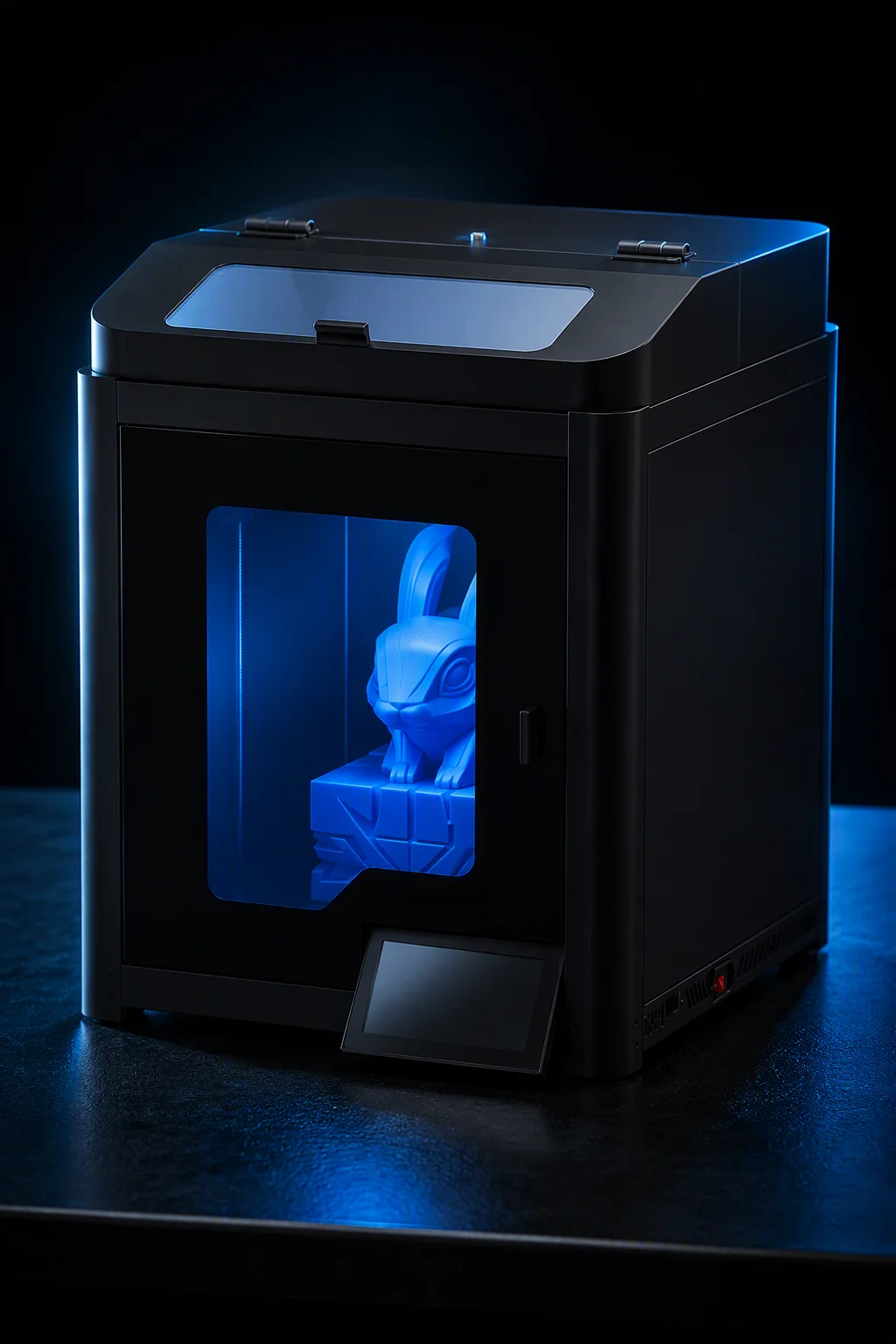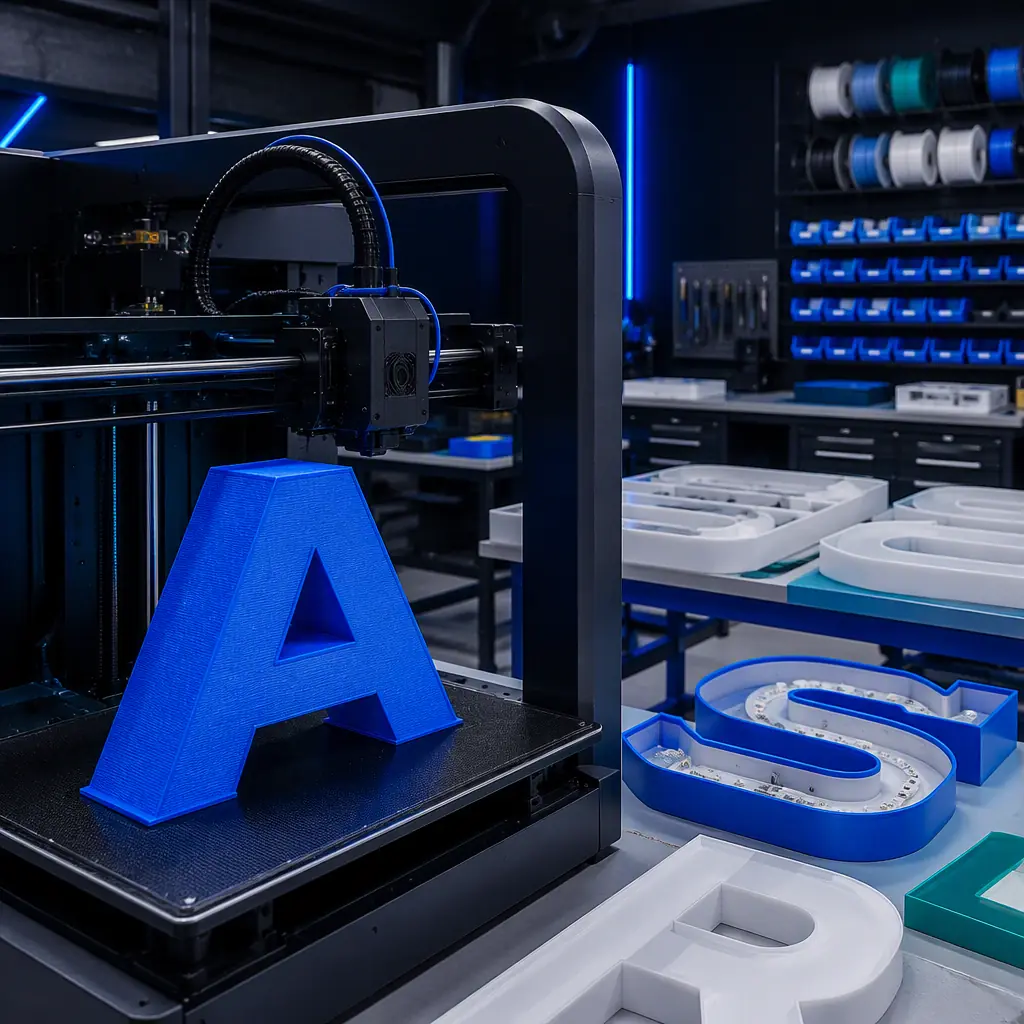
The signage vertical spans custom sign shops, architectural signage and wayfinding firms, retail display fabricators, brand and franchise programs, and sign supply distributors. One structural fact drives the opportunity: every sign job is a one-off, and lead time is the bid killer. A bank rebrand needs 40 dimensional letters in a custom typeface, a restaurant chain needs 12 illuminated channel letters with brand-matched colors, a hospital needs 200 wayfinding panels with tactile braille. No catalog carries any of it, and CNC routing or vacuum forming takes 1-3 weeks and thousands in setup. A printed letter costs 5-15% of the routed version, ships the same week, and revisions are a reprint, not a re-quote. The same make-versus-buy economics are mapped in our CNC machining vs 3D printing guide.
Why Sign Shops & Display Fabricators Are Buying 3D Printers
Four structural facts make signage buyers durable. First, unit-of-one production: every sign is custom, so there is no inventory to amortize, the tooling logic mirrors our manufacturing tooling guide. Second, prototype-to-production in one machine: a letter, bracket or fixture can be validated on the shop floor and installed the same week, cutting the 3-4 week vendor cycle that stalls sign permits and tenant build-outs. Third, brand personalization: franchises and retail chains want branded displays, logo letters and dimensional accents that no distributor stocks, the fixture logic connects to our retail & hospitality fixtures guide. Fourth, recurring material and service revenue: every printed sign consumes ASA, PETG, PC and specialty filaments plus finishing supplies, and the recurring-demand model is developed in our consumables & accessories bundling guide.
The Applications That Actually Buy
Six clusters generate the orders. The buyers are sign shop owners, architectural signage firms, franchise brand teams, retail display departments, and sign supply dealers.
1. Dimensional letters and logos. The highest-frequency application: custom-typeface letters, logos, numerals and emblems for storefronts, offices, lobbies and wayfinding. Printed in ASA or PETG at 5-30 cm height, these replace CNC-routed acrylic at 10-20% of the cost with no tooling, the material-selection framework is in our engineering filaments guide.
2. Channel letter and light box components. Letter backs, LED diffuser clips, standoff mounts, return panels and light box frame brackets that hold illumination systems together. Printed in flame-retardant ABS or PC where building codes require it, the LED adjacency is covered in our lighting & luminaire industry guide.
3. Wayfinding and architectural signage elements. Directional signs, room-number plates, braille/tactile ADA panels, post-mounted elements and wall-mount brackets. Unit-of-one runs that must match building standards exactly, the precision workflow is in our calibration & dimensional accuracy guide.
4. Retail displays and point-of-purchase fixtures. Product display risers, shelf edge strips, counter displays, logo holders and seasonal promo elements for retail and trade show booths. Brand-matched colors and short production runs, the display playbook is in our fixtures & displays guide.
5. Sign hardware, jigs and installation tooling. Standoff spacers, mounting templates, drill guides, raceway clips and alignment jigs that make installation faster and repeatable. Every sign crew uses jigs, the tooling logic is in our manufacturing tooling guide.
6. Legacy and discontinued sign parts. Replacement faces, trim caps, hinge pins and drive components for signs whose manufacturers stopped production. Scan, model, and print the part on demand, the reverse-engineering workflow is in our 3D scanner & printer bundle guide.
Materials & Outdoor Durability Rules
Signage buyers select materials by exposure, code and finish, not by cost. Five families dominate:
Two realities dominate material conversations. First, outdoor exposure is a spec, not a wish: ASA and PC hold color and strength under UV for 5-10 years, while PLA fades and embrittles within months, the full outdoor durability framework is in our outdoor weather-resistant printing guide. Second, code compliance gates the order: illuminated signs in most jurisdictions require flame-retardant materials rated UL 94 V-0 or better, and sign shops need documented material certificates; the certification framework is in our certification & compliance guide.
From Design File to Installed Sign: The Workflow
The workflow that wins sign accounts has five stages. Convert the brand file . Import the client's vector logo or typeface, extrude it to dimensional letters, and scale to the job; the design-for-printing rules are in our part cooling & duct design guide. Select the material by exposure and code . Outdoor gets ASA or PC, illuminated gets flame-retardant grades, indoor displays get PETG or ABS, using the framework in our filament stocking guide. Print and finish . Print the run, sand, prime, paint or vapor-smooth to the brand finish spec; the finishing techniques are in our post-processing & finishing guide. Install and document . Mount the sign and log the job's material, machine time and finish recipe. Build the digital sign library . Every letter, bracket and jig becomes a digital asset the shop can reprint for the next branch, franchise or renewal; the recurring-demand model is developed in our consumables subscription guide.
Budget Reality: Printed vs CNC vs Cast Letters
The comparison that closes sign accounts:
The distributor math compounds because a sign shop runs dozens of jobs per month, and every successful print creates demand for the next letter, bracket and jig. The printer investment model that justifies the shop's own machines, and your demo fleet, is in our TCO & ROI calculator guide.
The Distributor Playbook: Entering the Sign Market
Five moves win signage accounts:
1. Target sign shops and display fabricators with active installs. Custom sign shops (2-50 employees), architectural wayfinding firms, franchise brand teams and retail display departments are the highest-intent buyers. Build a target list of 30-60 shops and brand programs in your territory.
2. Lead with a free letter-and-bracket pilot. Offer to print a shop's own logo letter set plus a channel letter clip batch for free. The owner sees a $350-500 vendor quote replaced by $18 and a day, the demo playbook is in our B2B sales demo guide.
3. Bundle the signage material set. An enclosed printer plus ASA, PETG, PC, ABS and TPU lines is the anchor combination, and the margin is in materials, build plates and nozzles. The bundling mechanics are in our consumables bundling guide.
4. Offer a brand program service. Franchise and retail brands need documented digital letter and fixture libraries per location. A distributor that prints, finishes and ships per-store kits captures the account before hardware discussion starts, the service-revenue logic is in our repair service center guide.
5. Work the rebrand and build-out cycle. Bank, restaurant and retail rebrands create waves of letter, wayfinding and display demand; sell printers, materials and print-on-demand services ahead of each cycle, using the framework in our trade show strategy guide.
Common Pitfalls in Sign Accounts
Five mistakes cost distributors signage business: (1) selling PLA for outdoor jobs, UV exposure embrittles it within months; qualify ASA or PC against the install environment before promising anything, using our outdoor durability guide; (2) ignoring code compliance . Illuminated sign components need documented flame-retardant ratings, and the paperwork is part of the sale; (3) treating signage like general manufacturing . The buyer is a shop owner bidding a job, and the pitch is lead time and finish quality, not throughput; (4) skipping the finish step . Raw printed letters lose bids to painted or smoothed ones; finishing is a skill to train, covered in our post-processing guide; and (5) forgetting the adjacent verticals . The same shops fabricate retail fixtures and lighting elements, covered in our retail fixtures guide and lighting industry guide.
Getting Started: The First 90 Days
A 90-day entry plan: Month 1 . Identify 30-60 target shops, fabricators and brand programs, and stock the signage material set: ASA, PETG, PC, ABS, TPU, plus build plates, hardened nozzles and a drying system. Month 2 . Run two free pilots (one custom sign shop, one franchise brand program), produce a brand-library template, and add a sign shop owner to your advisory loop. Month 3 . Convert pilots to paid accounts with per-store kit agreements, publish your first measured case study ("Regional sign shop: $412 vendor letters → $18 printed, 9 days → same day, 6 letters"), and open one sign supply dealer account. The printer investment model that justifies the distributor's own machines is in our TCO & ROI calculator guide.
Reviewed by the Precise3D engineering & OEM team. Compliance files that accompany the catalog are auditable at the certification register.
Enter the Signage Market
Ready to Supply Sign Shops & Display Fabricators?
Get wholesale pricing on enclosed printers, ASA/PETG/PC/ABS/TPU material lines, build plates, hardened nozzles, dryers, and the signage playbook that wins dimensional letter, wayfinding and display accounts.