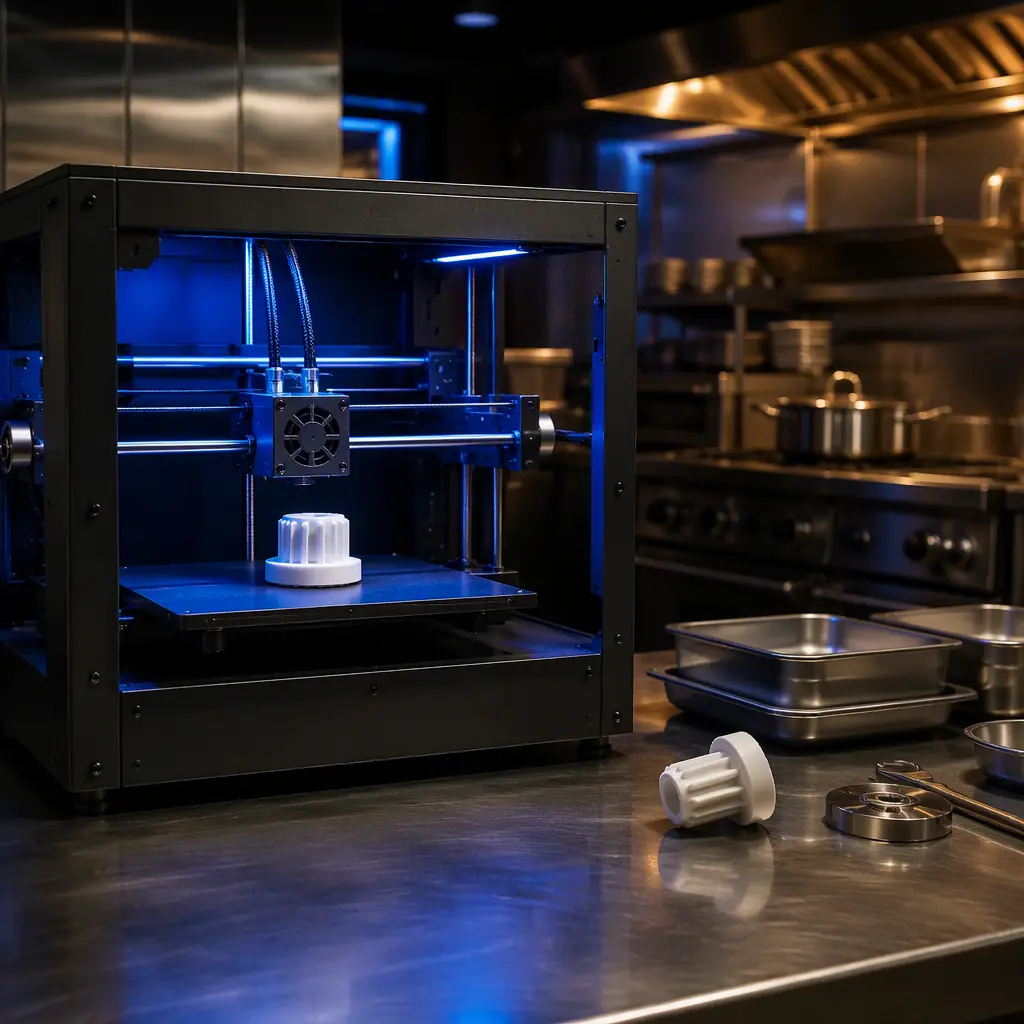
The foodservice vertical spans QSR and fast-casual chains, independent restaurants, food trucks and mobile kitchens, caterers and commissary kitchens, commercial kitchen equipment dealers, and restaurant supply houses. One structural fact drives the opportunity: commercial kitchen equipment breaks constantly, and downtime costs money immediately. A mixer, slicer, fryer, ice machine or dishwasher is mission-critical; when a knob, foot, handle, guard or vent breaks, the OEM part costs $15-150 and takes 1-3 weeks to ship, while a printed replacement costs $1-20 and takes under an hour. Every kitchen has a drawer of broken parts and a stack of back-ordered SKUs. And every one of them is a print job. The same make-versus-buy economics are mapped in our CNC machining vs 3D printing guide.
Why Foodservice Operators & Dealers Are Buying 3D Printers
Four structural facts make foodservice buyers durable. First, downtime economics: a down prep station or fryer costs a kitchen $200-2,000 per day in lost service, so a same-day printed part beats a two-week OEM shipment every time, the same urgency logic as our maintenance guide. Second, fleet commonality: chains run dozens of identical pieces of equipment, so one scanned part becomes a digital spare for the whole fleet, and the recurring-demand model is developed in our consumables & accessories bundling guide. Third, customization and branding: restaurants want branded fixtures, menu holders, table numbers and display pieces that no catalog supplies, the fixture logic connects to our hospitality & retail fixtures guide. Fourth, dealer service differentiation: equipment dealers who print parts on demand win and keep service contracts against dealers who only ship OEM parts, the service-revenue logic is in our repair service center guide.
The Applications That Actually Buy
Six clusters generate the orders. The buyers are chain maintenance teams, independent operators, kitchen equipment dealers, and restaurant supply houses.
1. Kitchen equipment spare parts. The highest-frequency application: knobs, handles, feet, guards, vents, drip trays, hinge pins and gear components for mixers, slicers, fryers, ovens, dishwashers, ice machines and refrigeration. Printed in PETG, ABS or PA-CF, these replace $15-150 OEM parts at 5-15% of the cost in under an hour, the material-selection framework is in our filament stocking guide.
2. Custom kitchen fixtures and organizers. Utensil holders, ladle racks, pan organizers, shelf clips, corner guards, and work-station jigs that keep kitchens efficient. Unit-of-one prints that adapt to any layout, the tooling logic is in our manufacturing tooling guide.
3. Portion-control and service tools. Portion scoops, measuring spoons, pour spouts, pastry cutters, piping tips, and prep tools that keep service consistent. Printed in food-safe materials and replaced frequently, the food-contact rules are in our food-safe 3D printing & regulatory guide.
4. Food-safe service and display items. Serving trays, condiment caddies, table numbers, menu stands, display risers and branded counter pieces. These carry the restaurant's look and are reordered in volume, the display-fixture playbook is in our fixtures & displays guide.
5. Ventilation, guard and hygiene components. Vent covers, kick plates, grommets, splash-guard clips and washable separators that keep equipment compliant and clean. Printed in PETG or PP for easy sanitation. The flexible and durable material options are in our TPU/TPE filament guide.
6. Legacy and discontinued equipment parts. Scan, model, and print parts for equipment whose OEMs stopped production. Every kitchen has legacy gear, the reverse-engineering workflow is in our 3D scanner & printer bundle guide.
Materials & Food-Safety Rules
Foodservice buyers select materials by contact level and wash cycle, not by cost. Four families dominate:
Two realities dominate material conversations. First, food contact is a spec, not a suggestion: anything that touches food must be printed in food-safe materials (PP, food-safe PETG, or coated parts) and replaced on a schedule, because layer lines harbor bacteria, the full regulatory framework is in our food-safe 3D printing & regulatory guide. Second, wash cycles kill weak parts: commercial dishwashers run hot caustic cycles, so parts need chemical-resistant, heat-tolerant materials; the PP details are in our PP filament guide.
From Broken Part to Installed Part: The Workflow
The workflow that wins foodservice accounts has five stages. Identify and scan the failed part. 3D-scan the broken knob, foot or gear, or model it from dimensions; the scanning path is in our scanner & printer bundle guide. Select the material by contact level . Food-contact parts get PP or food-safe PETG; structural parts get PA-CF; washable parts get PETG or PP, using the framework in our filament stocking guide. Print and verify . Print the part, check fit and function, and log it in the kitchen's parts file; the verification checklist is in our incoming QC guide. Install and track . Install the part and note the service date; the reliability data builds the case for the next 50 parts. Build the digital parts library . Every qualified part becomes a digital spare the fleet can reprint on demand; the recurring-demand model is developed in our consumables & accessories bundling guide.
Budget Reality: Printed vs OEM Parts
The comparison that closes foodservice accounts:
The distributor math compounds because a chain with 40 locations has hundreds of broken parts per year, and every successful print creates demand for the next. The printer investment model that justifies the operator's own machines, and your demo fleet, is in our TCO & ROI calculator guide.
The Distributor Playbook: Entering Foodservice
Five moves win foodservice accounts:
1. Target chains and dealers with maintenance programs. QSR chains (10-500 locations), regional franchise groups, and kitchen equipment dealers with service contracts are the highest-intent buyers. Build a target list of 30-60 operators and dealers in your territory.
2. Lead with a free parts pilot. Offer to print and install five commonly broken parts (knobs, feet, guards) for free. The operator sees a $25-150 part problem solved for $2 and an hour, the demo playbook is in our B2B sales demo guide.
3. Bundle the foodservice material set. An enclosed printer plus PETG, PP, ABS, PA-CF and TPU lines is the anchor combination, and the margin is in materials, build plates and nozzles. The bundling mechanics are in our consumables bundling guide.
4. Offer a fleet parts-library service. Chains need a documented digital spare library per equipment model. A distributor that scans, prints and maintains the library for a monthly fee captures the account before hardware discussion starts, the service-revenue logic is in our repair service center guide.
5. Work the equipment-sales and remodel cycle. New-store openings and remodels need custom fixtures and branded display pieces; sell printers, materials and print-on-demand services ahead of each build-out, using the framework in our trade show strategy guide.
Common Pitfalls in Foodservice Accounts
Five mistakes cost distributors foodservice business: (1) treating every part as food-safe . Only contact-level parts need food-safe materials; selling food-safe claims for structural parts wastes margin, and the classification framework is in our food-safe regulatory guide; (2) ignoring wash-cycle durability . A knob that melts in the dishwasher gets returned; qualify materials against hot caustic cycles before promising anything; (3) treating foodservice like general manufacturing . The buyer is a maintenance manager or franchise owner, and the pitch is downtime prevention, not throughput; (4) skipping the parts library . One-off prints don't build recurring revenue; the library model in our consumables subscription guide is the actual business; and (5) forgetting the adjacent verticals . The same dealer network sells to coffee and vending operators, covered in our coffee & espresso equipment guide and vending machines & kiosks guide.
Getting Started: The First 90 Days
A 90-day entry plan: Month 1 . Identify 30-60 target chains, dealers and independent operators, and stock the foodservice material set: PETG, PP, ABS, PA-CF, TPU, plus build plates, hardened nozzles and a drying system. Month 2 . Run two free parts pilots (one chain maintenance program, one equipment dealer), produce a parts-library template, and add a franchise maintenance manager to your advisory loop. Month 3 . Convert pilots to paid accounts with monthly parts-library agreements, publish your first measured case study ("QSR chain: $86 OEM mixer knob → $0.80 printed, 2 weeks → 40 minutes, 40 locations"), and open one restaurant supply house account. The printer investment model that justifies the distributor's own machines is in our TCO & ROI calculator guide.
Reviewed by the Precise3D engineering & OEM team. Compliance files that accompany the catalog are auditable at the certification register.
Enter the Foodservice Market
Ready to Supply Kitchens & Equipment Dealers?
Get wholesale pricing on enclosed printers, PETG/PP/ABS/PA-CF/TPU material lines, build plates, hardened nozzles, dryers, and the foodservice playbook that wins chain maintenance and dealer service accounts.