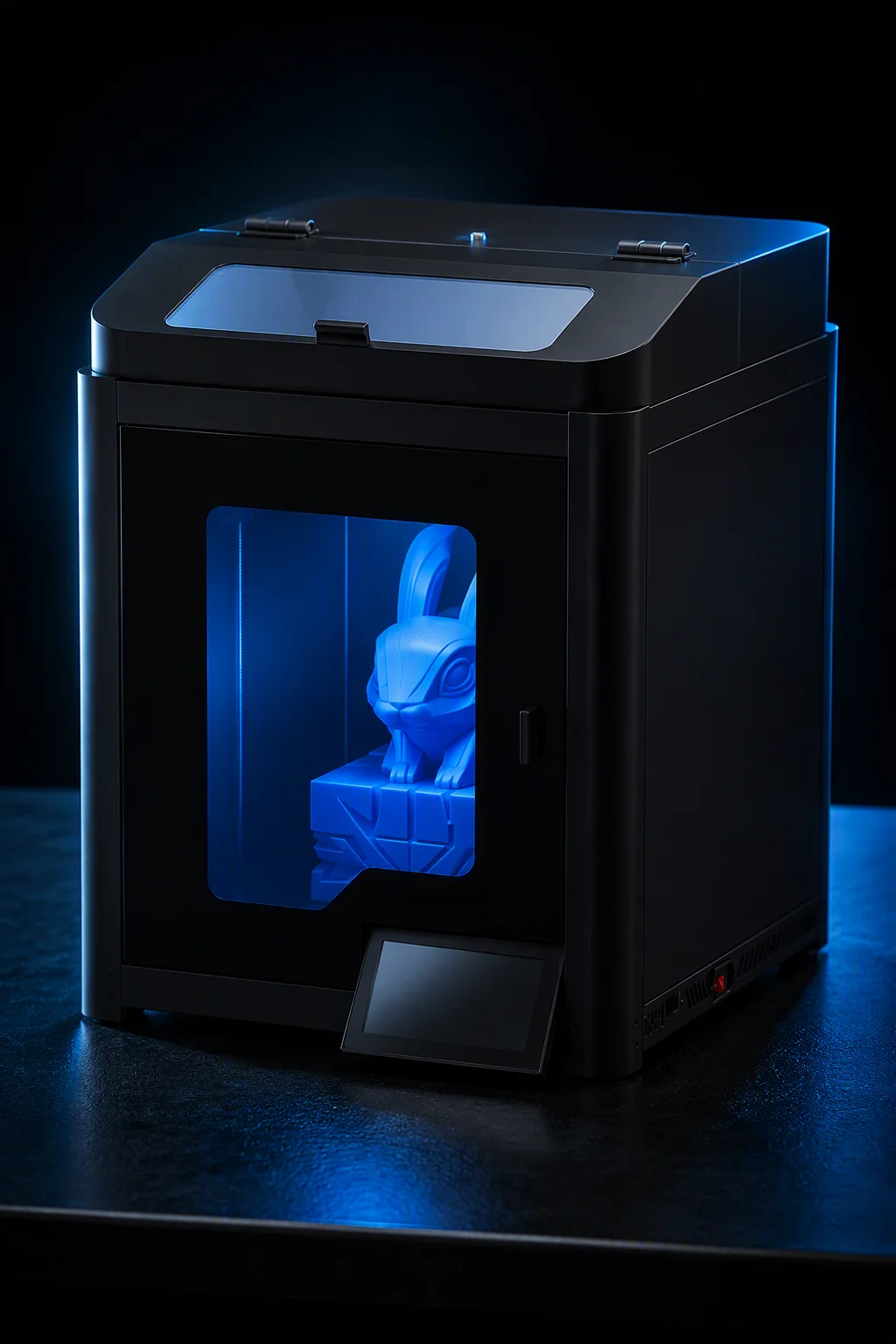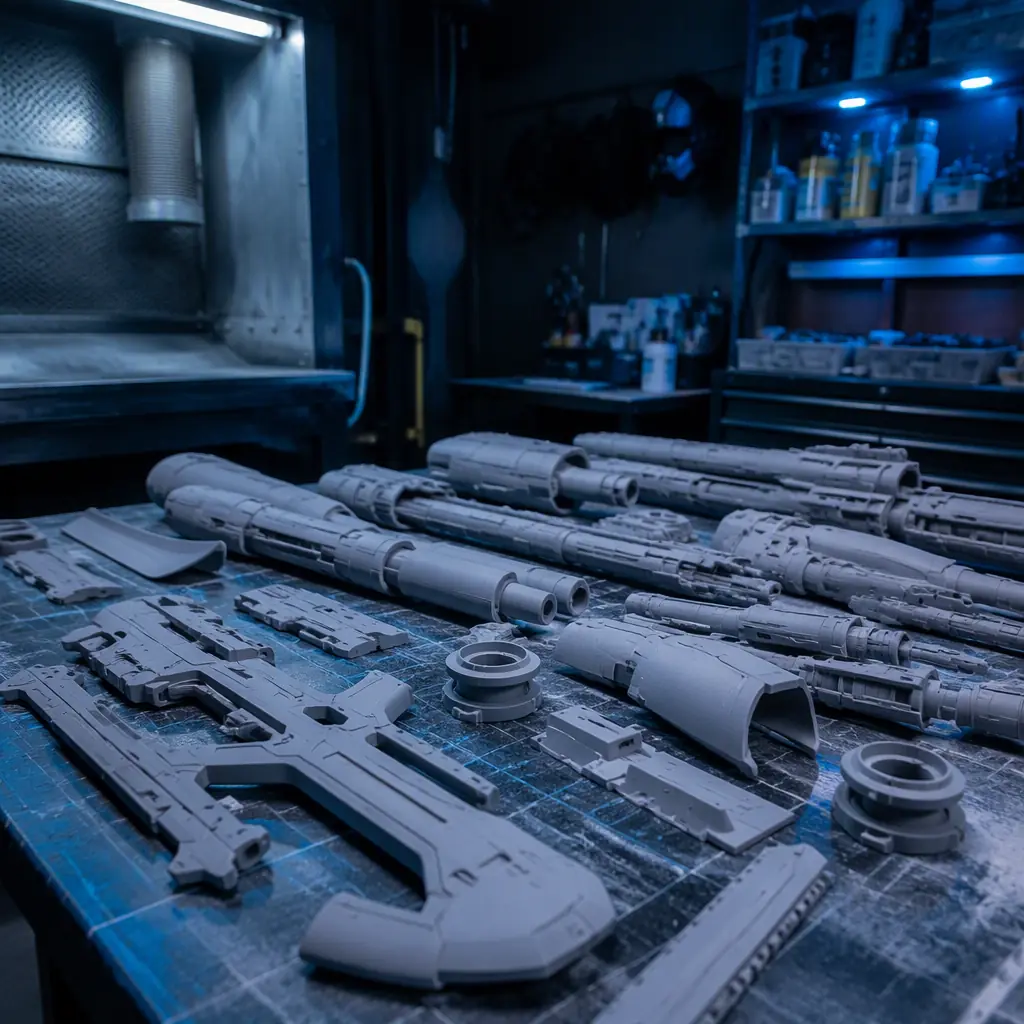
A prop house outside Los Angeles won a commission for forty identical sci-fi rifles, hero versions for close-ups plus background versions, with a six-week delivery deadline. Traditional fabrication would have needed molds, casting, and a paint shop queue, pushing the job past twelve weeks. Instead, the shop printed the rifles in reinforced PLA on four FDM printers in three weeks, finished them with filler primer and automotive paint, and delivered ahead of schedule. Film and television production is the ultimate short-run industry: quantities are small, deadlines are brutal, and revisions happen after the design is "final." That combination is exactly what 3D printing is built for.
Why Production Design Is Buying 3D Printers
Three structural facts make film and TV a durable buyer. First, iteration under deadline: a director can change a prop's design on a Thursday for a Monday shoot, and only digital fabrication can absorb that. Second, no tooling economics: a hero prop used for five days of shooting cannot justify injection molds or cast tooling, but a printer costs nothing per design change. Third, batch-of-one logistics: sets need matching multiples, six identical helmets, forty rifles, a hundred identical tiles for a hero wall, and printing a run of identical parts is trivially repeatable once the file is right. The same prop-and-replica logic that drives cosplay and entertainment work is covered in our cosplay & entertainment props guide . Production work is the professional tier of that market.
The Applications That Actually Buy
Five clusters generate the orders. The buyers are prop houses, production design departments, creature shops, set decorating companies, camera rental houses, and indie crews buying their own first printer.
1. Hero props. The flagship application: weapons, artifacts, gadgets, and signature items that appear in close-up. Hero props must look perfect on camera, so they are printed, sanded, primed, and painted, the finishing discipline in our post-processing & finishing guide is what makes a printed part read as a "real" prop on screen.
2. Creature and character parts. Prosthetic-style armor plates, creature skulls, animatronic housings, and mask components. Shops print masters, then mold and cast in silicone or urethane for multiples, the mold-master workflow that jewelry and collectible makers use, detailed in our jewelry casting guide.
3. Set dressing at scale. The quiet volume driver: crates, futuristic wall panels, signage blanks, period-specific objects, and hero-wall tiles. Sets consume hundreds of identical dressing pieces, and each one that is printed instead of bought or built saves days. The display-and-fixture logic transfers from our retail fixtures & displays guide.
4. Camera rigs and motion-control mounts. The engineering application: custom camera mounts, lens supports, focus-puller brackets, gimbal adapters, and motion-control rig parts. These need real strength and precision, printed in PETG, PA, or carbon-fiber-filled nylon, and rental houses value them because every shoot rigs cameras differently. The strength and material logic is in our frame rigidity & materials guide.
5. Miniatures and set models. Pre-visualization models, miniature buildings, and scale sets for establishing shots. Resin printers dominate here for surface detail; the resin selection map is in our resin types guide.
Materials for Screen-Ready Parts
Prop shops buy a narrower material set than most verticals, and they buy it repeatedly:
One on-set reality drives material choice more than any spec sheet: flame retardancy. Studios and soundstages enforce fire codes on set dressing and props, so printed set pieces may need flame-retardant treatment or materials rated for the location, a compliance angle covered in our certification & compliance guide. Flexible-part selection is covered in our flexible filaments guide.
From CAD to Camera: The Prop Workflow
The workflow that wins production accounts has five stages. Scan or model . Existing objects are digitized with a 3D scanner (the scanning selection logic is in our scanner & printer bundle strategy); new designs are modeled directly in CAD. Print. FDM for structural parts, resin for detail; the FDM-versus-resin decision framework is in our FDM vs resin guide. Finish . Sand, filler-prime, sand again; props are judged by surface, not layer lines. Paint . Automotive and airbrush systems give props their screen finish. Harden for set . Clear-coat, flame-retardant treatment, and durability passes for parts that actors will handle. Shops that master this flow become the ones that never miss a deadline, and the slicer settings that get them there are covered in our slicer software guide.
Budget Reality: Printed vs Traditional Fabrication
The comparison that closes production accounts:
The distributor math compounds because production is consumable-hungry: a busy prop house printing hero props and set dressing can consume 30-80 kg of filament and 10-20 liters of resin per month, plus build plates and finishing supplies. The recurring-revenue model is developed in our consumables & accessories bundling guide.
The Distributor Playbook: Entering Film & TV
Five moves win production accounts:
1. Target the shops, not the studios. Prop houses, creature shops, set decorating companies, and camera rental houses are the buyers; studios outsource to them. Build a target list of 20-30 within your region plus the rental houses that serve visiting productions.
2. Sell the deadline, not the printer. The pitch is "hero prop in three weeks, revision overnight." Show a demo hero prop finished to screen quality, a prop house instantly recognizes the difference between a raw print and a finished part.
3. Bundle the finishing ecosystem. Filament and resin are table stakes; the margin is in build plates, finishing consumables, paint supplies, and spare nozzles. A prop house goes through nozzles and plates faster than any other customer.
4. Offer the scan-to-print service. Many small prop shops and indie crews will not own a scanner. A distributor offering scan-to-print service (customer sends an object or reference, distributor delivers finished parts) captures the work before they buy. The service economics mirror our after-sales support strategy.
5. Work the education pipeline. Film schools and VFX programs teach the next generation of prop makers, and they buy printers through the same education procurement channels covered in our education & university guide. A school account seeds the professional accounts of tomorrow.
Common Pitfalls in Production Accounts
Five mistakes cost distributors production business: (1) selling raw prints as finished props, a prop house that gets an un-primed, layer-lined part will not come back, so finish quality is the product; (2) ignoring set fire codes, printed set dressing that fails a studio fire inspection creates liability, so know the flame-retardancy requirements before selling into soundstages; (3) underestimating resin fume handling, resin shops need ventilation and safe work areas, and a distributor who ignores this earns a bad reputation fast (the fume-management logic is in our fume extraction guide); (4) treating screen-used parts as durable goods. Props break on set by design, so sell the repair-and-reprint workflow, not a lifetime guarantee; and (5) missing the revision revenue: every director's change is a reprint order, so build a 48-hour reprint SLA into the account rather than charging full price each time. The broader entertainment-adjacent markets that buy the same way are covered in our amusement & attractions guide and museums & cultural heritage guide.
Getting Started: The First 90 Days
A 90-day entry plan: Month 1 . Identify 20-30 target accounts (prop houses, creature shops, set decorating companies, camera rental houses, film schools) and stock the production material set: PLA+, PETG, PA12, TPU, two resin lines, plus build plates and finishing consumables. Month 2 . Produce a demo hero prop finished to screen quality, run two pilot jobs at cost-plus-10% (a hero prop and a set-dressing batch) to build documented evidence, and offer scan-to-print service to two small shops. Month 3 . Convert pilots to full accounts with consumables subscriptions and the 48-hour reprint SLA, publish your first measured case study ("40-unit hero prop: 12 weeks → 5 weeks, $32,000 → $8,500"), and open a film-school account. The prototyping discipline that production shops share with engineering teams is covered in our rapid prototyping & R&D guide.
Reviewed by the Precise3D engineering & OEM team. Compliance files that accompany the catalog are auditable at the certification register.
Enter the Production Market
Ready to Supply Prop Houses & Production Studios?
Get wholesale pricing on FDM and resin printers, production-grade filament and resin lines, finishing consumables, and the film-and-TV playbook that wins deadline-driven accounts.